
Agiloft Targets Enterprise Value Leakage with New Suite of Execution-Focused AI Agents
Source: PR Newswire
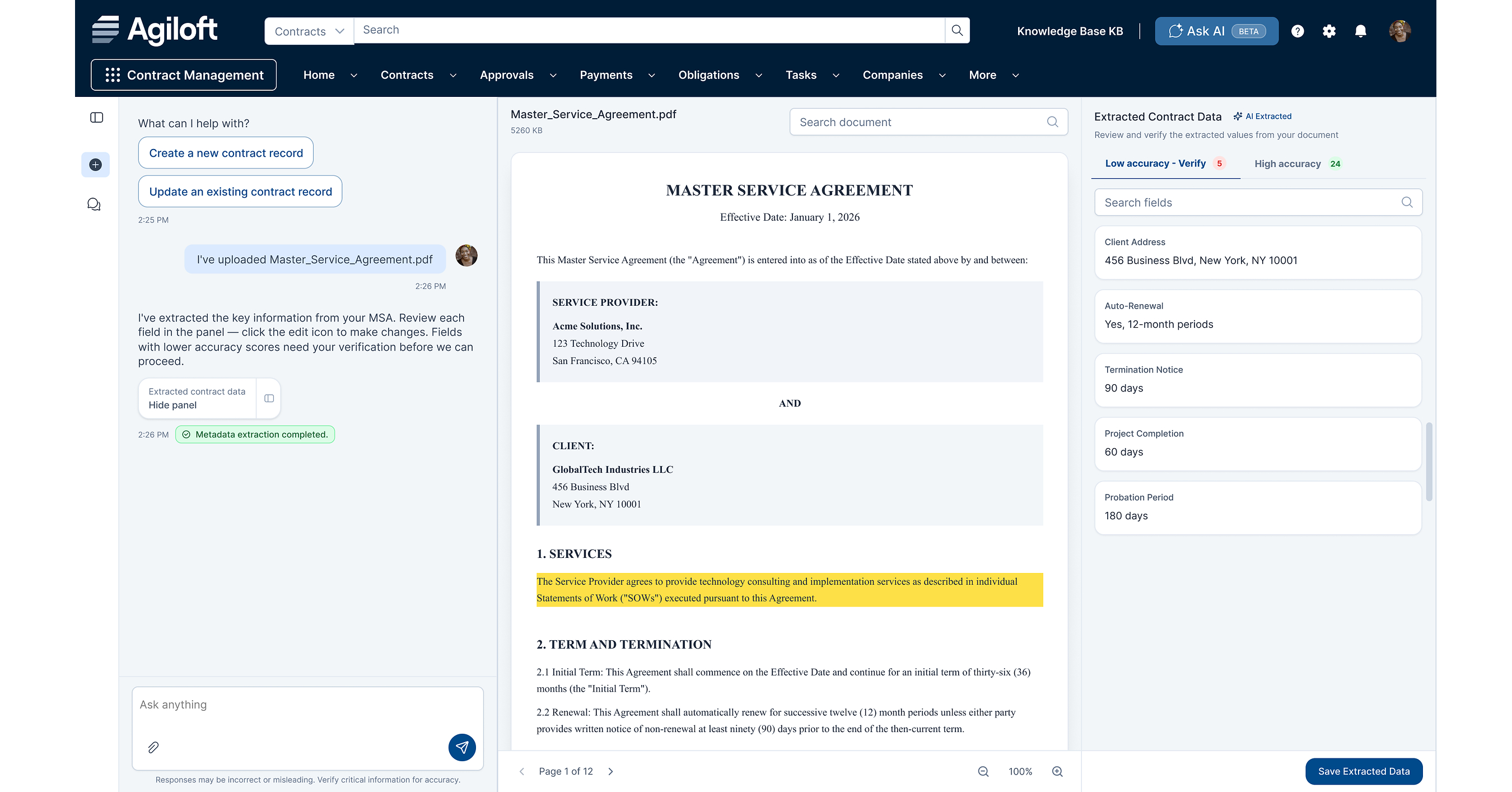
Agiloft announced three execution-focused AI agents for bulk contract updates, contract-request routing, and Adobe Acrobat Sign workflows, alongside a multi-pane document viewer and other Ask AI enhancements. The company cited its research finding that procurement leaders estimate at least 15% of supplier spend occurs outside contracted agreements, while only 36% of organizations automatically link sourcing outcomes to contracts. The Bulk Update Agent can change up to three data fields across multiple records and requires human confirmation; Claude is the first MCP client in the current beta.
Analysis
The investable signal is more about control of the enterprise workflow than near-term software revenue. If external agents can query contract repositories while respecting permissions, the system of record may retain value even as users shift their interface to Claude or other assistants. The counter-risk is that MCP makes repositories more interchangeable and shifts customer loyalty—and potentially pricing power—to the agent layer. Agiloft’s announcement establishes a beta path, not evidence of customer adoption, realized savings, or durable differentiation; the claimed leakage opportunity is not proof that this release captures it.
For Adobe, the Acrobat Sign connection is a possible distribution and workflow-retention positive, but a single CLM integration does not establish material incremental Sign usage or revenue. Anthropic could gain product utility from access to governed enterprise data, though no commercial terms or usage figures are disclosed. Competing CLM providers and e-signature vendors could face pressure to expose similarly usable, permissioned interfaces; alternatively, customers may prefer bundled incumbent workflows over adding another agent layer.
Days: likely limited read-through to ADBE or ANT. Over 1–3 months, watch for beta-to-general-availability timing, named customer deployments, and evidence of repeat use. Over 6–18 months, the key question is whether MCP integrations increase CLM retention and expansion or commoditize repository access. Thesis weakens if permissions/security gaps delay rollout, customers do not adopt agent workflows, or vendors keep integrations proprietary. No defensible earnings or valuation impact can be inferred without adoption, pricing, and usage data.
AllMind Terminal
AI-powered research, real-time alerts, and portfolio analytics for institutional investors.
Request TrialMarket Sentiment
Overall Sentiment
mildly positive
Sentiment Score
0.15
Ticker Sentiment
Key Decisions for Investors
- No trade on this release alone: the named public-company exposure is indirect, and the announcement provides no quantified adoption, revenue contribution, or commercial terms.
- Watch ADBE for evidence that Acrobat Sign integrations improve usage or retention, rather than assuming a material revenue catalyst; reconsider only with disclosed adoption or financial contribution.
- Track ANT and enterprise agent competitors for MCP customer deployments and usage. Treat broader agent access as a two-sided catalyst: it may improve utility while increasing the risk that AI interfaces capture value from systems of record.
- Set a 1–3 month diligence trigger: verify general availability, customer references, security/permission performance, and actual workflow volume. Failure to progress beyond beta or evidence of low usage would invalidate the adoption thesis.
More News
- U.S. stock futures rise after AI rout batters Wall St; payrolls data in focus
- Anthropic faces valuation pushback on $1.5T IPO following market rout, WSJ reports
- Behind Wall Street’s plunge: AI liquidation threatens Anthropic’s mega-IPO
- OpenAI debuts new cybersecurity-focused AI model amid growing alarm about AI-driven cyber attacks
- Chinese AI lab Moonshot turned to Europe for Nvidia Blackwell access amid U.S. China curbs, sources tell CNBC
- A cyber-storm watch went out last month, and almost nobody reported it