
MemorialCare Expands Advanced Thoracic Surgery Program with Addition of Matthew D. Stanley, M.D.
Source: PR Newswire
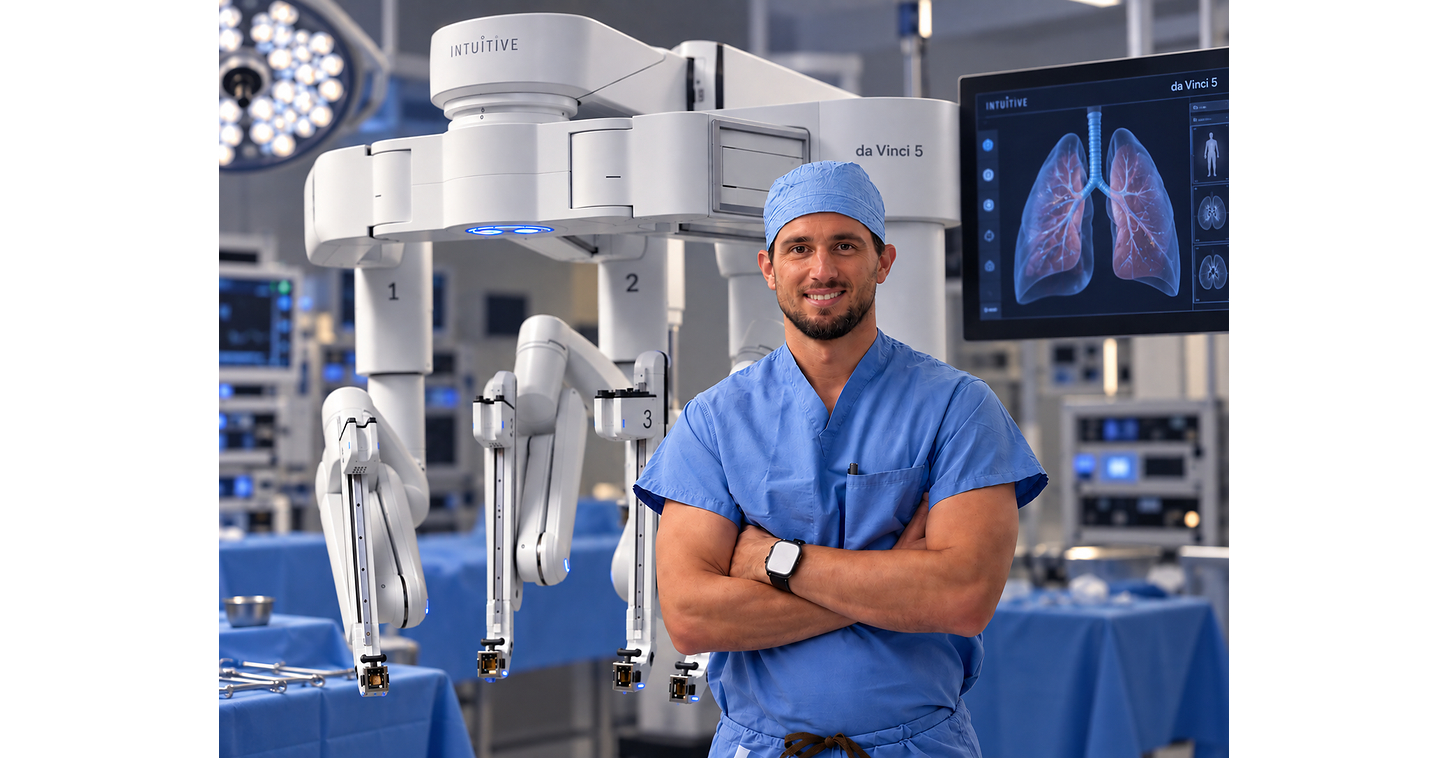
MemorialCare expanded its thoracic surgery program by hiring robotic-surgery specialist Matthew D. Stanley, M.D., adding capabilities including robotic lung resection, esophagectomy, airway reconstruction and hiatal-hernia repair using da Vinci 5 and Xi systems. The health system will also further develop its Lung Nodule Program to address California's low high-risk lung-cancer screening rate of 16.8% versus 18.2% nationally and its 25.9% early-diagnosis rate. The announcement improves regional access to minimally invasive cancer and complex thoracic care but is primarily an operational healthcare-system expansion with limited broad market implications.
Analysis
This is not a standalone investable catalyst: MemorialCare is private, and a single-system clinical hiring announcement does not establish procedure-volume, reimbursement, or capital-spend impact. The relevant public read-through is modestly positive for Intuitive Surgical (ISRG), but only if the program converts into incremental thoracic and foregut procedures rather than shifting cases from other da Vinci-equipped Southern California hospitals. A newer installed platform can support recurring instruments-and-accessories revenue, but one surgeon and two service areas are immaterial against ISRG's global procedure base.
The more important second-order signal is the emphasis on coordinated incidental-nodule follow-up. If health systems operationalize this pathway, it can lift downstream CT surveillance, navigational bronchoscopy, biopsy, molecular testing, surgery and oncology treatment volume over 6-18 months; however, the near-term bottleneck is patient capture and payer-approved diagnostic sequencing, not surgical capacity. Potential beneficiaries include ISRG, Medtronic (MDT) and Johnson & Johnson (JNJ) in robotic/bronchoscopy ecosystems, plus imaging exposure through GE HealthCare (GEHC); the economic impact will be diffuse and cannot be inferred from this release.
Contrarian view: expanded robotic capacity may initially dilute rather than enhance hospital returns if utilization ramps slowly, because trained staff, block time and capital costs are largely fixed while reimbursement is procedure-driven. The market should not extrapolate a broad lung-screening inflection from a provider press release: screening adherence, referral leakage and false-positive management determine whether the clinical pathway produces profitable intervention volumes. Watch California low-dose CT screening data, MemorialCare case-volume disclosures if available, and ISRG thoracic procedure commentary on its next two earnings calls.
AllMind Terminal
AI-powered research, real-time alerts, and portfolio analytics for institutional investors.
Request TrialMarket Sentiment
Overall Sentiment
mildly positive
Sentiment Score
0.32
Key Decisions for Investors
- No immediate position based solely on this announcement; treat it as a low-signal datapoint rather than a catalyst for ISRG, MDT, JNJ or GEHC.
- Maintain ISRG on a 6-18 month watchlist for evidence that U.S. thoracic and general-surgery procedures are accelerating above management's baseline growth outlook. Upgrade only if quarterly procedure growth and instruments-and-accessories revenue both reaccelerate; a procedure-growth deceleration or hospital capital-budget pressure falsifies the incremental-utilization thesis.
- For existing healthcare-technology exposure, prefer ISRG over GEHC as a screening-to-intervention beneficiary: ISRG has recurring per-procedure economics, whereas GEHC's benefit depends more on capital-equipment budgets. Reassess if hospital imaging orders weaken or ISRG's installed-base utilization does not improve over the next two quarters.
- Monitor a potential pair opportunity: long ISRG / short a broad hospital operator ETF only if evidence emerges that robotic thoracic volumes rise while labor and capital intensity pressure provider margins. Do not initiate without utilization and margin data; the stated mechanism remains unverified.
More News
- Here’s the ‘core economic flaw’ in the AI bull case as stock and bond trades unravel, according to a top economist
- Biotech stocks are surging. How investors can play the new drug innovation boom
- Ukraine says Starlink and Starshield high speed restrictions have been lifted
- Goldman says these top tech stocks have plenty of upside ahead of earnings
- Ukraine says Starlink restored as attacks continue in Russia and Ukraine
- Starlink seems to be working normally again in Ukraine