
LinkSquares Transforms Enterprise-Wide Contract Workflow
Source: PR Newswire
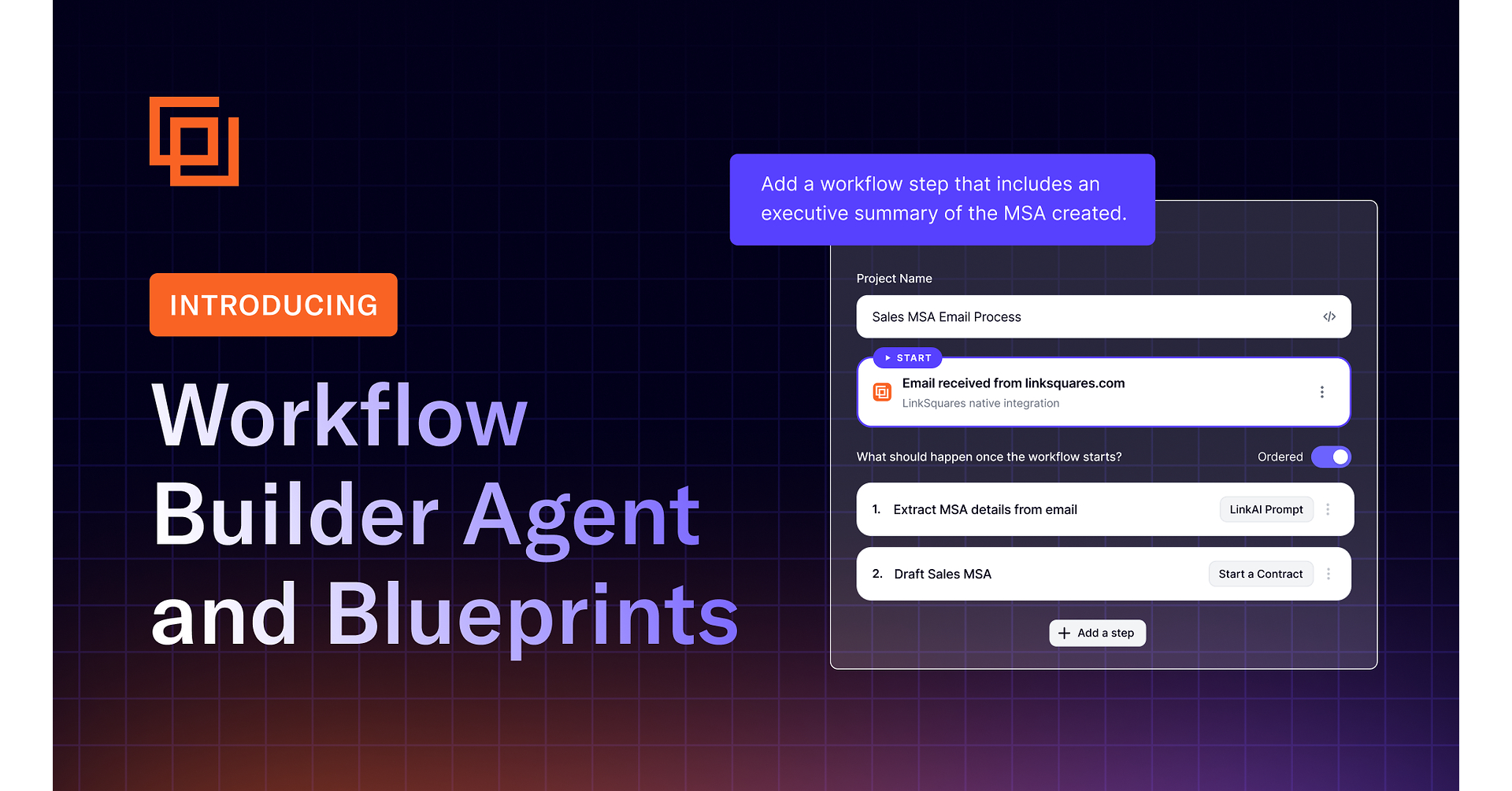
LinkSquares launched Workflow Builder Agent and Workflow Blueprints, enabling legal and business teams to create customizable contract workflows from plain-language instructions or prebuilt templates. The AI-powered CLM capabilities automate workflow steps, routing, dependencies and approvals while retaining customer review, access controls and governance before deployment. The release strengthens LinkSquares' agentic contract-management offering, which serves more than 1,200 customers.
Analysis
This is not a direct DKNG earnings catalyst: the vendor is private and the customer reference does not establish incremental spend, deployment scope, or measurable procurement-cycle benefit. The relevant read-through is modestly positive for enterprise AI software adoption, but near-term value accrues primarily to CLM incumbents with public exposure—DOCU, IAC's Ironclad private-market peers, and broader workflow vendors—only if customers accept AI-generated routing as sufficiently auditable for regulated approvals.
The more important competitive effect is potential commoditization of basic workflow configuration. If natural-language workflow creation reduces implementation dependence, smaller CLM platforms can narrow a historical services and ecosystem gap versus DOCU and enterprise suites such as NOW, CRM, and MSFT. Conversely, governance, permissions, integrations, and auditability—not workflow generation—remain the switching-cost moat; vendors unable to demonstrate error rates, human-review controls, and deployment time reductions may see AI features treated as table stakes rather than a pricing lever.
Over the next 1-3 months, monitor public CLM and workflow-software earnings for AI attach-rate disclosure, professional-services revenue trends, net retention, and sales-cycle duration. A rise in self-serve deployments alongside stable retention would validate operating leverage; rising support costs or security-review delays would falsify the productivity narrative. Over 6-18 months, wider agentic workflow adoption could lower legal-operations headcount growth and modestly improve contracting velocity for users such as DKNG, but the financial effect is too diffuse to underwrite a DKNG position today.
AllMind Terminal
AI-powered research, real-time alerts, and portfolio analytics for institutional investors.
Request TrialMarket Sentiment
Overall Sentiment
moderately positive
Sentiment Score
0.42
Key Decisions for Investors
- No standalone DKNG trade: require evidence of a material LinkSquares deployment and a quantifiable effect on legal/procurement expense or contract turnaround time before assigning earnings sensitivity.
- Place DOCU and NOW on an AI-workflow adoption watchlist for the next two earnings cycles; become constructive only if management reports improving enterprise seat expansion or implementation velocity without incremental services intensity.
- For a liquid thematic expression, prefer a small long IGV / short equal-weight legacy IT-services basket only after corroborating evidence that AI configuration reduces implementation hours; use a 3-6 month horizon and exit if software net retention weakens or services demand remains resilient.
- Watch enterprise AI governance requirements—especially audit trails, approval controls, and data-permission reviews—as the key falsifier. Security incidents or prolonged legal review cycles would favor entrenched platforms with established compliance ecosystems over newer CLM entrants.
More News
- 'Hostile act': Trump threatens EU with tariffs over Canada associate-membership proposal
- US official says upcoming spectrum auctions could generate more than $100 billion
- Investors react to Fed hike and market sell-off: Brace for 'higher for longer' rates
- Fed delivers its first hike in 3 years. Plus, what's moving Starbucks and GE Vernova
- Fed’s Warsh lays out forces driving up bond yields
- The Fed unanimously agrees to hike interest rates for the first time since 2023, despite Trump’s call for the ‘lowest rates’ in the world
From AllMind Research
- Anthropic IPO Preview: Valuation, Timing, and What to Watch
- Shein After the IPO: Venue, Valuation, and What Must Be Proved
- What AI Research Tools Should a Small Hedge Fund Buy First?
- The Great Divergence: North American Banking at the Crossroads of Monetary Policy and Agentic AI (Q4 2025 Bank Earnings)
- AI for M&A Target Screening: From Universe to Deal File