
Ittikar ist online und steht neuen Mitgliedern offen
Source: PR Newswire
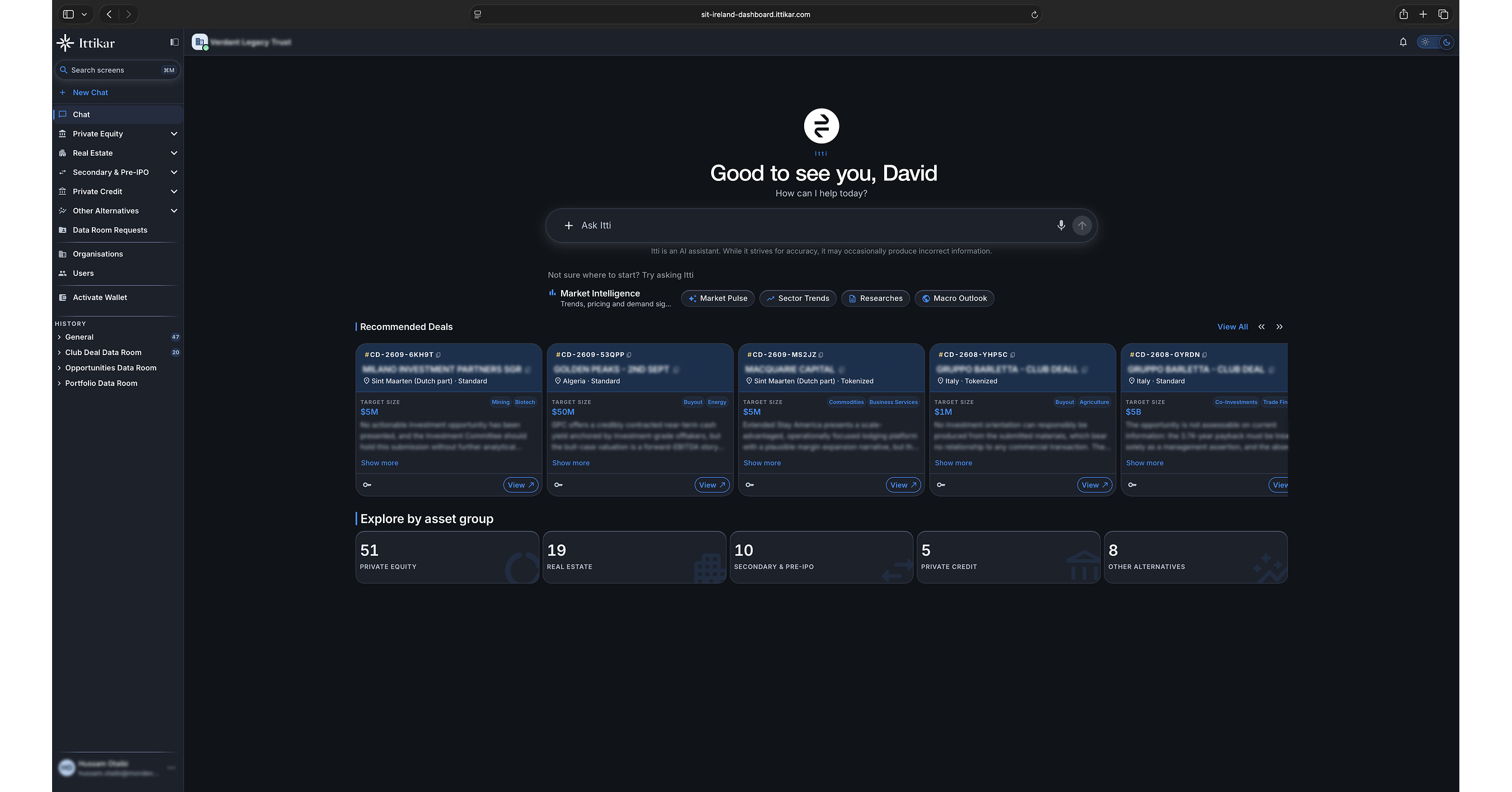
Mondevo Group's AI-native private-capital platform Ittikar, live since March 2026 and initially owned by 100 founding members, has opened to additional global family offices after supporting two Mondevo acquisitions: Italian menswear house Caruso in February and Milan brand accelerator Underscore District in August. Mondevo Tech says more than 50 engineers oversee 120 AI coding agents, while the platform uses segregated, member-controlled data pods designed for GDPR, NIS 2 and EU AI Act compliance. Version 2 development began in September, with portfolio tools due in early 2027, negotiation functions in Q2 2027 and tokenized assets/distributed-ledger co-investment capability targeted by mid-2027; a tokenization proof of concept is planned before year-end.
Analysis
This is not a public-markets earnings catalyst, but it reinforces a medium-term disintermediation risk for traditional private-capital service providers. If AI-assisted diligence materially compresses deal execution time, smaller family offices can internalize work historically outsourced to boutique advisers, legal/process providers, placement agents, and parts of the Big Four transaction-advisory ecosystem. The economic value accrues less to generic AI models than to platforms with proprietary deal workflows, trusted distribution, and data-security credibility—creating an eventual competitive analogue to a buy-side Bloomberg/DealCloud layer.
The more investable second-order implication is for alternative-asset managers: faster underwriting and curated co-investment matching could increase competition for lower-middle-market control assets, pressuring entry multiples and weakening the informational advantage of smaller PE sponsors. Large listed alternatives managers—BX, KKR, APO, ARES—are comparatively insulated because sourcing brands, financing capacity, operating resources, and LP access remain decisive; however, their fee-related earnings could benefit if they productize similar tools across wealth channels. The nearer risk is reputational and regulatory rather than technological: one data breach, flawed diligence output, or tokenization structure deemed to facilitate unregistered securities activity would slow adoption sharply.
Over 1-3 months, no direct trade is warranted: the claims are company-supplied, privately held, and lack independently verifiable client-retention, transaction-volume, pricing, or realized-cost-savings data. Over 6-18 months, monitor whether private-market workflow automation becomes a measurable procurement theme at listed alternatives firms and whether regulated tokenized-fund infrastructure gains traction. The market may be underestimating that compliant data isolation—not model quality—is likely the binding adoption constraint for ultra-high-net-worth capital pools.
AllMind Terminal
AI-powered research, real-time alerts, and portfolio analytics for institutional investors.
Request TrialMarket Sentiment
Overall Sentiment
moderately positive
Sentiment Score
0.48
Key Decisions for Investors
- No immediate position: treat this as a private-markets workflow alert, not a tradable catalyst, until disclosed platform revenue, external deal volume, member retention, and regulated-partner details are available.
- Maintain a quality bias within listed alternatives: long BX or KKR versus smaller, less differentiated private-capital platforms over 6-18 months. Thesis is that scaled managers can absorb AI-enabled sourcing competition while monetizing advisor/wealth distribution; reassess if fee-related earnings growth decelerates by more than 5 percentage points or fundraising turns negative.
- Watch MSFT and ORCL for enterprise AI/data-governance demand rather than taking a direct tokenization proxy. A sustained rise in regulated financial-services AI workloads and sovereign-data deployments would be the confirmatory catalyst; this specific announcement alone is insufficient.
- Avoid using COIN or crypto-beta as a proxy for the planned distributed-ledger functionality. The relevant trigger is licensed issuance, custody, transfer restrictions, and actual institutional settlement volumes—not a proof of concept; adverse EU regulatory guidance would invalidate the adoption thesis.
More News
- U.S. market regulator seeks to make it easier for funds, advisers to hold crypto
- Trump launches midterms campaign blitz amid record low approval ratings
- Nvidia Faces Questions Over China AI Chip Smuggling Cases
- Fed’s Cook sees AI buildup as top inflation risk for 2027
- The September jobs report will be released Friday. Here's what to expect
- U.S. stock futures drift higher with nonfarm payrolls in focus