
HanchorBio Announces U.S. FDA Clearance of IND Application for HCB303, a Next-Generation Trispecific Immunotherapy
Source: PR Newswire
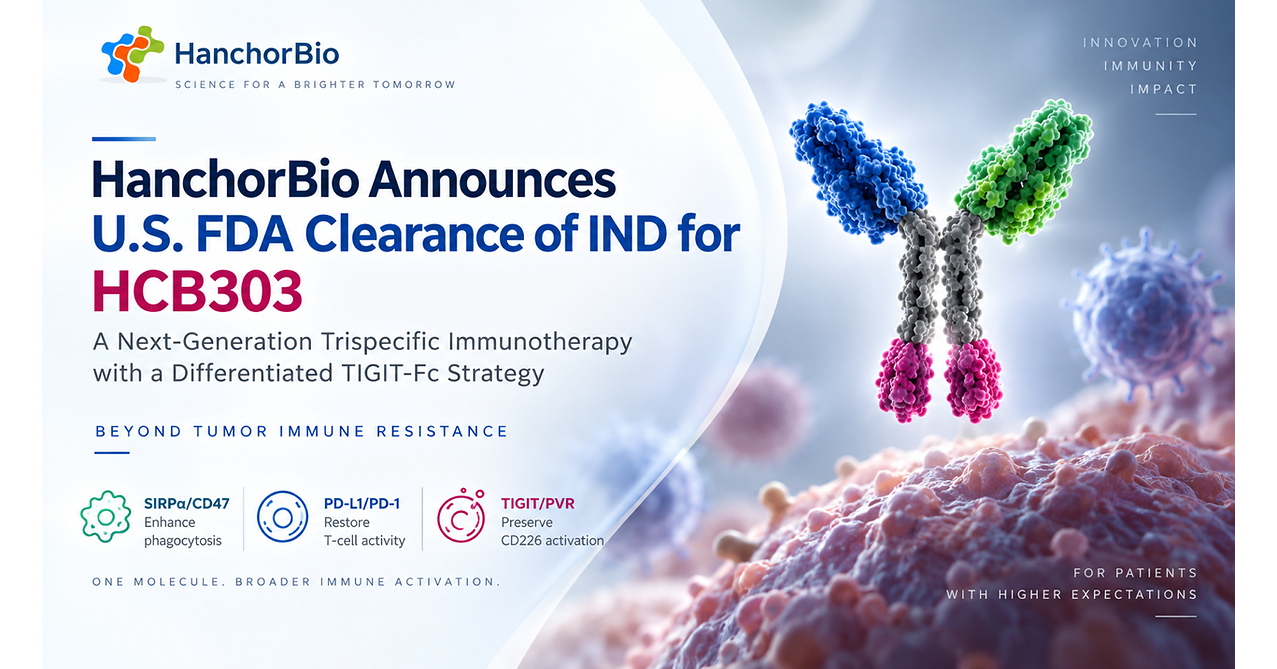
The FDA cleared HanchorBio’s IND application for HCB303, enabling the company to proceed with a planned Phase 1 first-in-human trial in patients with advanced, relapsed, or refractory solid tumors. The investigational trispecific immunotherapy is designed to target TIGIT/PVR, PD-L1/PD-1, and SIRPα/CD47 pathways; safety, tolerability, and preliminary antitumor activity will be evaluated. IND clearance permits clinical investigation but does not establish safety or efficacy.
Analysis
The IND clearance removes a regulatory gating item, not the main investment uncertainty: whether this three-pathway construct can achieve tolerable exposure and meaningful activity in humans. The proposed CD226-preservation rationale is a testable biological hypothesis; it should not yet be capitalized as platform validation. In particular, combining PD-L1 and CD47-related activity may create a difficult therapeutic window, while the TIGIT ligand-trap mechanism adds complexity rather than reducing the usual early-stage risks.
Near term (days to weeks), the announcement may support sentiment, but no material revenue or near-term earnings sensitivity follows from permission to begin a Phase 1 study. Over 1–3 months, verify first-patient dosing, trial-site activation, and whether the company provides a credible enrollment cadence. Over 6–18 months, safety, pharmacokinetics, dose selection, and biomarker evidence—not the IND milestone—will determine whether HCB303 earns meaningful pipeline value. Read-through to HanchorBio’s platform or other programs is limited until human data demonstrate a reproducible advantage.
The contrarian risk is treating mechanistic differentiation as clinical differentiation: crowded checkpoint biology and multi-target toxicity can undermine a compelling preclinical design. The counterpoint is that a convincing tolerability/target-engagement profile could attract partner interest before efficacy is mature. No valuation, cash runway, trial timeline, or trading-liquidity data are supplied, so the risk-adjusted stance is monitor rather than chase.
AllMind Terminal
AI-powered research, real-time alerts, and portfolio analytics for institutional investors.
Request TrialMarket Sentiment
Overall Sentiment
mildly positive
Sentiment Score
0.30
Key Decisions for Investors
- No immediate directional position on this milestone alone. Before considering exposure, verify HanchorBio’s current valuation, cash runway, share liquidity, and expected first-patient-dosing timing; these determine whether the catalyst can justify the binary clinical risk.
- Set an alert for first-patient dosing and subsequent dose-escalation updates. Upgrade the thesis only if disclosures show tolerable dosing and pharmacodynamic evidence consistent with engagement of the intended pathways; IND clearance alone is not validation.
- Falsification watch: a material delay to trial initiation, a clinical hold, dose-limiting toxicity that constrains exposure, or no interpretable target-engagement signal would weaken the platform-upside case. Treat any early response claims cautiously absent cohort size, tumor type, and durability detail.
- Avoid a peer pair trade for now: the mechanism is differentiated but too early to establish a relative efficacy or safety edge, and the article provides no comparative clinical evidence.
More News
- Jefferies cuts RXO stock rating on C.H. Robinson acquisition
- Goldman Sachs downgrades Nike stock rating to sell on market share concerns
- Samsung, SK Hynix shares drop as Q3 earnings loom
- Security researcher claims to they found KVM guest-host escape flaw
- DeepSeek set to raise at least $12 bln in Tencent, CATL-led round- Bloomberg
- SpaceX stock climbs to highest since June, returning Musk to trillionaire status