
Spoločnosť Huawei predstavuje vylepšenú sieť umelej inteligencie Stellar na podporu sveta inteligentných agentov bezpečným a inteligentným prepojením
Source: PR Newswire
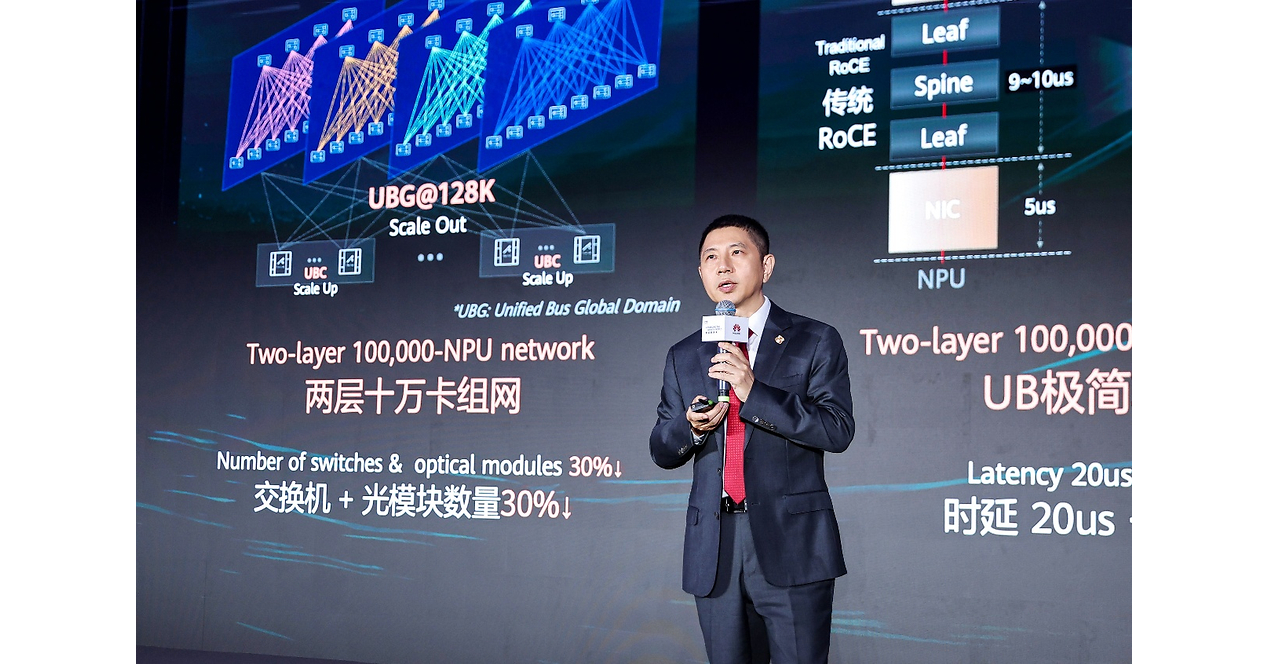
Huawei launched its upgraded Stellar AI Network at HUAWEI CONNECT 2026, spanning AI Fabric, AI WAN and AI Campus products designed to improve AI-compute networking efficiency and security. The new architecture claims to cut network build costs by 30%, reduce endpoint latency from 20μs to 11μs, lower optical interconnect power consumption from 1,000W to 600W, and support lossless compute transmission over 1,000km with more than 95% remote-processing efficiency. Huawei also highlighted AI-native security features with 95% detection rates for cryptojacking, prompt injection and malicious commands, alongside sub-5-minute network incident resolution.
Analysis
Huawei’s integrated compute-networking push is strategically more relevant to China’s AI capex allocation than to global Ethernet spending. If adopted by state-owned enterprises and cloud providers, it can shift wallet share away from NVIDIA/Arista/Cisco architectures toward a domestically sourced stack, but export controls already limit those vendors’ addressable China AI market; the larger read-through is reduced dependence on imported optical and switching components. This is modestly negative for China-exposed optical suppliers such as LITE and COHR only if Huawei’s in-house optical integration scales beyond flagship deployments; it is more immediately supportive of a China AI infrastructure build cycle benefiting local, largely inaccessible, suppliers.
The commercial risk is that integrated network claims often optimize for controlled reference architectures rather than heterogeneous customer environments. Enterprise procurement will require independently validated throughput, failure rates, interoperability with non-Huawei accelerators, and total cost of ownership after software/support costs; absent disclosed customer wins, this is not a catalyst for listed global networking peers. Over 1-3 months, monitor Chinese hyperscaler and telecom tenders for bundled Huawei networking-plus-accelerator awards. Over 6-18 months, meaningful adoption could pressure the premium assigned to imported AI interconnect vendors’ China growth assumptions, while strengthening the case that AI infrastructure demand is fragmenting into regional technology stacks rather than consolidating around NVIDIA’s ecosystem.
The contrarian view is that Chinese substitution is already broadly embedded in consensus forecasts for NVIDIA and Arista, while the addressable market for Huawei’s differentiated architecture may be constrained by software compatibility, customer lock-in concerns, and a limited supply of competitive domestic accelerators. A product announcement alone is insufficient to change earnings estimates; the investable signal is order conversion, not technical specifications.
AllMind Terminal
AI-powered research, real-time alerts, and portfolio analytics for institutional investors.
Request TrialMarket Sentiment
Overall Sentiment
moderately positive
Sentiment Score
0.58
Key Decisions for Investors
- No immediate directional trade on the announcement; Huawei is not publicly investable and the financial impact on listed global peers is unverified.
- Set a 1-3 month tender watch for Alibaba, Tencent, ByteDance, China Mobile and China Telecom AI-cluster procurement. Repeated Huawei bundled wins would justify reducing China-driven revenue assumptions for ANET and CIEN, rather than initiating outright shorts.
- Maintain any existing long NVDA exposure unless evidence emerges of domestic Chinese accelerator deployments displacing incremental imported hardware demand. Falsification threshold: a material China revenue-guide reduction or disclosed cancellation/deferral of China-related AI systems orders.
- For a liquid relative-value expression if Huawei win data accumulates, consider long ANET / short CIEN only if Arista demonstrates continued hyperscaler Ethernet share gains outside China; this isolates stronger North American AI fabric demand from greater China telecom and optical-cycle exposure. Exit if ANET’s AI networking order growth decelerates materially or CIEN reports an optical demand inflection.
More News
- Trump & Xi to Meet Amidst Friction on Wars, Tech, Trade
- Here are the 3 big things we're watching in the stock market this week
- Tech leads shares higher in Asia, oil eases
- Yuan hits fresh multi-year peak as PBOC eases curb ahead of Trump-Xi summit
- China slows humanoid robot IPO rush as hype outruns reality
- The economy has undergone a structural transformation that ended the low-cost era. ‘The regime change in inflation and interest rates is the outcome’