
PeptidePrices Publishes Peptide Market Intelligence Index Covering 100+ Vendors, 3,200+ Listings and 112,000+ Public COA Records
Source: PR Newswire
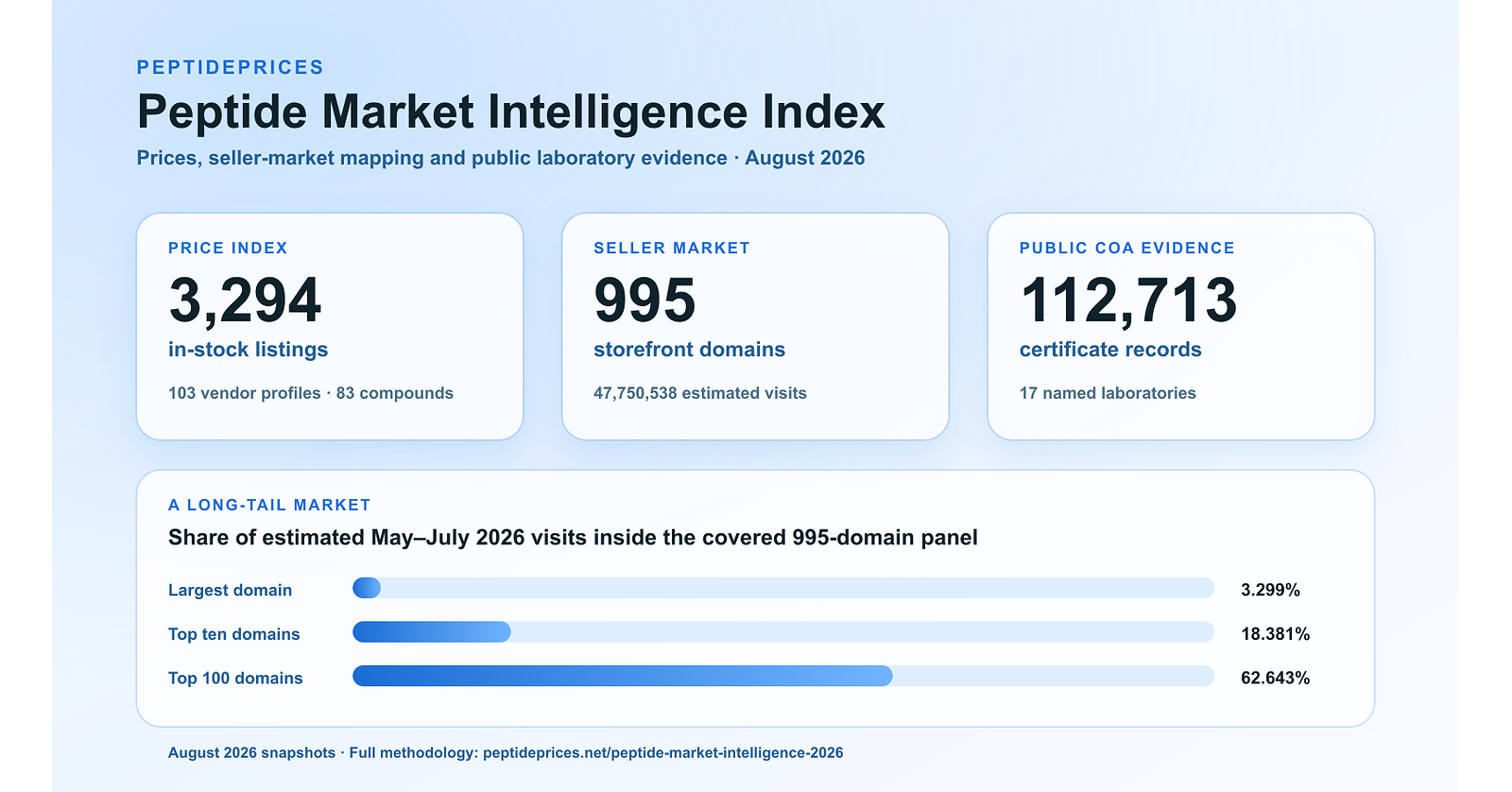
PeptidePrices launched a Peptide Market Intelligence Index aggregating 103 vendor profiles, 3,294 in-stock listings across 83 compounds, and 112,713 public COA records into a single platform. The service adds automated price refresh with check dates and a COA Checker to trace vendor-reported documents back to laboratory-issued records from 17 named labs. While it maps a highly fragmented market (995 storefront domains, 47.75M estimated visits), the announcement appears primarily informational rather than a direct financial/material catalyst.
Analysis
This reads more like a search-and-distribution layer than a fundamental demand shock, so the public-market read-through is small unless a listed company is monetizing opaque discovery or low-trust sourcing. The main mechanism is margin compression at the lowest-quality end of the market: once buyers can compare, verify, and sort by recency of testing, vendors that rely on information asymmetry should see higher CAC, lower pricing power, and more churn. That is bullish for whoever sits on the verification side of the stack, but the scale is likely too fragmented for a clean equity expression today.
The second-order effect is consolidation of attention, not necessarily of supply. In the next 1-3 months, the battleground shifts to SEO, paid acquisition, and reputation management; vendors with weak brand trust may get pushed into discounting or disappear, while better-capitalized operators can win share by spending into traffic. Over 6-18 months, transparency tools can actually expand the market by reducing buyer hesitation, so the consensus risk is assuming this is purely bearish for the category when it may just reallocate economics from sellers to intermediaries and testing/validation layers. The key falsifier is any evidence that the index materially increases conversion or average order value for the strongest operators, in which case the net effect becomes neutral-to-positive rather than disinflationary.
AllMind Terminal
AI-powered research, real-time alerts, and portfolio analytics for institutional investors.
Request TrialMarket Sentiment
Overall Sentiment
neutral
Sentiment Score
0.06
Key Decisions for Investors
- No immediate trade in MTAKU; impact is too indirect. Treat this as a watch item and only get involved if we can verify revenue exposure to peptide commerce, marketplace traffic, or testing/verification workflows.
- Monitor large lab/quality-control proxies such as TMO and DHR for any incremental benefit from verification demand; only consider a small long if commentary shows measurable pull-through in higher-volume screening or analytics work over the next 1-2 quarters.
- Avoid shorting the broader biotech complex on this headline alone. If anything, the more defensible expression would be a later-stage short in opaque DTC commerce names if organic traffic or conversion data deteriorates, but we need hard data before sizing.
- Set a catalyst alert for SEO/traffic shifts and domain-concentration trends over the next 1-3 months; if the strongest operators gain share without discounting, the thesis flips from margin compression to category expansion.
More News
- Indonesia stocks suffer biggest daily slump since 1998 as MSCI weighs downgrade
- Order to limit Starshield for Ukraine came from inside White House: Reuters reports
- The IPO drought is driving private equity-owned companies to the debt market to pay investors
- CoreWeave credit default swaps hit distress levels as investors sour on AI debt
- FDA approves Enspryng for thyroid eye disease treatment
- Giant Taiwanese chipmaker TSMC confirms it’s in talks with Elon Musk to join ‘Terafab’ complex in Texas: ‘The AI market continues to be very strong’