
The New Anesthesiology Financial Equation
Source: PR Newswire
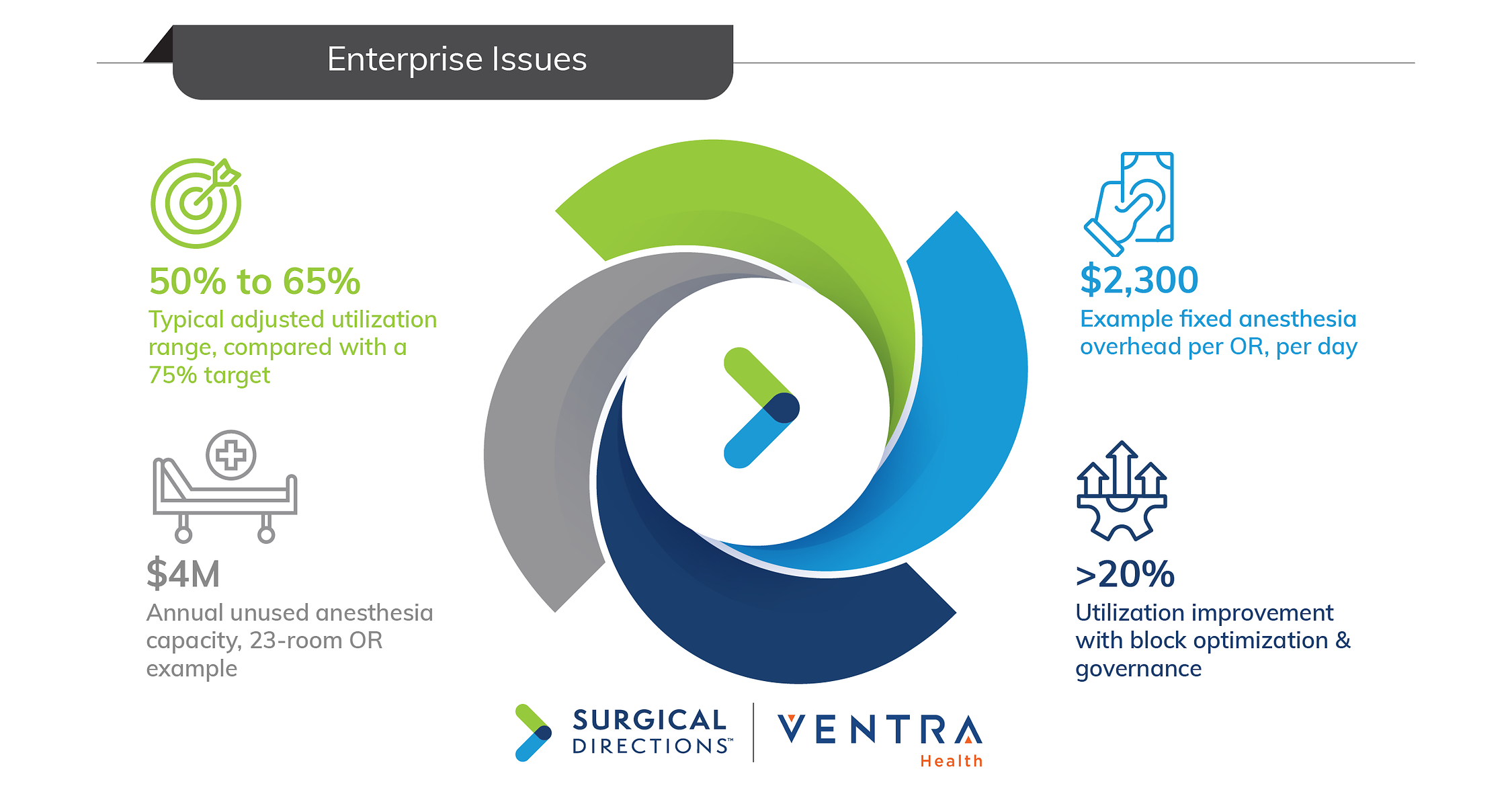
A white paper from Surgical Directions and Ventra Health argues hospitals can improve anesthesiology finances by managing coverage operations and revenue-cycle performance together. It cites a 23-room OR example with about $2,300 in fixed daily anesthesia overhead per staffed OR and an estimated $4 million in annual unused capacity, while noting documented utilization improvements of more than 20%. In a Centra Health case following the 2024 Change Healthcare disruption, the service line reported a 4.3% improvement in Net Collections Rate, $46,000 more in average monthly collections and an $18 increase in collections per visit; the authors caution these results are specific to Centra.
Analysis
Signal quality is low for public equities: this is a vendor-authored white paper, not evidence of broad hospital adoption or independently verified savings. The investable mechanism is nevertheless real: better OR utilization can spread fixed coverage costs across more cases, while cleaner documentation and collections can recover revenue already earned. But the two levers are not interchangeable. Higher utilization may require premium labor or added coverage, and stronger collections cannot cure structurally uneconomic payer mix, low reimbursement, or a hospital’s need to maintain access capacity.
The likely winners, if hospitals implement the model, are facilities that can add cases into existing staffed capacity and anesthesia/RCM operators able to demonstrate measurable cash conversion. Potential losers include premium-labor providers if better scheduling reduces locum reliance. The risk is that hospitals treat utilization targets as mandates: pushing toward a benchmark without local demand, staffing and case-mix validation could impair access or raise labor costs. The Centra example is a single, vendor-reported outcome and should not be extrapolated.
Timing: over the next 1–3 months, look for hospital budget commentary and contract renewals citing subsidy, staffing and procedural access; this release alone is unlikely to move sector earnings. Over 6–18 months, evidence of repeatable improvement in subsidy per case, denial rates and cash collections would matter more than utilization alone. Contrarian point: the headline opportunity may be less about RCM software and more about governance and capacity coordination—difficult to scale and monetize consistently. No direct trade is justified without adoption, contract economics and audited outcome data.
AllMind Terminal
AI-powered research, real-time alerts, and portfolio analytics for institutional investors.
Request TrialMarket Sentiment
Overall Sentiment
mildly positive
Sentiment Score
0.20
Key Decisions for Investors
- No immediate position based on this release: Surgical Directions and Ventra Health provide no independently validated evidence here of broad deployment, recurring revenue impact or sector-wide savings.
- For hospital operators, monitor subsidy per anesthetizing location/case alongside utilization, premium labor, cancellations and access. Treat utilization gains as positive only if subsidy per case improves without deterioration in access or labor expense.
- For anesthesia and RCM service providers, use contract wins and renewal disclosures as the catalyst watch. Seek proof of realized collections and durable client retention; do not value vendor claims from a single case study as a scalable earnings driver.
- Falsification/watch item: if higher utilization is accompanied by rising premium staffing, stagnant subsidy per case, worsening access, or no sustained improvement in denials and cash collections, the integrated-operations thesis is not translating into economic value.
More News
- Why is Samsung Electronics stock plunging today?
- SK Hynix plunges 8% amid Asia tech rout as Fed rate hike fears, AI funding worries mount
- Elon Musk says Trump is 'ultimately' responsible for any curbs on Ukraine's Starshield systems
- SK Hynix seeks U.S. chip equipment exports to China tied to new factory
- Dell stock plunges 11%, leading data center sell-off on concerns about 'enterprise AI timing'
- Why is Rocket Lab stock tumbling today?
From AllMind Research
- Anthropic IPO Preview: Valuation, Timing, and What to Watch
- Shein After the IPO: Venue, Valuation, and What Must Be Proved
- What AI Research Tools Should a Small Hedge Fund Buy First?
- Bitcoin's 52% Crash Proves It's a Tech Stock: Here's What That Means for Portfolio Construction
- What Is an AI Investment Research Platform?