
Can Macy's Raised 2026 Outlook Offset Third-Quarter Earnings Risk?
Source: zacks.com
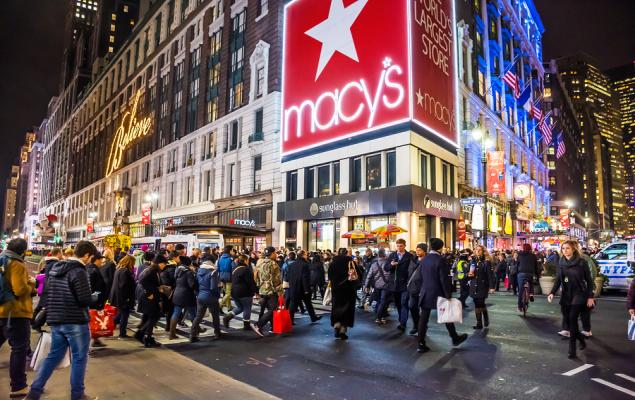
Macy's raised its 2026 adjusted EPS outlook to $2.15-$2.35 from $2.00-$2.20 and lifted its sales forecast to $21.675-$21.825 billion following Q2 adjusted EBITDA growth to $457 million from $373 million. However, it expects Q3 adjusted EPS loss of $0.19-$0.23 on $4.65-$4.70 billion in sales, with comparable sales ranging from -0.5% to +0.5% and EBITDA margin of 3.7%-4.0%. Reduced tariff and fuel pressure, now expected to cut gross margin by 5-15 bps versus 20-30 bps previously, provides an offset, but $82 million of tariff-refund reinvestment in Q3 and a roughly $30 million store-closure sales headwind leave near-term execution risk elevated.
Analysis
M's setup is less a demand-recovery story than an earnings-timing problem: investment expense is being pulled into the weakest seasonal quarter while the benefit must be earned back during holiday. That creates a low bar for reported Q3 EPS but a higher bar for holiday conversion, inventory discipline and markdown control. The key market risk is that investors capitalize the annual margin improvement before management proves that incremental spend produces traffic rather than simply defends share.
TGT's stronger digital momentum raises the cost of maintaining relevance for department stores, particularly in discretionary categories where price transparency and fulfillment speed determine conversion. M can protect gross margin through sourcing and logistics, but SG&A deleverage becomes acute if comparable sales remain near flat; a 100 bp shortfall in holiday comp can plausibly erase much of the planned margin cushion through promotions and fixed-cost absorption. KSS is a less clean read-through because its turnaround actions can lift earnings despite weak traffic, but it reinforces that guidance raises across the cohort need not signal healthy underlying demand.
Near term, the asymmetry is modestly negative for M: a guided quarterly loss may be tolerated, yet any evidence of elevated markdowns, inventory growth above sales, or a reduction in holiday traffic assumptions would undermine the full-year credibility that supports the stock. Over 6-18 months, M's property monetization and luxury exposure provide valuation support, but neither offsets a structurally lower productivity profile if digital share continues migrating to TGT, AMZN and off-price chains. Contrarianly, tariff relief is likely already visible in guidance; the incremental surprise now depends on demand and reinvestment ROI, not further input-cost easing.
AllMind Terminal
AI-powered research, real-time alerts, and portfolio analytics for institutional investors.
Request TrialMarket Sentiment
Overall Sentiment
mixed
Sentiment Score
0.08
Ticker Sentiment
Key Decisions for Investors
- Maintain a tactical underweight in M into Q3 results and reassess after holiday guidance; use a close above the post-guidance high or explicit confirmation that Q4 comparable-sales assumptions are improving as a thesis stop. Downside catalyst is inventory/markdown commentary rather than the guided EPS loss itself.
- Preferred relative-value expression: long TGT / short M over the next 1-3 months, sized beta-neutral. The trade captures superior digital/customer-acquisition economics versus M's investment-heavy margin defense; exit if M demonstrates comp acceleration above TGT or TGT guides to renewed discretionary weakness.
- Do not chase KSS on an outlook revision without evidence of sustained comparable-sales improvement. Treat it as a watch item for retail-wide promotional intensity: a widening gap between KSS traffic and earnings would signal cost actions, not demand, and is not a bullish read-through for M.
- For M longs, wait for post-Q3 confirmation that inventory growth is below sales growth and that holiday gross-margin guidance holds despite promotions. Missing data: current inventory turns, digital conversion, and category-level big-ticket trends; absent those, risk/reward is insufficient for a directional long.
More News
- FTC demands Walmart, Uber, Delta and others hand over data on personalized pricing: Reuters
- Is Costco the next healthcare disrupter?
- The FTC asks companies from Uber to Walmart about how they personalize the prices you pay
- What investors need to know about Alphabet's stock-busting earnings report
- Our next steps for Alphabet stock after earnings disappoint at nearly every turn
- Wendy's shares jump 15% as Nelson Peltz's Trian offers $1.4 billion to buy burger chain