
AutoTrust AI's JEV-27B-VL Tops Hugging Face Global Trending List as Open Decision Models Gain Momentum
Source: PR Newswire
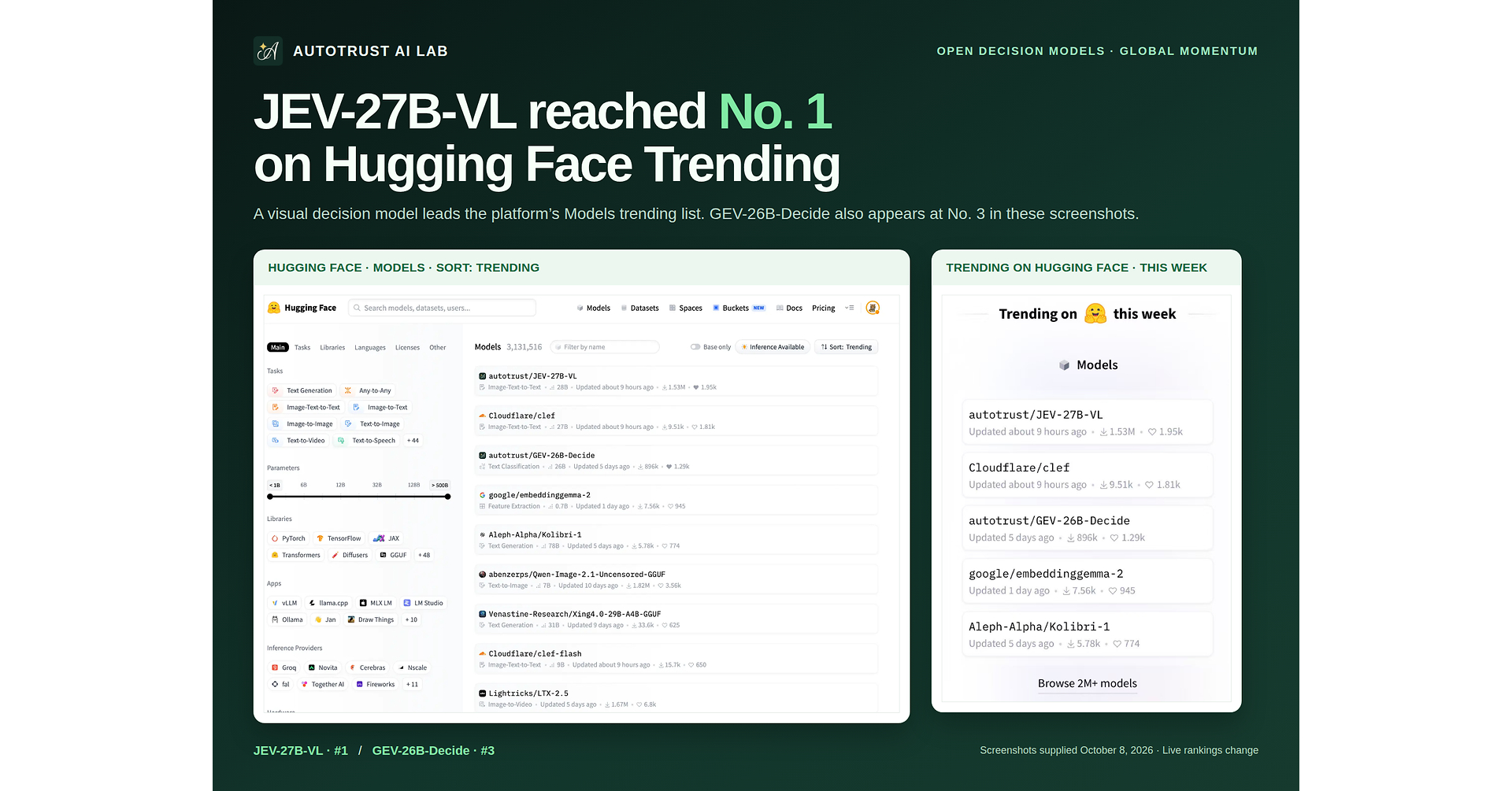
AutoTrust AI said its JEV-27B-VL ranked No. 1 and its GEV-26B-Decide No. 3 on Hugging Face’s global Models trending list on October 8, 2026; nine repositories recorded 2.98 million downloads over 30 days. The company also reported JEV-27B-VL’s Jev Decision Index vision-board score of 69.82, 6.4 points above the cited 397-billion-parameter reference model. Results are largely company-reported, and the release notes that trending ranks measure recent attention rather than performance; downloads are not revenue or customers.
Analysis
The investable signal is ecosystem validation, not yet evidence of a new revenue pool. If decision models reliably replace multiple narrow classifiers or reduce expensive LLM calls, value shifts toward whoever owns workflow integration, data and distribution—not necessarily the model publisher. Open weights make that value capture uncertain and could pressure proprietary inference pricing.
GOOG has a two-sided read-through: use of Gemma as a base model could strengthen developer adoption and reinforce Google’s open-model ecosystem, while capable third-party decision layers may make the underlying model more interchangeable and compete with hosted AI services. Treat as a modest strategic positive, not an earnings catalyst. For NVDA, the reported B200 throughput is a product demonstration, not evidence of material incremental GPU demand; efficiency gains could lower compute per decision even as broader adoption expands workloads.
Near term, the rankings and downloads are attention metrics, not paid usage. The benchmark and application results are largely company-reported, with small task samples; production accuracy, latency at scale, integration costs and enterprise conversion remain unproven. Over 1–3 months, verify independent evaluations and named customer deployments. Over 6–18 months, the key question is whether decision APIs become a standard control layer or are absorbed into platforms and existing agent stacks. A reversal would be weak production performance, no commercial conversion, or incumbent platforms bundling comparable functionality. No standalone trade is justified on this release.
AllMind Terminal
AI-powered research, real-time alerts, and portfolio analytics for institutional investors.
Request TrialMarket Sentiment
Overall Sentiment
moderately positive
Sentiment Score
0.40
Ticker Sentiment
Key Decisions for Investors
- Do not trade GOOG or NVDA on the announcement alone. For GOOG, view Gemma-based adoption as ecosystem validation, but require evidence that usage translates into Google Cloud or other monetizable demand before upgrading the thesis.
- Keep NVDA on watch rather than extrapolating GPU demand from a single-B200 benchmark. Reassess only if deployments show sustained inference volume growth that outweighs lower compute per decision.
- Set a 1–3 month diligence trigger: independently reproduced benchmark results plus production customer evidence, including decision volume, latency, error rates, and whether the system actually replaces existing classifiers or LLM calls.
- Falsify the adoption thesis if subsequent evaluations fail to reproduce performance on held-out real-world workflows, or if enterprise pilots do not progress to paid deployments; do not treat repository downloads alone as a commercial KPI.
More News
- Israel’s economy prospers despite years of war, but prices worry voters
- OpenAI's revenue scare, Delta earnings, what investors think of a Starbucks-Chipotle deal and more in Morning Squawk
- Is AI the new China Shock?
- Wall Street is pitching data centers as a major real estate bet. The risks are piling up
- ‘Indentured servants’: US green card move will hit thousands of IT workers
- Ukraine’s drones knock out AI data center belonging to "Russia’s Google"
From AllMind Research
- Anthropic IPO Preview: Valuation, Timing, and What to Watch
- Shein After the IPO: Venue, Valuation, and What Must Be Proved
- What AI Research Tools Should a Small Hedge Fund Buy First?
- Weekly Update: Adding Live MBO Level 3 Data - Liquidity Heatmap, OFI Charts, and More
- AI Software for Buy-Side Teams: Build the Research Stack