
Forget the Perfect Family Dinner. Ello Says Keep It Fresh.
Source: PR Newswire
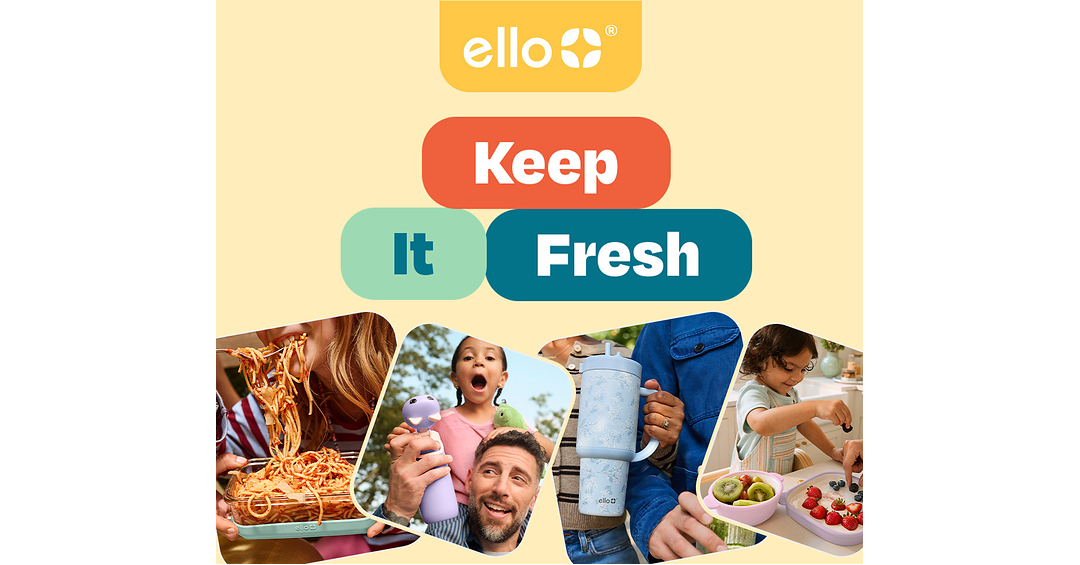
Ello will launch its first brand campaign, "Keep It Fresh," in late September across connected TV, digital and social media. The campaign unifies the brand's food-storage, hydration and children's product lines under a single platform aimed at increasing relevance in everyday family routines. The announcement contains no financial results, sales outlook or quantified spending commitments.
Analysis
This is primarily a private-brand marketing event, not a standalone public-markets catalyst. The relevant read-through is whether back-to-school/fall household-goods demand is shifting toward branded, reusable storage and hydration products rather than commoditized private label; that would modestly favor retailers with differentiated assortments and higher-margin owned brands, including Target (TGT) and Williams-Sonoma (WSM), over pure broadline volume plays. CTV-led spend also marginally supports ad-inventory demand, but the budget is unlikely to be material for Roku (ROKU) or connected-TV platforms.
The more important second-order issue is category fragmentation: a unified brand platform can raise shelf velocity across bottles, lunch containers and food storage, increasing pressure on low-differentiation vendors and retailer private labels during promotional fourth-quarter resets. However, consumer packaged-home categories remain highly promotion-sensitive; if the campaign requires elevated discounting or retailer-funded placement, sales gains may not translate into supplier margin expansion. There is no disclosed spend, distribution expansion, retailer commitment, or sales baseline, so no investable revenue inference is currently possible.
Near term, treat this as a minor confirmation of competitive advertising intensity around seasonal household essentials, not a demand signal. Over 1-3 months, Nielsen/retailer channel data showing sustained unit growth without deeper promotions would support a branded-category recovery thesis. Over 6-18 months, the structural question is whether reusable food-storage and hydration products maintain premium pricing amid private-label expansion and lower-cost imports; absent evidence of pricing power, broad category multiple expansion is unlikely.
AllMind Terminal
AI-powered research, real-time alerts, and portfolio analytics for institutional investors.
Request TrialMarket Sentiment
Overall Sentiment
mildly positive
Sentiment Score
0.20
Key Decisions for Investors
- No directional trade recommended on this announcement; Ello's parent is private and disclosed information is insufficient to estimate revenue, media spend, or margin impact.
- Add TGT to a 1-3 month watchlist: a positive read-through requires improving comparable-sales trends in home/essentials alongside stable gross margin, indicating differentiated assortment rather than incremental discounting. Falsifier: another comp-sales miss or renewed gross-margin compression at the next earnings update.
- Monitor ROKU and The Trade Desk (TTD) for broader CTV budget confirmation, but do not attribute material upside to a single consumer-brand campaign. Consider only if Q4 ad-spend checks show multi-brand CPG reallocation into CTV; the falsifier is weak fourth-quarter ad guidance or a soft retail-media/CTV pricing environment.
- Watch public category proxies Newell Brands (NWL) and Helen of Troy (HELE) for promotional intensity and gross-margin commentary in hydration/food-storage-adjacent businesses. A rise in promotional allowances without unit acceleration would be a negative signal for branded household-goods suppliers and favors avoiding the group rather than shorting it.
More News
- Coffee giant Dutch Bros made all of its executives, including the CEO, do a two-week bootcamp where they learned how to pour drinks and run stores
- argenx reports positive phase 3 data for autoimmune myositis drug
- AI broke the cybersecurity world. What’s next?
- Good riddance, Cybertruck!
- Alabama Power spent more than $6 million on ads last year — and customers can be billed for half of them until 2029
- Starter homes cost $1 million in a record 242 U.S. cities—proof the affordability crisis has hit the homes meant for first-time buyers