
Nukleus Launches a Front Office for Athletes
Source: PR Newswire
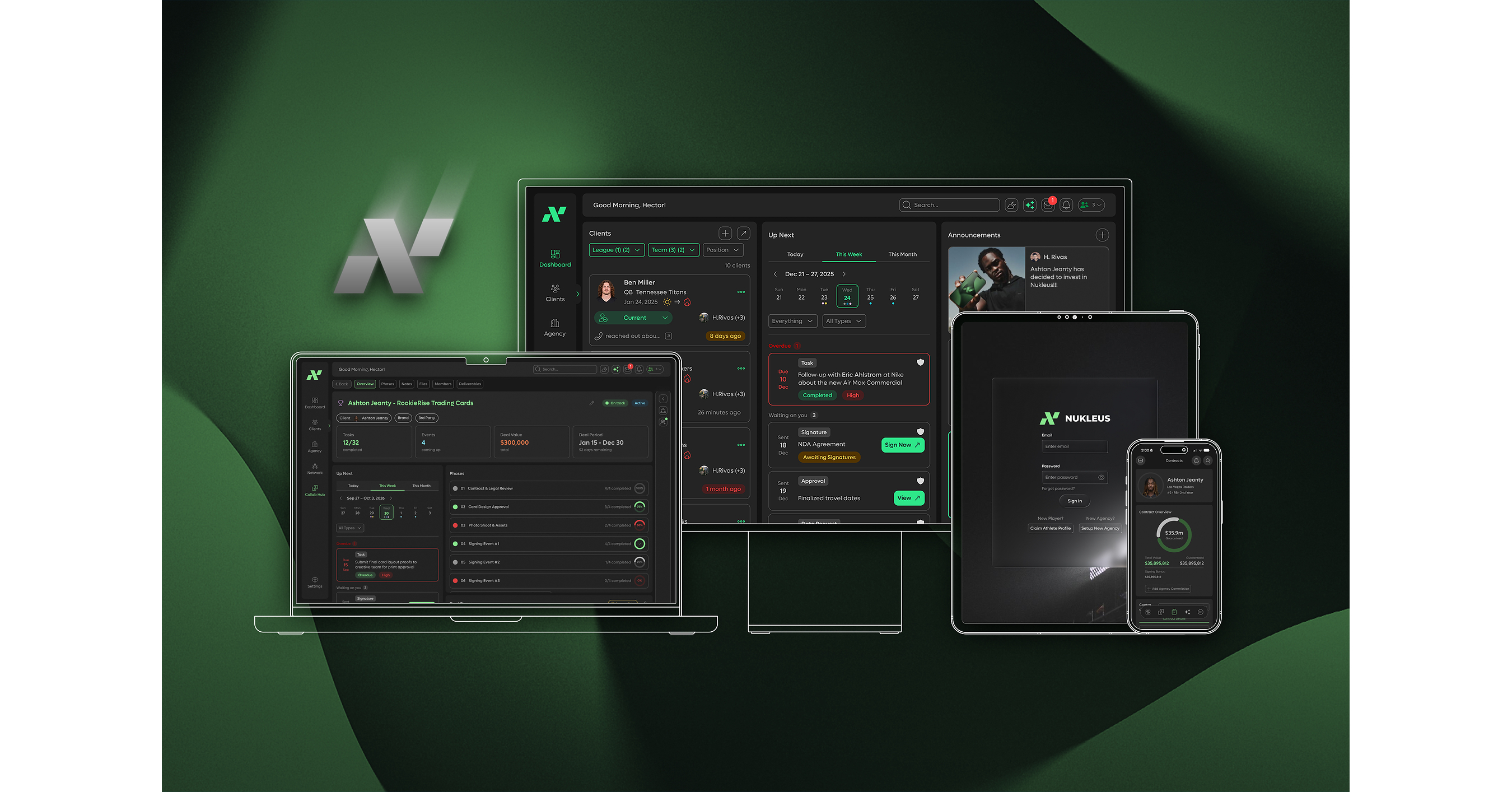
Nukleus launched a sports-business platform that centralizes athletes' contracts, brand deals, payments and advisors, with Las Vegas Raiders RB Ashton Jeanty serving as an investor and public face. The company operates its AI on proprietary servers to keep sensitive contract and financial data in-house, while offering athletes free access and charging agents, advisors and organizations after a 30-day trial. The launch targets a growing need among professional and college athletes following the House v. NCAA settlement, which permits schools to pay student-athletes up to approximately $21.58 million per school in 2026-27 in addition to NIL income.
Analysis
This is not a material read-through for AAPL or GOOG; the relevant signal is the emergence of a vertical workflow layer between athletes and the fragmented professionals monetizing their careers. The likely incumbents at risk are point-solution providers in sports representation, NIL administration, payments, and athlete financial-management software—not consumer mobile or hyperscale AI platforms. Adoption will depend less on athlete downloads than on whether agencies accept a system that makes commissions, deal status, and payment timing more transparent to clients.
The near-term economics are unproven: free athlete acquisition plus a 30-day adviser trial can produce engagement without demonstrating willingness to pay, retention, or low-cost onboarding of contracts and payment data. A 1-3 month validation path is agency/collective partnerships, integration with payment rails and accounting systems, and evidence that the platform reduces receivables or compliance workload. The central failure mode is data-network fragmentation: agents, attorneys, accountants, and brands have little incentive to migrate sensitive records unless the platform becomes the system of record for invoicing and settlement.
The non-obvious structural opportunity is college NIL, where institutional programs and collectives may need audit trails, approval workflows, and conflict controls as compensation administration professionalizes over the next 6-18 months. That could create demand for enterprise-grade governance rather than a consumer athlete app; established NIL infrastructure vendors or university-facing compliance platforms would have a distribution advantage. Self-hosted AI is a privacy marketing feature, but it raises fixed security, model-maintenance, and breach-liability burdens that small vendors may underestimate.
Contrarian view: athlete financial fragmentation is a credible pain point, but the addressable software budget may sit with agencies and schools that already use CRM, document-management, and accounting tools. Without proprietary transaction rails or exclusive distribution, the product risks becoming a collaboration overlay with modest pricing power and high customer-support intensity.
AllMind Terminal
AI-powered research, real-time alerts, and portfolio analytics for institutional investors.
Request TrialMarket Sentiment
Overall Sentiment
moderately positive
Sentiment Score
0.42
Key Decisions for Investors
- No directional trade in AAPL or GOOG: neither has a discernible revenue, margin, or competitive exposure from this launch; treat the supplied ticker linkage as non-actionable.
- Set a private-market diligence alert for enterprise adoption rather than app downloads over the next 90 days: agency or Power-conference/collective contracts, paid-seat conversion after trials, payment-volume integration, and security certifications are the minimum validation markers.
- For public-market thematic exposure, monitor NIL-adjacent sports-betting/media names and payments vendors only if college compensation workflows demonstrably expand transaction volumes; do not underwrite a revenue read-through until a named rail partner or institutional customer is disclosed.
- Falsify the constructive vertical-SaaS thesis if adviser conversion remains weak after the initial trial cohort, if agencies resist invoice/payment workflow migration, or if a security incident exposes the cost of operating sensitive contract and financial data in-house.
More News
- Broadcom to lend Anthropic up to $42 billion to lease its chips, filing says
- One of our most recent defensive buys cleared a hurdle and its stock jumped
- AI’s biggest players promise to police themselves at the White House
- Google unveils latest AI model, but Wall Street wants a breakout personal agent
- You think Nvidia's $235 billion buyback is big. Just wait and see what Micron might do
- Exclusive-Broadcom to lend Anthropic up to $42 billion to lease its chips, filing says