
El auge de la IA amenaza con ampliar la brecha entre naciones ricas y pobres
Source: PR Newswire
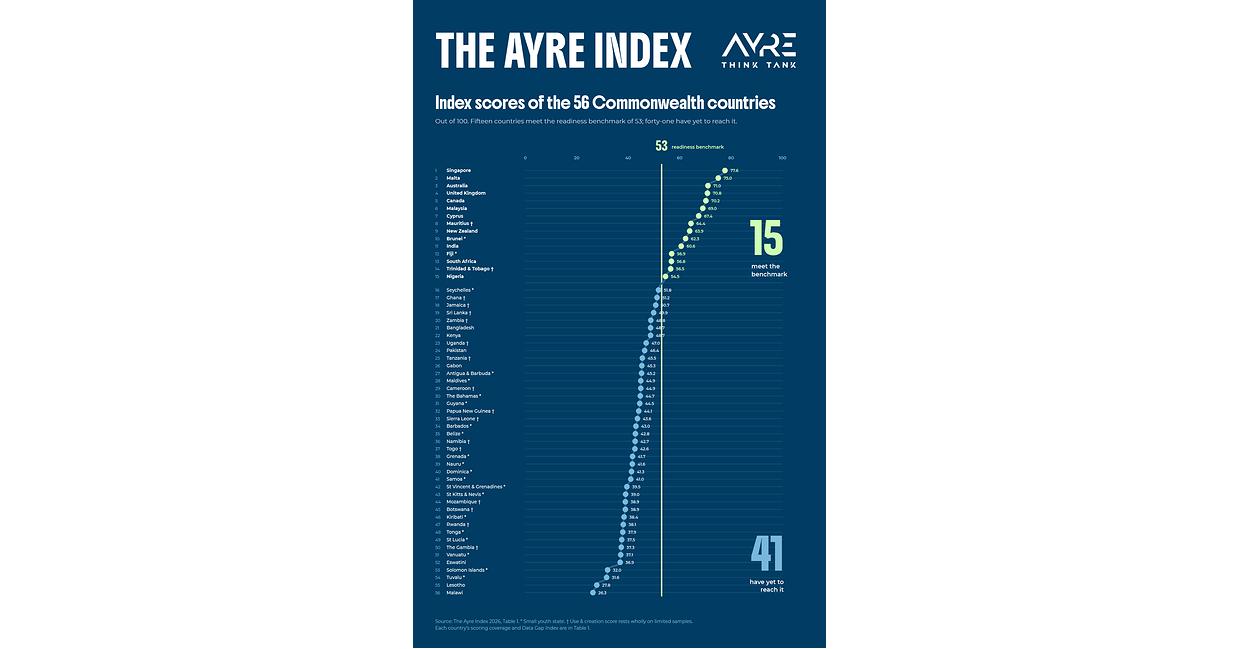
Un estudio de Ayre Think Tank estima que los 15 países de la Commonwealth que superan el umbral de preparación juvenil para la IA podrían sumar US$389.200 millones a sus economías en 10 años, frente a US$29.200 millones entre los otros 41; la brecha proyectada es de US$360.000 millones. El informe advierte que la conectividad por sí sola no basta: las capacidades digitales, el acceso asequible y las oportunidades laborales determinarán si la IA reduce o amplía las desigualdades. Señala, entre otros datos, que Nigeria obtuvo 0,8 sobre 10 en capacidades digitales convencionales y que el desempleo juvenil en Sudáfrica fue del 46,3%, pese a cumplir el umbral de preparación.
Analysis
The investable signal is not the estimated economic gap; it is that AI returns may concentrate where compute, reliable power, skills and routes to commercialization already exist. That favors infrastructure owners and firms able to monetize AI over broad “AI adoption” exposure in lower-income markets. The second-order risk is that labor-cost arbitrage becomes less valuable if automation substitutes for routine services before affected economies can build higher-value work—pressuring outsourcing growth and weakening the expected consumer-demand payoff from digital access.
Treat the study as a scenario, not an earnings forecast: it is a think-tank estimate, covers Commonwealth countries rather than all emerging markets, and acknowledges weak comparable skills data. Its own examples imply that connectivity alone is not a sufficient demand catalyst. For investors, announced broadband or AI-access programs should not translate into telecom revenue assumptions without evidence of affordability, usage, power availability and business monetization.
Near term, the finding is unlikely to move listed-company earnings; AI infrastructure concentration is already a crowded market narrative, so avoid chasing it on this release. Over 1–3 months, watch budgets, power/grid investment, employer hiring and paid AI use—not readiness rankings. Over 6–18 months, persistent skills and employment bottlenecks could widen the gap between infrastructure beneficiaries and emerging-market domestic-demand or labor-arbitrage theses. A reversal would require measurable improvement in adoption and productivity outside the leading markets, alongside evidence that gains translate into local employment and income.
AllMind Terminal
AI-powered research, real-time alerts, and portfolio analytics for institutional investors.
Request TrialMarket Sentiment
Overall Sentiment
mildly negative
Sentiment Score
-0.15
Key Decisions for Investors
- No event-driven trade on this report alone. Do not treat its 10-year modeled benefits as addressable revenue or a forecast for any issuer.
- For AI exposure, favor businesses with demonstrable paid demand and access to power, compute and distribution over broad emerging-market “AI catch-up” baskets; avoid adding to crowded infrastructure positions solely on this thesis.
- Set a 1–3 month watchlist for telecom usage and affordability, grid/power investment, employer AI deployment and local hiring. Upgrade the adoption thesis only when these indicators improve together.
- Falsify the divergence thesis if earnings or credible productivity data show sustained AI monetization and job/income gains across lagging markets; otherwise, persistent usage, skills or employment gaps argue against assuming access alone closes the opportunity gap.
More News
- Magnificent 7 loses $1 trillion. The most eye-popping stats from Thursday's tech stock plunge
- Tech stocks are suffering their biggest selloff since Covid, as investors see premature end to AI datacenter boom
- Wall Street’s best post-midterm rally in 44 years lasted just one day—then $3 trillion vanished as chip stocks plunged over AI fears
- How Wall Street's postelection rally got obliterated — and what's next
- AI stocks plunge after election, driving down US markets
- Elon Musk's Tesla and SpaceX lose over $420 billion in combined market cap after midterms