
Rivvor Debuts Valen™ Edge Series: Wireless, Wire-Free Compute for AI Inference at OCP 2026
Source: PR Newswire
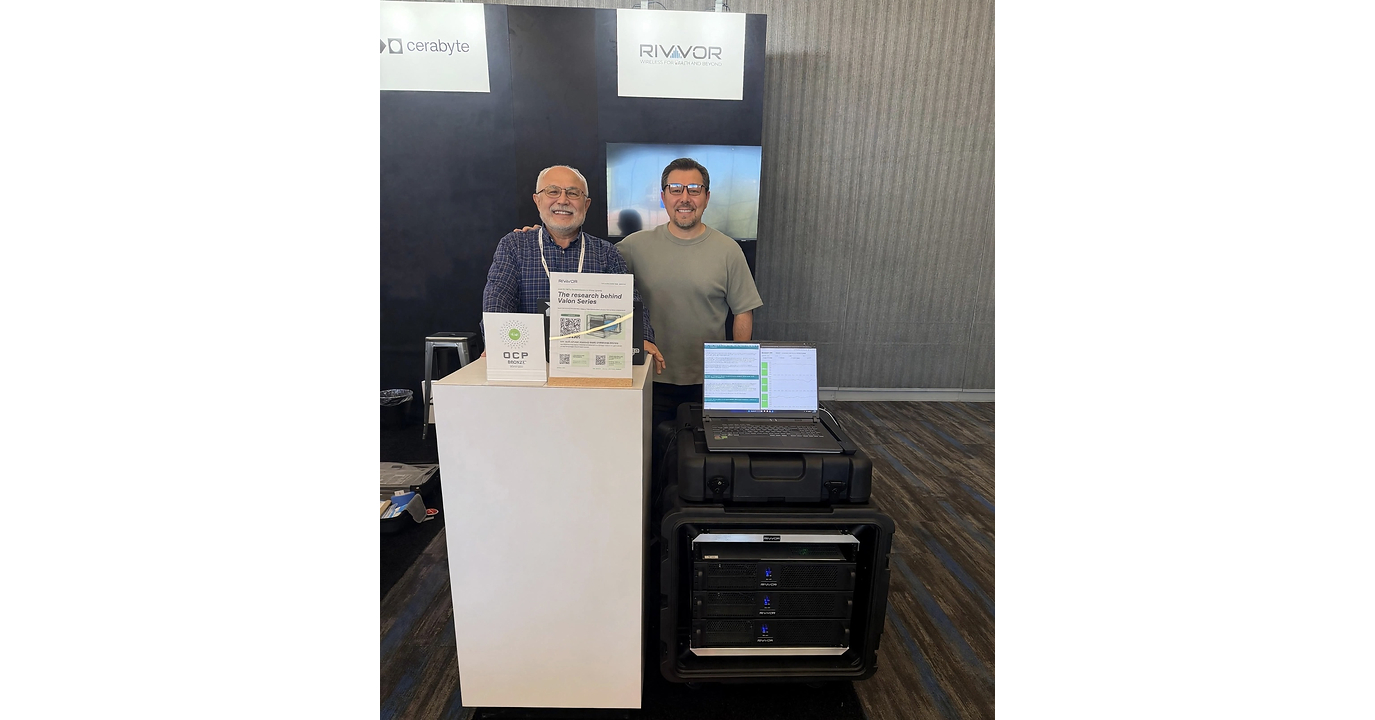
Rivvor demonstrated its Valen cable-free, three-blade AI inference rack publicly for the first time at the 2026 OCP Global Summit. The system reported 300+ Gbps aggregate bandwidth and 250 ns application-memory-to-application-memory latency, down from 1,600 ns round trip in an enclosed rack in June. Rivvor says its next step is sub-THz interconnect targeting 400+ Gbps per link; these are company-reported product specifications and future design goals.
Analysis
This is a technology-validation signal, not yet an investable displacement signal. The key economic claim is that wireless links could return rack volume otherwise consumed by cabling and connectors, potentially easing serviceability and topology constraints. That only creates value if end-to-end performance, reliability, power use, and cost hold up under dense, sustained workloads; the demo does not establish those economics. A three-blade system and company-stated roadmap are far removed from hyperscale qualification.
Near term, no clear public-equity beneficiary: Rivvor is private, and AMD’s presence in the demo does not imply commercial endorsement or material exposure. If wireless interconnect eventually substitutes for some physical links, cable/connectivity suppliers such as Amphenol and TE Connectivity could face a long-dated headwind; conversely, incumbent electrical and optical interconnect providers—including Astera Labs, Credo, Broadcom, and Marvell—could adapt or supply complementary fabric. The article supports neither a revenue-impact estimate nor a near-term winner/loser trade.
The contrarian point is that removing cables does not remove the need for a high-performance fabric. mmWave propagation, blockage, interference, thermal conditions, and aggregate capacity across many nodes may constrain deployment; software reconfigurability is valuable only if it avoids adding latency or operational complexity. The sub-THz ASIC roadmap is a development target, not demonstrated capability. Over 1–3 months, the November 12 demo and subsequent customer pilots are the relevant checks. Over 6–18 months, qualification data and deployments—not conference interest—would determine whether this is a niche edge solution or a meaningful rack architecture shift.
AllMind Terminal
AI-powered research, real-time alerts, and portfolio analytics for institutional investors.
Request TrialMarket Sentiment
Overall Sentiment
mildly positive
Sentiment Score
0.25
Key Decisions for Investors
- No trade on the announcement alone. Do not treat AMD as a beneficiary or Rivvor’s demonstration as evidence of an AMD partnership.
- Add a watch item for the November 12 demo and any pilot disclosures: verify sustained workload throughput, latency measurement methodology, bit-error/retransmission rates, power per delivered bit, thermal behavior, and performance under congestion or blockage.
- Keep cable and interconnect suppliers on a long-horizon displacement watchlist, not a short list. Revisit only after repeatable multi-rack deployments or customer qualification indicate physical links are being removed rather than supplemented.
- Falsify the deployment thesis if field testing shows unstable performance in realistic rack conditions, material power or cooling penalties, or no measurable serviceability/capacity benefit; upgrade it only with independently verifiable customer deployments and production-scale sub-THz results.
More News
- Stocks slump, bonds leap as AI giants’ spending spooks investors
- DoorDash offers $17 billion for Instacart: ‘the largest companies are only eating more and more of the pie’
- Alphabet Erases $500 Billion as ChatGPT, Google AI Cut into Search
- Alphabet just had its worst day as a public company. BofA now values Google search at a lower multiple than fossil fuel stocks
- Taiwan Stocks Heads for Correction as Global AI Selloff Deepens
- Asia stocks tumble as AI spending concerns deepen; BOJ holds rates