
SDMC Showcases Deployable AI Home Services at IBC 2026
Source: PR Newswire
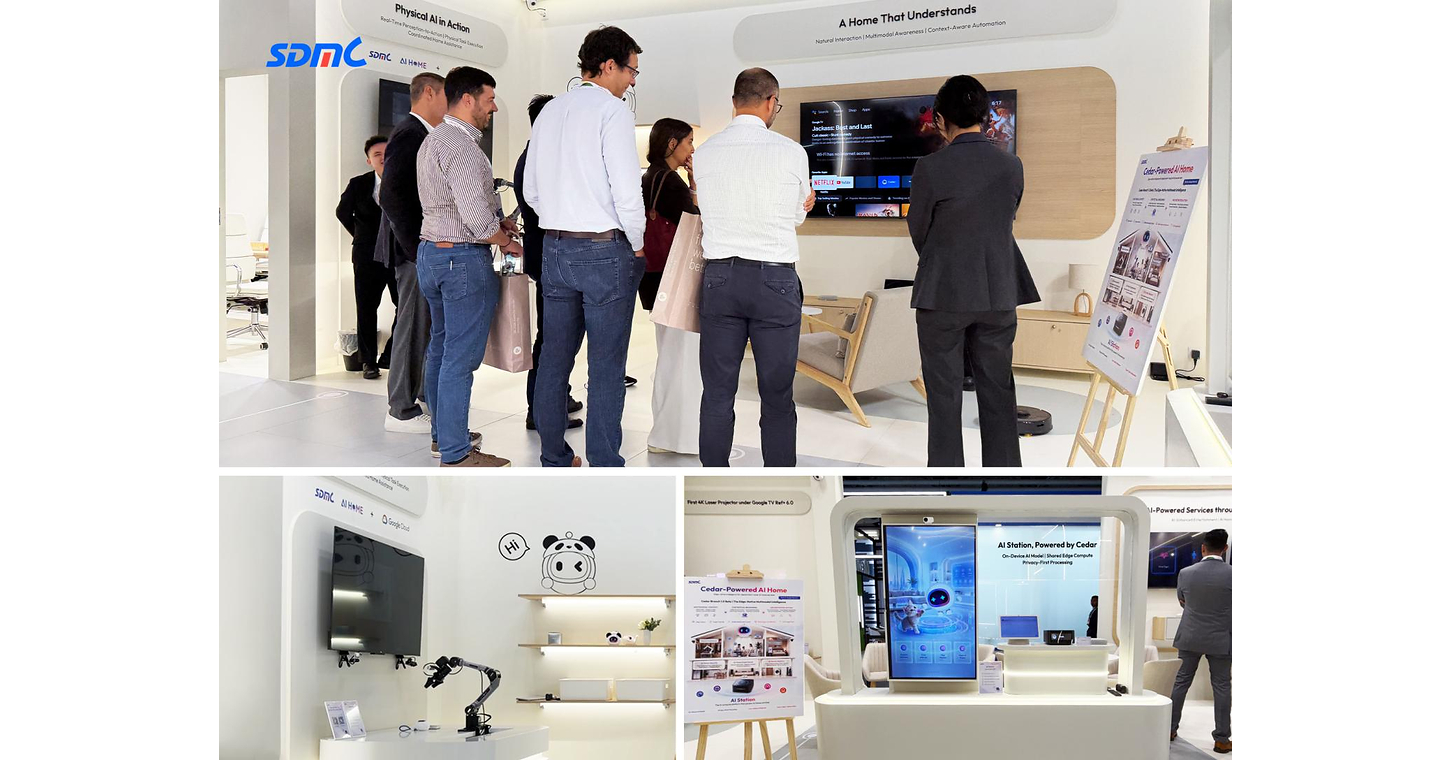
SDMC showcased its AI Home architecture at IBC 2026, featuring Cedar edge AI, AI Station shared edge computing powered by NVIDIA Jetson T5000, and cloud integration with Google Cloud's Gemini and Gemma models. The company said its participation in Google Cloud's Proactive Physical AI Acceleration Program will support technology co-creation, validation and service pilots for operator-focused home entertainment, security, connectivity and operations use cases. The announcement signals continued ecosystem development but provides no financial targets, revenue contribution, commercialization timeline, or customer commitments.
Analysis
This is strategically useful validation for edge inference architecture but immaterial to GOOG or NVDA financial estimates. Google’s upside is indirect: operator-led home deployments can create recurring Cloud, Gemini and device-management consumption, but the relevant bottleneck is telecom procurement cycles and willingness to subsidize premium in-home hardware—not model capability. For NVDA, embedded edge modules broaden software ecosystem reach but remain a negligible revenue pool versus data-center demand; investors should not extrapolate a single OEM showcase into an incremental earnings catalyst.
The more important second-order issue is whether shared edge compute lowers operators’ cost-to-serve enough to turn AI features into a paid broadband bundle. If it does, broadband incumbents and equipment vendors with installed CPE bases—including CHTR, CMCSA, T and VZ—could eventually use AI network operations to reduce truck rolls, churn and support costs. Conversely, open-model edge stacks may commoditize endpoint intelligence, limiting hardware pricing power for device vendors and favoring silicon suppliers with low-power inference economics such as QCOM and AMD alongside NVDA.
Near term, this is a narrative/data-point rather than a trade catalyst. Over the next 1-3 months, monitor disclosed service-pilot commitments, operator purchase orders, and attach-rate or ARPU evidence; without those, the commercial claim remains unverified. Over 6-18 months, the thesis becomes investable only if operators report measurable reductions in support costs or launch paid AI tiers, as consumer privacy concerns, local inference power consumption, and fragmented smart-home standards could otherwise prevent scale.
Consensus is likely to over-credit cloud AI partnerships while underweighting deployment friction. A successful home AI platform needs integration across legacy gateways, content interfaces, security devices and operator billing systems; proof-of-concept activity alone does not establish a scalable revenue model. The key falsifier for the optionality case is absence of named operator rollouts and recurring-service metrics by the next two major industry procurement cycles.
AllMind Terminal
AI-powered research, real-time alerts, and portfolio analytics for institutional investors.
Request TrialMarket Sentiment
Overall Sentiment
mildly positive
Sentiment Score
0.38
Ticker Sentiment
Key Decisions for Investors
- No directional GOOG or NVDA trade on this announcement; treat it as a watch item because the probable revenue contribution is below materiality thresholds for both companies.
- Create a 1-3 month alert for named operator pilots with committed unit volumes, paid-service pricing, or disclosed cloud consumption. Upgrade GOOG only if multiple operators demonstrate recurring AI-service ARPU rather than device demonstrations.
- For edge-AI exposure, monitor a QCOM/NVDA relative-value setup rather than chase NVDA: consider long QCOM versus short NVDA only if operator CPE design wins begin favoring lower-power endpoint inference and NVDA’s edge attach does not translate into disclosed revenue. Falsify if NVDA reports meaningful embedded-platform growth or QCOM loses gateway/socket share.
- Watch CMCSA and CHRTR for evidence that AI operations reduce customer-service expense or churn over the next 2-4 quarters; absent quantified opex savings or broadband ARPU uplift, do not price a margin benefit into cable valuations.
More News
- Investors react to Fed hike and market sell-off: Brace for 'higher for longer' rates
- The Fed decision, Clarity Act fails in Senate, Ford's truck prices and more in Morning Squawk
- Snap tries to bring AR glasses to enterprise market, partnering with Nvidia, AWS and Salesforce
- Hyperscaler debt signals warning sign, Apollo cautions
- Why Forgent Power Stock Keeps Going Up
- Banks provide $22 billion chip loan to Blackstone, Alphabet cloud venture, Bloomberg News reports