
Seoul National University of Science and Technology Researchers Show How Smartphones Can Help Detect Lung Problems in Children
Source: PR Newswire
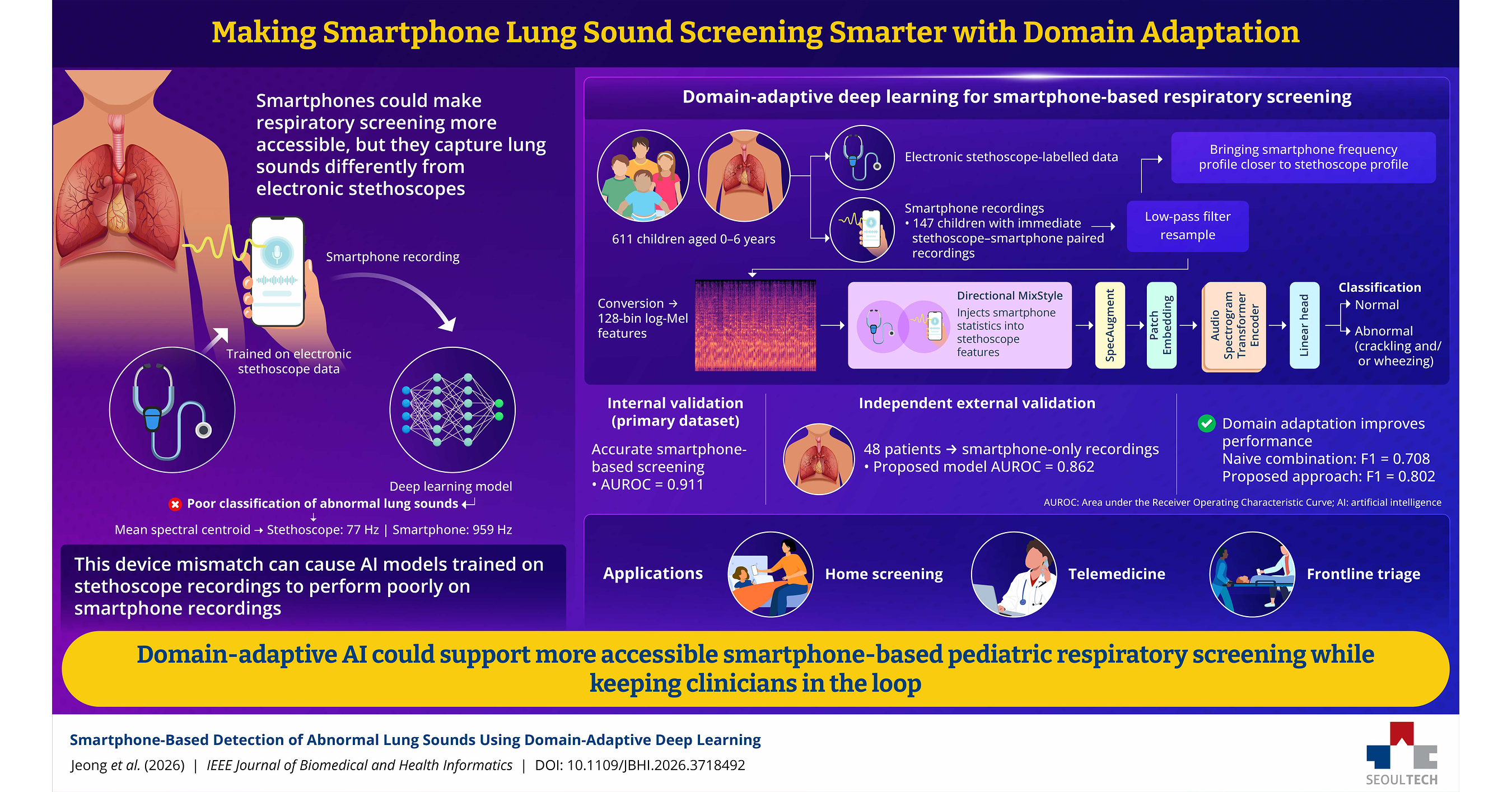
A SeoulTech-led team developed a domain-adaptive deep-learning model for detecting abnormal pediatric lung sounds from smartphone recordings. It achieved an F1 score of 0.802 and AUROC of 0.911 on the primary smartphone dataset, versus F1 scores of 0.732 for a smartphone-only model and 0.708 for naïve pooling; on an independent cohort, it recorded an F1 of 0.744 and AUROC of 0.862. The results are a proof of concept, with larger-cohort and real-world validation still needed.
Analysis
This is a research signal, not yet a commercial signal. The key economic question is whether device-robust screening can lower the cost of triage without creating enough false positives, missed cases, or clinician workload to erase the benefit. If it clears that bar, value is more likely to accrue to whoever owns clinical workflow, validated datasets, and distribution than to the smartphone hardware layer; the model itself may be reproducible and its performance may degrade across phones, recording environments, and patient populations.
The near-term market impact is negligible: there is no named commercial partner, product, reimbursement pathway, or public-company exposure in the supplied information. Over 1–3 months, watch for independent replication and prospective real-world validation, particularly sensitivity for clinically important disease and performance across phone models and noisy home settings. Over 6–18 months, regulatory classification, clinician oversight requirements, and integration into pediatric or telehealth workflows determine whether this becomes a product or remains an academic proof of concept. A small validation cohort and classification metrics alone do not establish clinical utility or avoided-care economics.
Potential pressure is on standalone auscultation hardware only if phone-based screening proves reliable and complementary rather than merely generating referrals. Conversely, established device vendors and telehealth platforms could benefit by incorporating screening into existing care pathways. The contrarian read: the technical result is promising, but translation risk—not model performance on curated recordings—is the binding constraint. With no identified issuer or direct revenue exposure, the article does not support a thematic long trade.
AllMind Terminal
AI-powered research, real-time alerts, and portfolio analytics for institutional investors.
Request TrialMarket Sentiment
Overall Sentiment
moderately positive
Sentiment Score
0.35
Key Decisions for Investors
- No trade on this item alone; the supplied data identifies no public company, commercial deployment, or near-term revenue catalyst.
- Add pediatric digital diagnostics and remote-care providers to a watchlist, but require prospective multi-site validation, phone/device subgroup results, and evidence of clinician workflow integration before treating this as a monetizable catalyst.
- Track regulatory status, reimbursement or payer adoption, and any licensing or distribution partnership over the next 6–18 months; these are more decision-relevant than another model-accuracy improvement.
- Falsify the adoption thesis if real-world testing shows material false-negative or referral burdens, performance varies materially by handset or recording environment, or no commercial/clinical partner emerges.
More News
- Why did CoreWeave stock get crushed this week? Look to this corner of the debt market for clues
- AI stock sell-off ramps up over debt-fueled data center spending fears: ‘Full-blown crisis of confidence'
- Dow falls 189 points as AI stocks slide and oil prices surge
- Wall Street Anxiety Spreads as AI Rout Meets $110 Oil Shock
- Wall Street's fear gauge is ripping. Traders see it going even higher
- All the news about the iPhone Duo