
Der KI-Boom birgt die Gefahr einer wachsenden Kluft zwischen reichen und armen Ländern, wie eine wichtige Studie des Ayre Think Tanks zeigt. Diese Studie enthüllt eine Kluft von 360 Milliarden US-Dollar
Source: PR Newswire
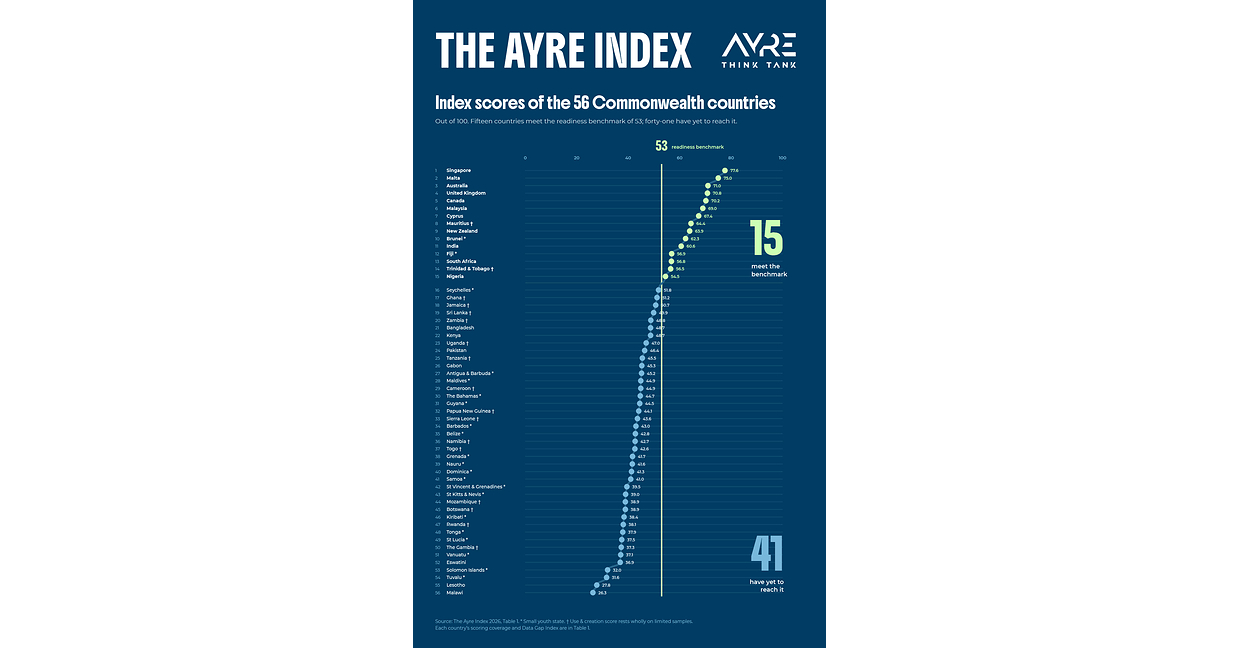
The Ayre Index estimates a $360 billion gap in potential 10-year economic gains between 15 Commonwealth countries meeting its youth AI-readiness benchmark and 41 that do not: $389.2 billion versus $29.2 billion, respectively. The study, covering 732 million people aged 15–29 across 56 member states, warns that connectivity alone is insufficient; skills, affordable access and routes to employment will shape whether AI widens or narrows economic disparities. Only Mauritius, South Africa and Nigeria met the benchmark among 21 African Commonwealth members, and South Africa’s youth unemployment rate was 46.3% despite meeting it.
Analysis
Investment read-through: This is a long-dated adoption constraint, not a near-term AI-demand catalyst. The key second-order effect is that connectivity spending alone may not produce usage, productivity or paying customers where power, affordability, digital skills and routes into work remain bottlenecks. That weakens the case for treating broad emerging-market exposure as a direct AI beneficiary and could concentrate value capture in global cloud, model and chip suppliers rather than local economies. Local telecom and power infrastructure could benefit only if investment translates into sustained usage and monetization; the index does not establish that link.
Timing and risks: Over days, the report is unlikely to change earnings or justify a thematic repricing. Over 1–3 months, watch for funded government programs, operator capex plans and measurable changes in data usage or affordability. Over 6–18 months, evidence of skills-to-employment conversion matters more than training announcements. The central estimate is a scenario, not realized cash flow; sparse comparable skills data and the South Africa employment example argue against treating readiness scores as a proxy for returns. A reversal would be credible if connectivity and power access improve but usage, productivity and youth employment do not.
Contrarian view: The headline funding gap risks making this look like an investable infrastructure shortage. The binding constraint may instead be the complementarity of infrastructure, skills and jobs—harder to finance and monetize than network rollout. No immediate broad EM or AI trade is warranted on this evidence alone.
AllMind Terminal
AI-powered research, real-time alerts, and portfolio analytics for institutional investors.
Request TrialMarket Sentiment
Overall Sentiment
mixed
Sentiment Score
-0.15
Key Decisions for Investors
- No immediate position: do not use this study alone to add broad emerging-market or AI exposure; its economic estimates are not earnings guidance.
- Put African telecom and power infrastructure on a watchlist, not a buy list. Require evidence of improving active-user/data-consumption trends, affordability and reliable power alongside capex before underwriting monetization.
- For the next 1–3 months, track funded skills-to-employment programs and operator disclosures; treat announcements without usage, productivity or hiring outcomes as non-confirming.
- Reassess over 6–18 months if adoption indicators improve without better employment or productivity, or if infrastructure spending rises without higher utilization; either would falsify the local-value-capture thesis.
More News
- Magnificent 7 loses $1 trillion. The most eye-popping stats from Thursday's tech stock plunge
- Tech stocks are suffering their biggest selloff since Covid, as investors see premature end to AI datacenter boom
- Wall Street’s best post-midterm rally in 44 years lasted just one day—then $3 trillion vanished as chip stocks plunged over AI fears
- How Wall Street's postelection rally got obliterated — and what's next
- Elon Musk's Tesla and SpaceX lose over $420 billion in combined market cap after midterms
- AI stocks plunge after election, driving down US markets
From AllMind Research
- AllMind Platform Feature Updates - Fall 2026
- AI Credit Covenant Monitoring: From Clause to Review
- AI-Led Expert Interviews vs. Transcript Libraries
- Run Cost-Controlled Financial Research in AllMind Agent Studio
- AllMind Discusses Ontario's AI Economy with Minister Stephen Crawford and Supply Ontario CEO James Wallace