
Trust Industry Turns to Peer Collaboration and Education as Technology, AI and Fiduciary Pressures Reach a Critical Inflection Point
Source: PR Newswire
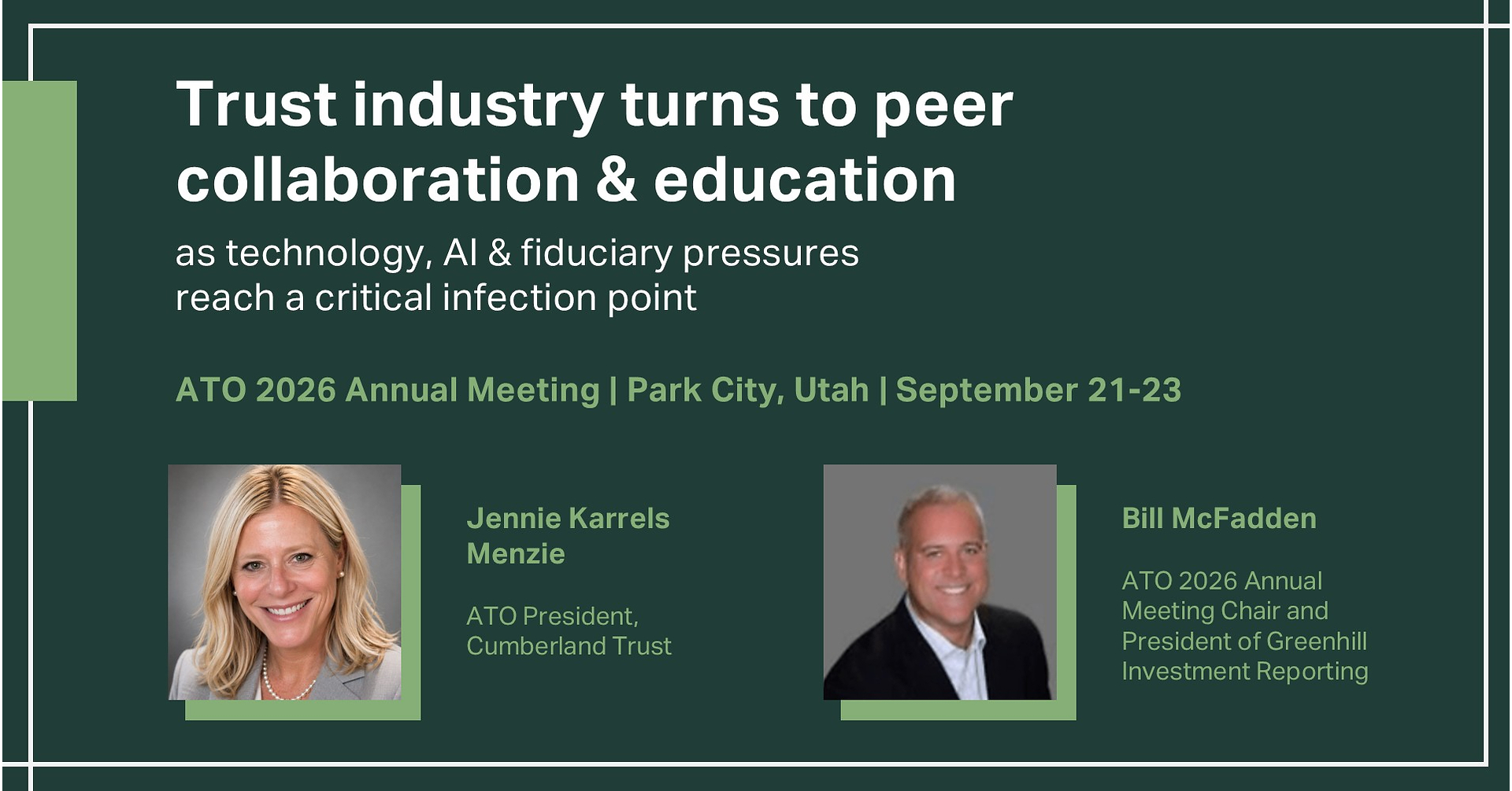
The Association of Trust Organizations promoted its 2026 Annual Meeting in Park City, Utah, scheduled for September 21-23, as a forum for trust-company executives to address technology, AI, cybersecurity, talent and operational challenges. The release contains no financial results, guidance, transaction details or other market-moving developments; it is primarily an industry-event announcement.
Analysis
This is not an investable company-specific catalyst; it is promotional industry commentary with no disclosed spending commitments, client wins, regulatory action, or measurable adoption data. The relevant read-through is that independent trust administrators face rising fixed costs for cybersecurity, AI governance, data retention, and specialized compliance talent—costs that favor scale rather than creating near-term revenue for any named public issuer.
Over 6-18 months, consolidation pressure could incrementally benefit scaled wealth-management platforms and custodians such as Charles Schwab (SCHW), Bank of New York Mellon (BK), Northern Trust (NTRS), and State Street (STT), which can amortize technology and control infrastructure across larger asset bases. Smaller state-chartered trust companies may increasingly outsource reporting, custody, cybersecurity, and workflow functions, creating a potential—but currently unquantified—tailwind for fintech and custody vendors.
Consensus should avoid treating broad references to AI and cyber as a direct software-buy signal. Trust-industry procurement cycles are slow, heavily governed, and constrained by data-security reviews; any spending uplift is more likely to appear first as margin pressure at smaller administrators than as material near-term growth for public technology vendors. There is no actionable price catalyst in the release absent evidence of vendor contracts, regulatory mandates, or disclosed operating-cost escalation.
AllMind Terminal
AI-powered research, real-time alerts, and portfolio analytics for institutional investors.
Request TrialMarket Sentiment
Overall Sentiment
neutral
Sentiment Score
0.05
Key Decisions for Investors
- No standalone trade: do not position in cybersecurity or AI software from this item; monitor 3Q-4Q earnings commentary from SCHW, BK, NTRS, and STT for quantified trust/wealth technology spend or outsourcing demand.
- Maintain a 6-18 month relative-value watchlist: long BK or NTRS versus smaller regional-bank wealth-management franchises if operating leverage diverges; validate only after evidence that fee growth exceeds technology and compliance expense growth.
- Set an alert for state or federal fiduciary cybersecurity/AI-governance rules. A mandatory compliance standard would accelerate vendor spending and favor scaled custodians, while voluntary industry education does not.
- Falsification for the scale-advantage thesis: smaller trust firms demonstrate stable operating margins and independent technology buildouts, or large custodians report rising control costs without corresponding asset-servicing or wealth-fee growth.
More News
- Here’s the ‘core economic flaw’ in the AI bull case as stock and bond trades unravel, according to a top economist
- Biotech stocks are surging. How investors can play the new drug innovation boom
- AI funding fears rattle Wall Street. Here's how we're adjusting our portfolio
- Nvidia's role as AI financier faces first big test as neoclouds take market hit
- Ukraine says Starlink and Starshield high speed restrictions have been lifted
- Goldman says these top tech stocks have plenty of upside ahead of earnings