
First Acceptance Corporation Reports Operating Results for the Three and Nine Months Ended September 30, 2026
Source: Newswire
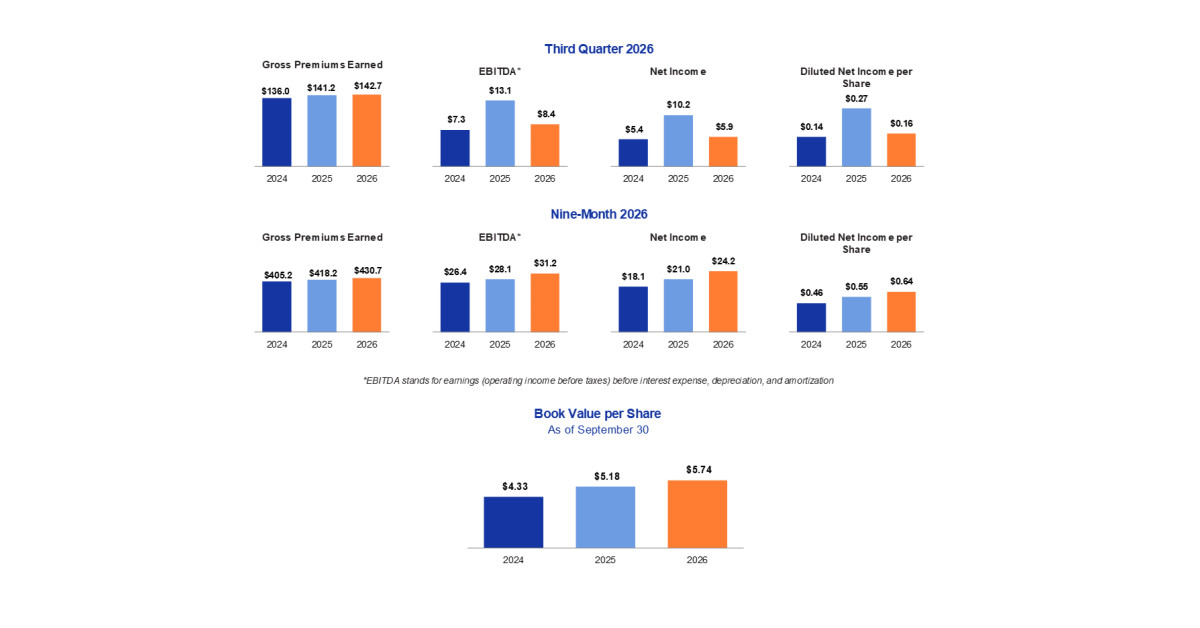
First Acceptance reported nine-month 2026 net income of $24.2 million, up 15% from $21.0 million, and recorded its 15th consecutive profitable quarter. In Q3, net income fell to $5.9 million from $10.2 million and diluted EPS declined to $0.16 from $0.27, although gross premiums earned rose to $142.7 million from $141.2 million. The nine-month combined ratio improved to 94.0% from 96.3%, while a sharp rise in interest rates reduced Q3 book value per share by $0.23 to $5.74; management cited challenging consumer conditions and emphasized disciplined underwriting.
Analysis
The key signal is the split between improving nine-month results and deteriorating Q3 underwriting: the quarterly combined-ratio move was driven by a materially higher loss ratio, partly cushioned by lower expenses. That mix matters more than the headline earnings comparison, which is clouded by prior-year reserve development and investment gains. If loss-cost pressure persists, expense discipline alone may not protect underwriting margins; in non-standard auto, financially stressed customers also raise the risk of payment lapses and adverse selection, though the release does not quantify either.
Over the next 1–3 months, test whether Q3 reflects a temporary claims fluctuation or the start of sustained loss-cost deterioration. The nine-month ratio and premium growth argue against declaring a broken trend, but premiums are not proof of profitable growth. Verify policy counts, retention, rate changes, claims frequency/severity, reserve development, and reinsurance economics in the full filing. A sustained combined ratio near or above 100% would weaken the growth case; a return toward the nine-month level with stable reserves would support it.
Higher reinvestment yields can gradually support investment income, but rising rates can pressure reported book value through fixed-maturity marks. This is a timing trade-off, not an automatic capital impairment; duration, realized losses, and regulatory capital sensitivity are missing. Given the OTC listing and absent valuation and liquidity data, the evidence supports monitoring rather than a directional equity trade. The contrarian angle is that Q3 headline EPS may overstate deterioration, while premium growth may conversely overstate underlying health.
AllMind Terminal
AI-powered research, real-time alerts, and portfolio analytics for institutional investors.
Request TrialMarket Sentiment
Overall Sentiment
mixed
Sentiment Score
0.05
Key Decisions for Investors
- No immediate directional position: first check the full quarterly filing and trading liquidity. OTC status makes execution and exit risk material, and the release alone does not establish valuation.
- Set a 1–3 month underwriting alert: reassess if the next reported combined ratio remains elevated or reserve development turns adverse; a move back toward the nine-month performance with stable claims metrics would falsify the deterioration thesis.
- Track the quality of premium growth—not just gross premiums—including policy counts, retention, rate adequacy, cancellations/payment behavior, and ceded versus retained economics. Treat any growth thesis as conditional until these are verified.
- Monitor rates alongside portfolio duration, realized gains/losses, and statutory capital: higher reinvestment income may accrue with a lag, while further yield increases can weigh on book value. Do not equate the reported mark-to-market decline by itself with a solvency problem.
More News
- Binance co-CEO Richard Teng says hackers used fake job interviews, AI tool to steal $6.3 billion in crypto 108511116
- AMD stock jumps 7% on earnings as data center revenue nearly doubles
- Marvell Technology could plunge on latest multibillion-dollar acquisition
- Disney Plans Thousands of Layoffs Companywide
- Opening Statement before the House of Commons Standing Committee on Finance
- AMD rides data center riches to ‘largest and most profitable’ quarter in history