
Ghosts Aren't a Dealbreaker for the 54% of Americans Who Would Consider Buying a Haunted House
Source: PR Newswire
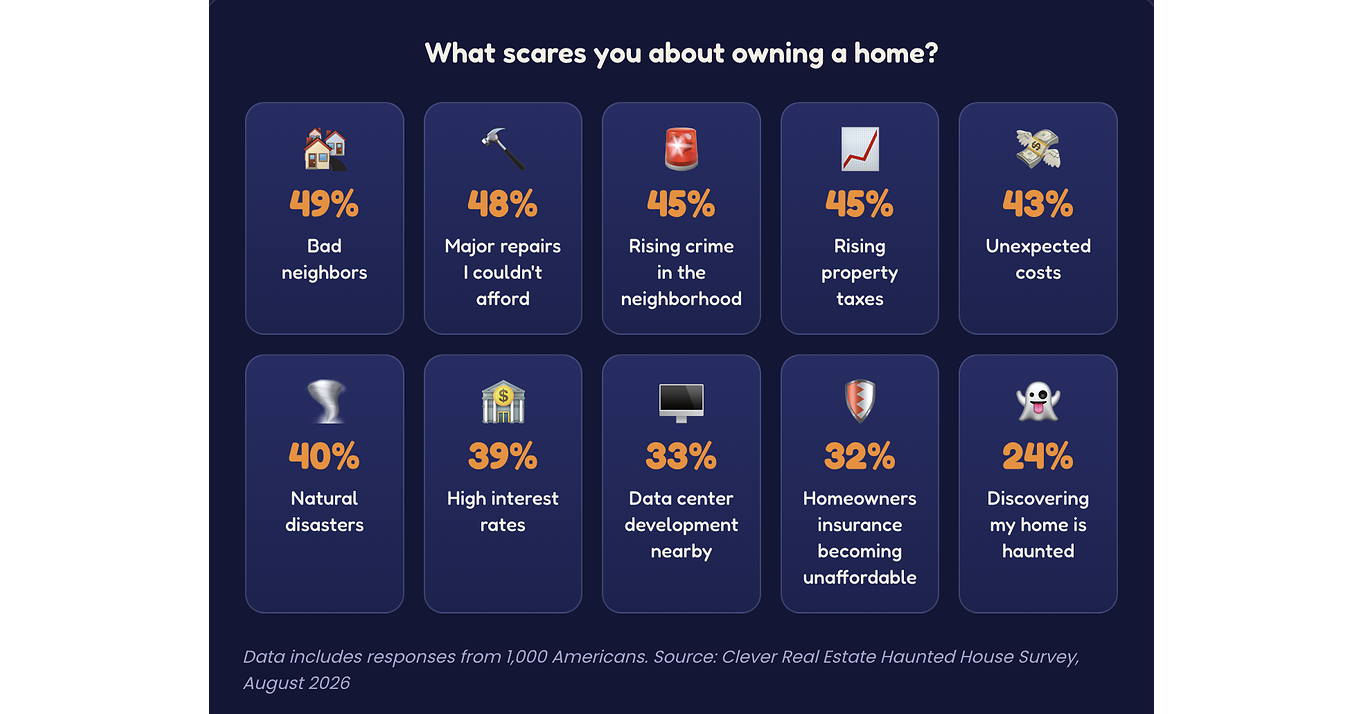
A Clever Real Estate survey found 54% of Americans would consider buying a home they knew was haunted, while 46% of potential buyers would offer below market value for one. Respondents were more concerned about home repair issues, bad neighbors, crime and property taxes than ghosts; 62% said a lower price could persuade them to buy. Only New York, New Jersey, Massachusetts and Minnesota have specific laws requiring disclosure of haunted homes.
Analysis
This is a low-signal survey, not evidence of changing home prices or completed transactions. Its useful read-through is that affordability and neighborhood quality appear to outweigh stigma: buyers may tolerate perceived nuisances when the price, financing, or location compensates them. That reinforces the housing market’s existing bifurcation—well-located, affordable inventory should remain more liquid, while homes carrying harder-to-price disamenities may require larger concessions. The survey does not quantify actual discounts, buyer behavior, or regional differences, so it cannot support a national valuation adjustment.
The more investable second-order issue is disclosure and reputational risk around property attributes. If buyers increasingly scrutinize nearby infrastructure or environmental conditions, brokers and listing platforms face pressure to standardize property-level disclosures; that could raise transaction friction and litigation exposure, while benefiting inspection and environmental due-diligence providers at the margin. But reported attitudes toward haunted homes are not a proxy for actual data-center or hazardous-site price impacts.
Near term, no trade: the Clever Real Estate survey is promotional and has no demonstrated earnings transmission to public companies. Over 1–3 months, watch transaction-level price concessions and days on market for properties near data centers or other locally contested infrastructure. Over 6–18 months, any durable impact depends on disclosure rules, litigation outcomes, and whether buyers translate stated preferences into bids. Contrarian point: the lower stated willingness to demand a discount versus last year could reflect survey noise or hypothetical answers, not improving buyer leverage. Falsify the affordability/location thesis if actual concessions and inventory rise broadly even in desirable neighborhoods.
AllMind Terminal
AI-powered research, real-time alerts, and portfolio analytics for institutional investors.
Request TrialMarket Sentiment
Overall Sentiment
neutral
Sentiment Score
0.00
Key Decisions for Investors
- No immediate position in housing or real-estate equities based on this survey; the source and hypothetical framing are too weak to establish a revenue or valuation catalyst.
- Set a watch item for transaction-level discounting and days-on-market data, segmented by proximity to data centers and other contested infrastructure. Treat stated survey preferences as unverified until they appear in actual comps.
- Monitor state disclosure requirements and litigation involving property conditions. A meaningful expansion could increase compliance and transaction costs for brokers and sellers, but the timing and financial exposure are not established here.
- Do not infer a broad demand recovery from willingness to accept stigmatized homes. Reassess only if affordability-sensitive buyer activity improves alongside completed-sale volumes and price concessions, rather than survey responses alone.
More News
- Budget 2026 speech
- Wendy's shares jump 15% as Nelson Peltz's Trian offers $1.4 billion to buy burger chain
- Federal Reserve issues FOMC statement
- Asian shares fall as Alphabet earnings miss drags Wall St futures lower
- Dollar steady after Fed hold leaves rate path murky
- Burnham’s government unveils its first UK budget: What to expect