
AutoFlight absolviert weltweit ersten Formationsflug mit 5 eVTOLs
Source: PR Newswire
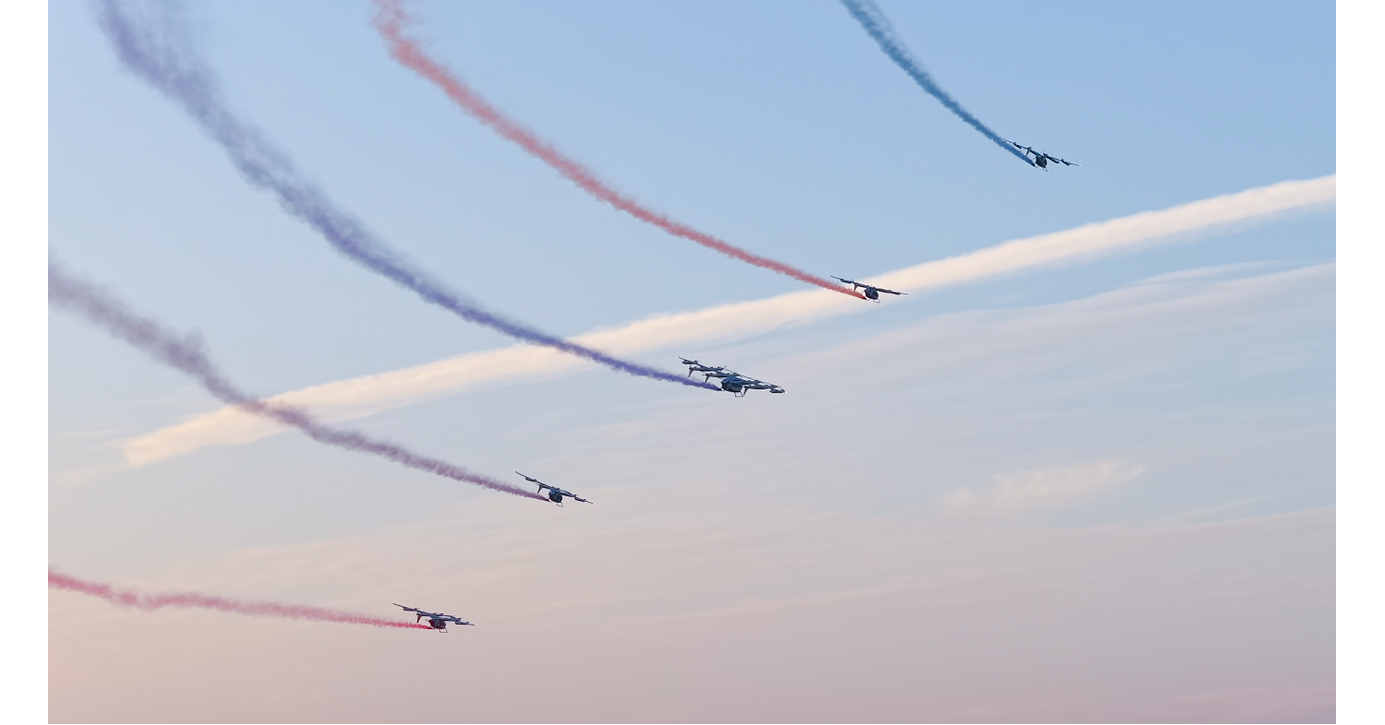
AutoFlight completed what it describes as the world’s first formation flight involving five eVTOL aircraft across two weight classes: one 5-tonne V5000 and four 2-tonne aircraft spanning three models. The fully autonomous flight lasted 47 minutes, with the lead V5000 covering more than 133 km; the formation maintained stable flight and safe separation despite strong winds. The demonstration advances AutoFlight’s multi-aircraft coordination capabilities, but the article reports no commercial deployment or financial results.
Analysis
The investable signal is a systems-integration milestone, not evidence of commercial readiness. If the capability carries into certified operations, coordinated autonomy could eventually raise aircraft utilization and reduce the need for pilots per aircraft—improving fleet economics across cargo and passenger routes. But a demonstration does not establish regulator-approved operating envelopes, dispatch reliability, communications resilience, insurance availability, or viable route-level costs. A multi-aircraft failure or loss of separation also creates correlated safety and reputational risk, so autonomy may add certification burden before it reduces operating expense.
Near term, the release is unlikely to justify repricing the broader eVTOL group on its own; it is company-reported, and the stated flight metrics do not establish repeatability or commercial performance. Over 1–3 months, look for independently verifiable regulatory progress, customer commitments, and repeat demonstrations under defined operating conditions. Over 6–18 months, the key test is whether autonomous coordination translates into certified service and better utilization—not merely more aircraft in a formation.
The contrarian point: investors may overvalue visible flight demonstrations while underweighting airspace integration, certification, and demand density. Conversely, if regulators accept scalable multi-aircraft operations, autonomy could become a differentiator that benefits operators with credible certification pathways, not just aircraft makers. AutoFlight’s corporate identity and any investable listing are not established by the supplied data; no direct security trade is supported here.
AllMind Terminal
AI-powered research, real-time alerts, and portfolio analytics for institutional investors.
Request TrialMarket Sentiment
Overall Sentiment
moderately positive
Sentiment Score
0.55
Key Decisions for Investors
- No event-driven trade: do not chase listed eVTOL comparables such as Joby, Archer, or EHang solely on this demonstration; the release does not establish a read-through to their certification or economics.
- Put AutoFlight on a watchlist rather than treating the announcement as a near-term revenue catalyst. Verify regulatory approvals, repeatability in adverse conditions, customer-funded deployments, and commercial utilization before underwriting operating leverage.
- Use a relative-value alert across eVTOL names if the group rallies on autonomy headlines without corresponding certification or order evidence; the thesis is falsified by sustained regulatory progress and disclosed operating data that demonstrate scalable, reliable service.
- Monitor airspace and safety rules, communications redundancy, and insurance terms as potential bottlenecks. These could delay the autonomy-driven cost benefit or make multi-aircraft operations uneconomic even if the technical demonstration is genuine.
More News
- Magnificent 7 loses $1 trillion. The most eye-popping stats from Thursday's tech stock plunge
- Tech stocks are suffering their biggest selloff since Covid, as investors see premature end to AI datacenter boom
- Wall Street’s best post-midterm rally in 44 years lasted just one day—then $3 trillion vanished as chip stocks plunged over AI fears
- AI stocks plunge after election, driving down US markets
- Iran says tankers struck in Hormuz amid fears of new US attack
- The Iran war has cost U.S. households nearly $2,000 each. New strikes could keep the bill climbing