
Coca-Cola vs. PepsiCo: Pepsi's Revenue Dwarfs Coke's, but This Is the Number to Watch
Source: fool.com
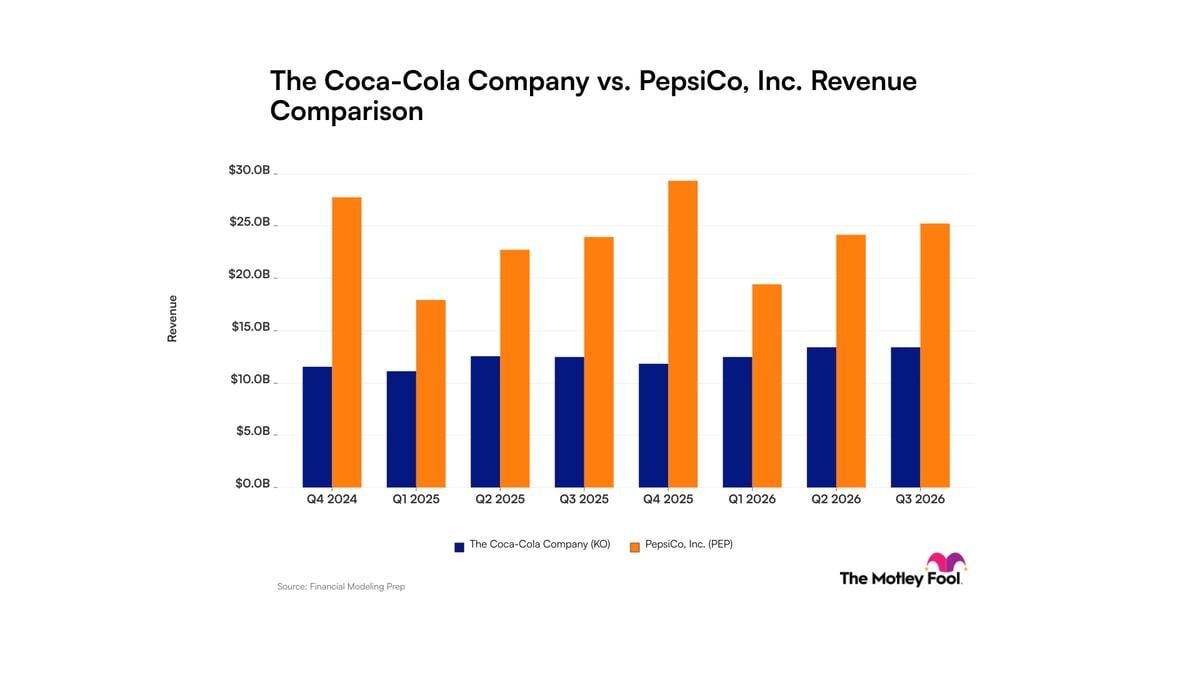
Coca-Cola shares have returned more than 40% in 2026, while PepsiCo is roughly flat year to date. PepsiCo cut its 2026 core EPS growth outlook to 1%–2% as North American beverage volumes fell modestly; KFC is also moving more than 3,700 U.S. restaurants from Pepsi to Coke by spring 2027, an account BofA values at about $500 million in annual sales and roughly 3% of PepsiCo sales. In Q3, operating margins were 33.4% for Coca-Cola and 16.9% for PepsiCo, both higher than a year earlier.
Analysis
The key question is whether large-chain wins signal durable share gains or merely contract-by-contract rotation. For KO, restaurant volume converts through concentrate sales and bottler distribution; the economics are not equivalent to capturing the restaurant’s full beverage revenue. Still, incremental volume may carry attractive economics in an asset-light system—verify through concentrate volumes and price/mix rather than account announcements alone. PEP’s retained Taco Bell relationship is a useful counterweight: customer decisions are not moving uniformly, and contract timing limits how quickly any one win or loss changes results.
Near term, PEP’s weaker North American beverage volumes and reduced outlook matter more than headline revenue scale. Over 1–3 months, watch volume, organic revenue, and operating-margin guidance for evidence that account churn is compounding rather than isolated. Over 6–18 months, broader chain conversions could support KO’s mix and undermine PEP’s beverage leverage, but execution, bottler capacity, and contract renewals determine the actual earnings impact. KO’s strong share performance raises the risk that good news is already priced in; without relative valuation data, avoid treating the operating story as a valuation signal. The data-breach investigation is a watch item, not yet a demonstrated financial impairment.
Contrarian read: PEP’s lower operating margin does not by itself make it the weaker equity if its valuation already discounts slower growth or if snacks stabilize results. Conversely, KO’s business-model advantage is real but does not immunize it from a sharp expectations reset. Falsify the relative-bear case on PEP if beverage volumes and guidance stabilize while margin expands; falsify the KO premium case if concentrate growth or margin trends weaken despite new accounts.
AllMind Terminal
AI-powered research, real-time alerts, and portfolio analytics for institutional investors.
Request TrialMarket Sentiment
Overall Sentiment
mixed
Sentiment Score
0.15
Ticker Sentiment
Key Decisions for Investors
- Consider a market-neutral KO-long/PEP-short pair only on a KO pullback or after confirming relative valuation is not stretched; the thesis is improving beverage-account momentum versus PEP’s volume and guidance pressure, not revenue size. Keep exposure modest because KO’s prior outperformance may have priced in much of the good news.
- Use the next earnings cycle to test the trade: track KO concentrate volume, price/mix and margin, alongside PEP North American beverage volume, organic growth and operating-margin guidance. Reduce or close the pair if PEP stabilizes while KO fails to convert account wins into reported volume or margin.
- Do not extrapolate announced restaurant transitions into immediate earnings. Verify the account rollout schedule, bottler participation, contract economics and any further chain conversions; treat additional wins or losses as catalysts only when they produce measurable reported volume changes.
- Keep the KO data-breach matter on an event watchlist rather than assigning a material earnings discount absent verified scope, remediation costs, customer impact or regulatory consequences.
More News
- NextDC shares surge 43% after Goodman, Digital Realty stake purchases
- Voters rebuff data centers in every ballot measure except one during the 2026 midterms
- Qualcomm issues disappointing earnings forecast as memory shortage weighs on smartphone sales
- ‘Seismic’ blue wave triggers the sinking of oil prices, energy stocks, and the chances of power permitting reform
- Softbank’s $5.4 bln takeover of ABB robotics unit blocked by China- FT
- Nifty Bounces Back to Beat All of Asia on Foreign Flows, Earnings