
Xense Robotics CEO Daolin Ma Publishes Bylined Article in the World Economic Forum
Source: PR Newswire
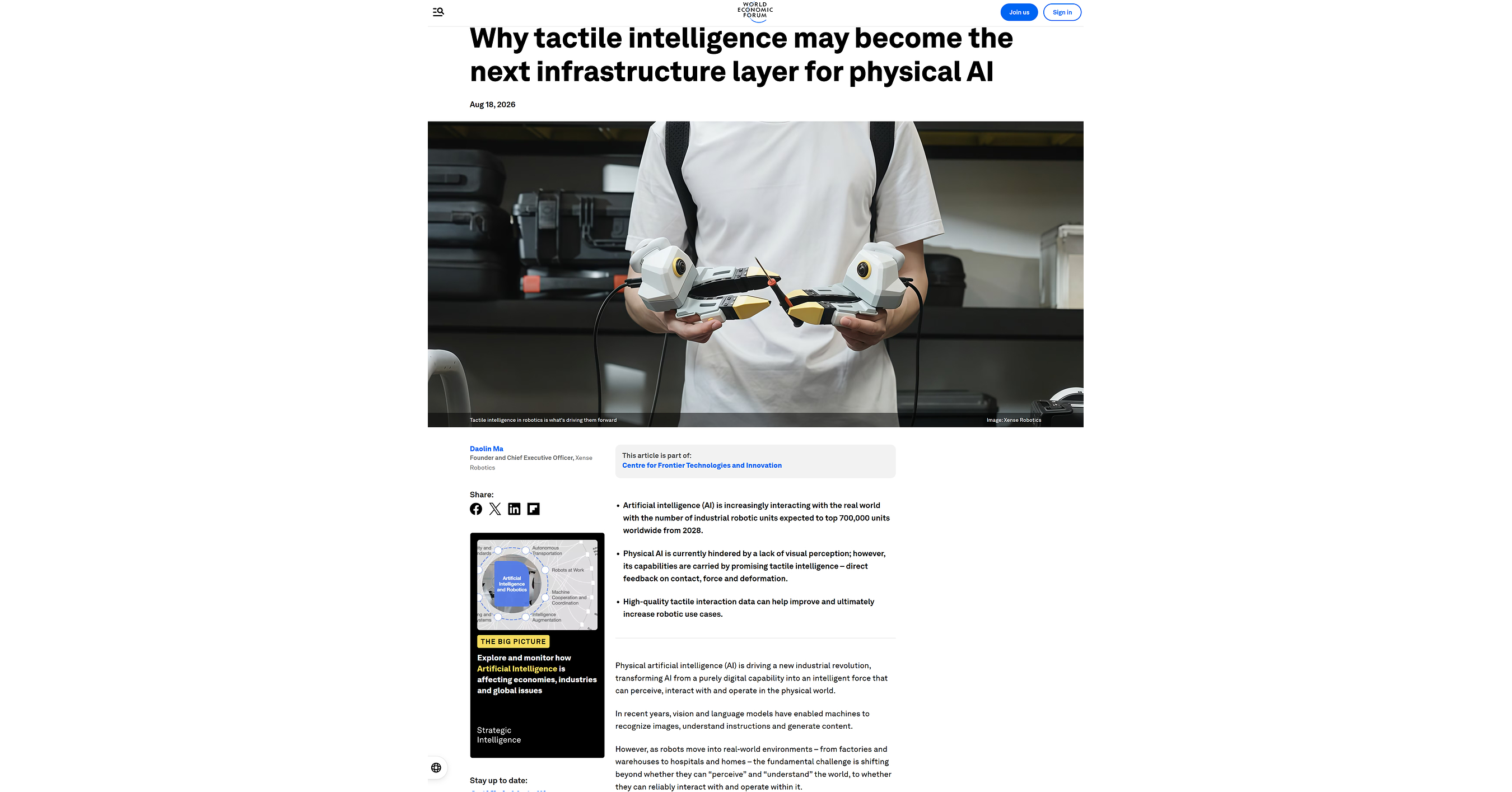
Xense Robotics CEO Daolin Ma published a World Economic Forum piece arguing that tactile intelligence could become the “next infrastructure layer” for physical AI, emphasizing reliable physical interaction via force/friction/material perception. The article highlights Xense’s platform—multimodal tactile sensors (XTac) and the VTLA foundation model integrating visual, tactile, language, and action—and claims deployment with 300+ leading companies, positioning the firm to accelerate Physical AI adoption. No financial figures or guidance changes were reported, making the near-term market impact likely limited.
Analysis
This is more of an ecosystem-signaling event than a monetization event. The real economic beneficiary of tactile intelligence is not the brand that publishes the thought piece, but the layer above it: robot OEMs and industrial integrators that can turn higher grasp reliability into lower warranty costs, higher uptime, and faster customer adoption. In the near term, that means any public-equity read-through is mostly narrative beta; the P&L impact likely stays muted until tactile sensing shows up in shipped systems, not demos.
For LI, the relevance is optionality rather than core earnings. If Li Auto can credibly associate itself with embodied-AI manufacturing or in-cabin/assembly robotics, it supports the market’s willingness to pay for a China tech-industrial multiple, but it does not change vehicle demand or margins in the next 1-2 quarters. LRLCY looks even more remote: a consumer brand partnership with a robotics startup is a marketing signal, not evidence of cost savings or revenue accretion. The more interesting second-order effect is competitive: tactile-data platforms could commoditize some of the advantage currently held by generalist vision-language model vendors if physical manipulation becomes the key bottleneck.
The contrarian view is that the market may be overpricing the speed of adoption. Tactile sensors, datasets, and model integration are still a systems-integration problem; the first real catalyst is not a keynote or byline, but a repeatable deployment that cuts pick-and-place error rates or labor cost enough to matter. Until then, this is mostly a private-markets signaling cycle, with public equities only seeing small sentiment spillover. What would falsify the bullish robotics thesis is a 2-3 quarter stretch with no evidence of real-world deployment wins, or any sign that tactile hardware remains too expensive / fragile for scale.
AllMind Terminal
AI-powered research, real-time alerts, and portfolio analytics for institutional investors.
Request TrialMarket Sentiment
Overall Sentiment
mildly positive
Sentiment Score
0.12
Ticker Sentiment
Key Decisions for Investors
- No aggressive trade on the article itself; treat as a watch item rather than a catalyst until a public deployment or revenue disclosure appears.
- Modest tactical long LI on any post-news weakness only if broader China tech sentiment is constructive; thesis is multiple support, not near-term EPS, so size should be small and time horizon 1-3 months.
- Avoid chasing LRLCY on the headline; the linkage is too indirect to justify multiple expansion without evidence of operational adoption or margin benefit.
- If TARS is the listed robotics/embodied-AI proxy in your universe, consider a small long versus a broader industrials basket over 1-3 months, but only on confirmation that tactile sensing is entering production rather than pilot programs.
- Set an alert for any follow-up showing shipped units, ARR, or repeat customer deployments from tactile-intelligence vendors; that is the real catalyst, and absence of it over 2-3 quarters is a bearish signal for the entire physical-AI theme.
More News
- Musk says Terrafab chip factory could outperform rivals despite challenges
- CBO chief warns it’s ‘probably not plausible’ that a strong economy alone can steady U.S. debt as 5%-6% growth is needed—more than Bessent’s 3% view
- Nvidia GPUs are everywhere. Here are the ways companies are accessing them
- Stocks saw new highs and big declines: How the volatile AI trade moved last week's market
- Will Warner Bros. kill Skydance — or will David Ellison kill Warner Bros?
- The world needs Ukraine’s grain. Its farmers are running out of reasons to plant