
BP Q3 2026 slides: net debt falls below target, portfolio reshapes
Source: Investing.com
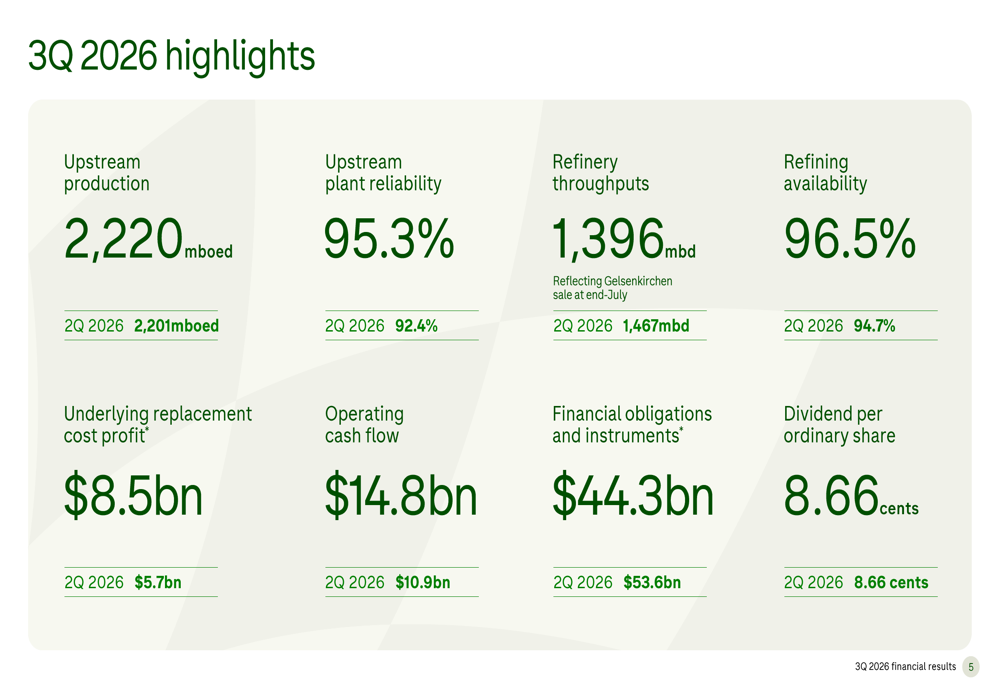
BP’s Q3 2026 underlying replacement cost profit rose 49% quarter over quarter to $8.5 billion, while net debt fell $8.4 billion to $13.9 billion, below its $14–18 billion target range. Results benefited from Brent averaging $97 per barrel and a $46.7-per-barrel refining indicator margin; the dividend remained unchanged at 8.66 cents per ordinary share. BP forecast lower Q4 production and refinery throughput, and shares fell 1.56% to $49.61 in after-hours trading.
Analysis
The key issue is earnings quality, not the headline deleveraging: BP’s quarter benefited from unusually strong refining/trading conditions, while Q4 guidance points to weaker downstream contribution, higher taxes and lower throughput. That makes the latest cash conversion a poor run-rate to capitalize. The balance-sheet improvement is real, but net debt below target should not be confused with a solved leverage problem: total obligations remain material, and the year-end reduction depends on roughly $7bn of divestment proceeds plus a working-capital release. Delays or weaker sale proceeds would expose the gap between reported progress and durable self-funded deleveraging.
Over 1–3 months, watch completion and cash receipts from announced disposals, Q4 refining margins, and whether operating cash flow holds up after the working-capital benefit fades. Over 6–18 months, portfolio simplification may lower volatility and support a better valuation, but lost asset earnings mean the rerating requires cost savings and reliable operations to replace them. The contrarian upside is that investors may be over-weighting the near-term earnings air pocket: lower debt and completed sales could reduce the risk premium. The counterpoint is that BP is near its recent high after a quarter supported by unusually favorable commodity and refining economics. A sustained fall in refining margins or a miss on disposal proceeds would falsify the constructive balance-sheet case.
AllMind Terminal
AI-powered research, real-time alerts, and portfolio analytics for institutional investors.
Request TrialMarket Sentiment
Overall Sentiment
mixed
Sentiment Score
0.15
Ticker Sentiment
Key Decisions for Investors
- Do not chase the quarter’s earnings strength. For a 1–3 month relative-value position, underweight BP versus a broad energy ETF such as XLE; the thesis is normalization of downstream earnings and BP-specific execution risk, not a bearish view on crude.
- Keep the underweight modest and reassess after Q4 results or material sale closings. Reduce it if divestment cash receipts arrive on schedule and BP maintains cash generation despite weaker refining conditions.
- Treat the $33–35bn year-end financial-obligations outlook as a catalyst with execution risk: track actual proceeds, working capital and capex against the assumptions. A material shortfall or delayed Castrol completion would strengthen the underweight; delivery would weaken it.
- For a longer horizon, keep BP on a watchlist rather than adding solely on the net-debt milestone. Seek evidence that lower debt is accompanied by repeatable operating cash flow and that cost savings offset earnings lost through disposals.
More News
- As Trump eyes new attack, Iran vows to retaliate beyond the Mideast and target financial assets, while oil markets brace for generational damage
- Why AI is boosting Meta's ad business while hurting Google search
- Binance sees outflows stabilising as exchange returns online after $6.3 billion heist
- Mediators continue US-Iran negotiations amid war rhetoric: What we know
- China’s top three airlines head for full-year losses as fuel costs weigh
- 2026 was meant to be the Philippines’ year—yet the country remains stuck in an ‘recurring cycle of underachievement’