
Southwest Airlines: Buy The Transformation Despite The Oil Shock
Source: seekingalpha.com
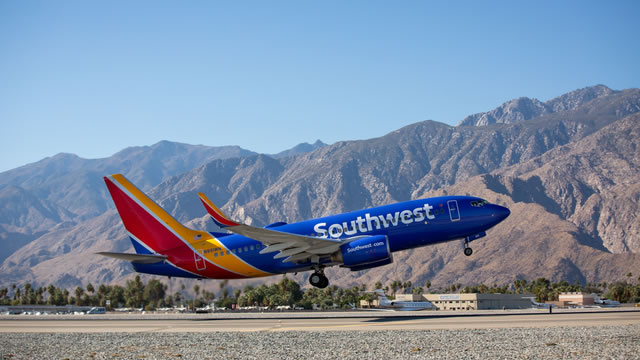
Southwest Airlines retains a buy rating as its commercial transformation and robust demand support a stronger earnings outlook despite higher fuel costs. Assigned seating, extra-legroom products and bag fees are projected to contribute more than $2 billion of EBIT in 2026, with additional gains anticipated in 2027. EBITDA is forecast to increase from $2.1 billion in 2025 to $5.0 billion in 2028, although elevated capital expenditures and transformation costs are expected to constrain free cash flow.
Analysis
The earnings revision opportunity is less about incremental ancillary revenue than whether LUV can close its structurally wide RASM gap versus DAL and UAL without surrendering its historical cost advantage. Assigned seating and premium-product monetization should improve yield management on high-load-factor flights, but it also adds boarding, IT, and customer-service complexity; any deterioration in aircraft turns would offset a meaningful portion of the benefit through lower asset utilization. The critical verification points are quarterly passenger revenue per available seat mile, ancillary revenue per passenger, and CASM-ex fuel—not management's aggregate profit target.
Near-term, higher jet fuel creates an asymmetric setup: LUV's commercial initiatives are gradual, while fuel pressure is immediate and difficult to pass through if domestic leisure fares soften after peak travel. DAL and UAL remain better positioned for a premium/international demand environment, so a broad airline rally would likely favor those carriers until LUV demonstrates sustained unit-revenue outperformance. Conversely, a decline in crude or jet cracks would disproportionately improve the visibility of LUV's margin-recovery narrative over the next one to three quarters.
The consensus may underappreciate the brand risk from unbundling a historically simple customer proposition. Fee adoption can lift revenue initially but may weaken loyalty among price-sensitive customers and give ULCCs such as F9 and SAVE's post-restructuring business an opening on bare-fare comparisons. Over six to eighteen months, the key structural upside is multiple expansion if LUV proves it can monetize its customer base while restoring free-cash-flow conversion; the key downside is that higher capital intensity leaves equity value dependent on EBITDA rather than cash generation.
AllMind Terminal
AI-powered research, real-time alerts, and portfolio analytics for institutional investors.
Request TrialMarket Sentiment
Overall Sentiment
mildly positive
Sentiment Score
0.38
Ticker Sentiment
Key Decisions for Investors
- Do not chase LUV on the transformation narrative before the next two earnings reports validate sequential RASM improvement and stable CASM-ex fuel. Initiate a long only if commercial revenue gains exceed implementation-related cost growth; reduce or exit if unit-cost guidance rises or operational metrics deteriorate.
- Use a three- to six-month relative-value expression: long LUV / short JETS only after confirmation of improving domestic unit revenue. This isolates company-specific execution from fuel and macro shocks; invalidate if LUV underperforms JETS by 10% following an earnings report despite positive revenue-per-passenger data.
- For a cleaner sector allocation while LUV execution remains unproven, favor DAL or UAL over LUV for the next one to three months. Their premium and international mix provides better fare resilience if domestic leisure demand normalizes, while LUV has greater dependence on successful implementation.
- Set a crude and jet-fuel alert rather than buying airline downside immediately: a sustained oil rally coupled with weakening domestic fares is the adverse combination for LUV. If that develops, consider a short LUV versus long XLE hedge; the thesis is falsified by successful fare pass-through and maintained unit-cost guidance.
More News
- Iran vows 'painful' retaliation as Trump piles on pressure ahead of UN General Assembly meeting
- Oil falls as crude flows remain 'surprisingly strong'
- US Diesel Tops $6.50 a Gallon as Wars Worsen Global Fuels Crunch
- Here are the 3 big things we're watching in the stock market this week
- Tech leads shares higher in Asia, oil eases
- China slows humanoid robot IPO rush as hype outruns reality