
2027 Saver's Match Could Accelerate Latino Participation in Retirement Investing, Finhabits Report Finds
Source: PR Newswire
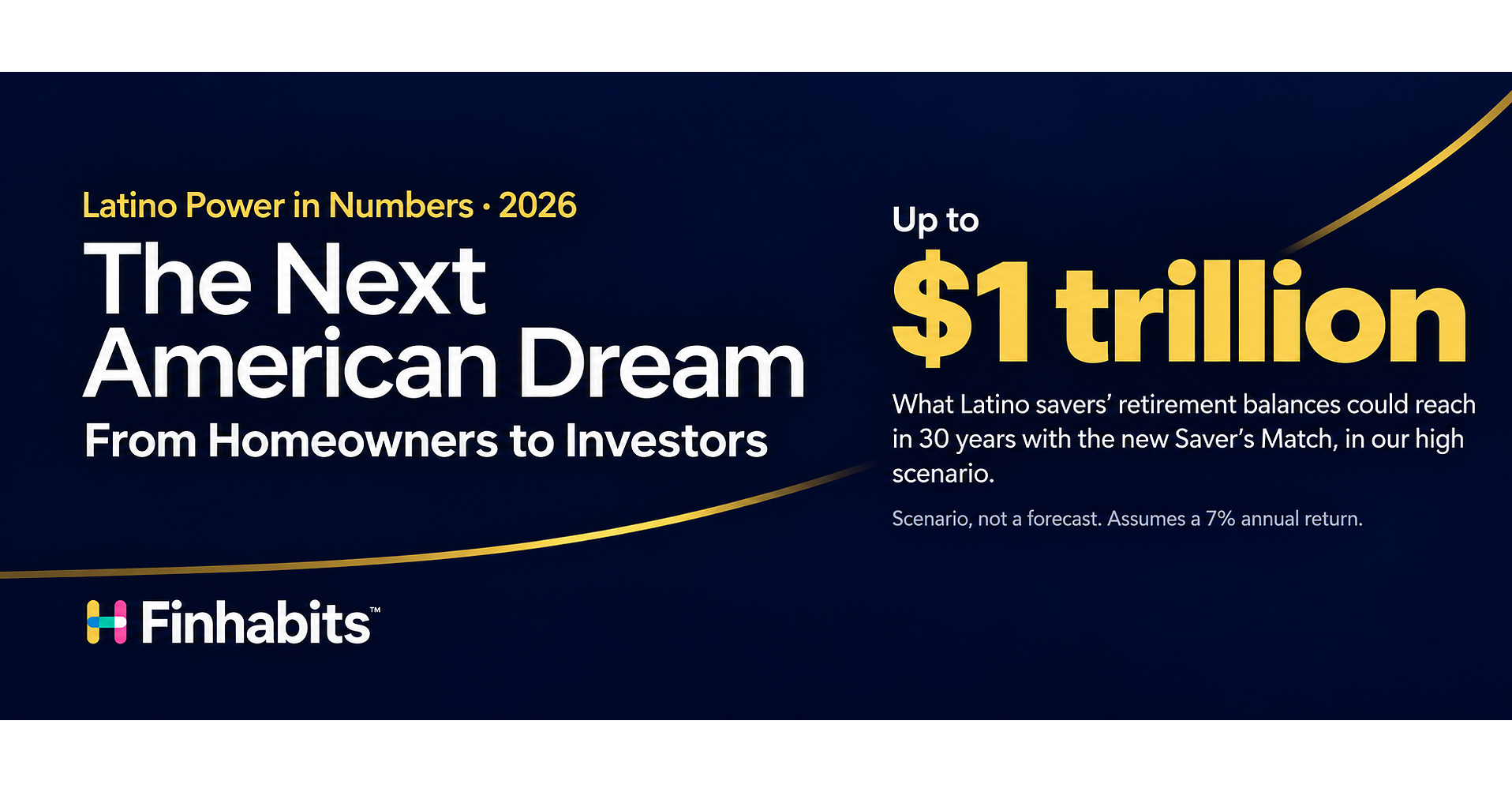
Finhabits estimates that 13.6 million Latino adults may be income-eligible for the federal Saver’s Match, scheduled to begin in 2027. Its illustrative scenarios—not forecasts—estimate that contributions of $1,600 annually, an average match of about 32%, participation rates of 21%–35% and a 7% annual return could produce $615 billion to $1.02 trillion in retirement balances over 30 years. The report highlights a potential opportunity for providers to expand Latino retirement-investing participation through accessible, culturally relevant guidance.
Analysis
The investable question is not the modeled long-run balance pool; it is who can turn a federal incentive into low-cost, persistent contributions. The likely advantage accrues to providers already embedded in employer payroll and retirement-plan workflows: distribution and enrollment matter more than investment performance or Spanish-language marketing alone. Payroll/recordkeeping platforms such as ADP and Paychex, and established retirement providers such as Fidelity, Vanguard and Empower, are plausible beneficiaries if the program is operationally easy to integrate. Finhabits’ report is a company-sponsored opportunity case, not evidence of customer acquisition, funded accounts or incremental revenue; the large 30-year balance scenarios are highly sensitive to participation, contribution persistence and the assumed return.
Near term, this is not a material earnings catalyst for diversified public firms. In the 1–3 months before implementation planning, watch for final program rules, employer/plan adoption and enrollment plumbing. Over 6–18 months, the key test is whether eligible workers make sustained, incremental contributions rather than shifting money from other savings or opening dormant accounts. A less obvious risk is unit economics: small balances may require substantial education and servicing, so asset growth need not translate into attractive margins. The thesis weakens if implementation is delayed, eligibility or claiming proves cumbersome, or early account data show low contribution persistence. No direct trade is justified from this report alone.
AllMind Terminal
AI-powered research, real-time alerts, and portfolio analytics for institutional investors.
Request TrialMarket Sentiment
Overall Sentiment
mildly positive
Sentiment Score
0.25
Key Decisions for Investors
- Do not buy a fintech or asset-manager basket on the report. Treat the estimates as a policy-driven adoption hypothesis, not company guidance or near-term addressable revenue.
- Add ADP, Paychex and established retirement recordkeepers to a watchlist as potential distribution beneficiaries; revisit only after disclosures or credible data show plan integrations, funded-account conversion and recurring contributions.
- Set a 2027 policy-monitoring catalyst: verify final eligibility, match delivery mechanics, employer participation and implementation timing. A delay or material administrative friction would invalidate the near-term adoption case.
- For any later position, require evidence of incremental, persistent contributions and acceptable acquisition/service costs; headline account openings or cumulative modeled balances alone are insufficient.
More News
- US fines Bank of America $1.2bn for money laundering, sanctions violations
- South Korean carmaker Hyundai plans 'strategic' investment of $15.5 billion in India by 2032
- Applied Materials’ $5 billion AI lab aims to cut chip development time in half—and restore Silicon Valley’s edge
- IMF says higher bond yields underscore urgency of fiscal consolidation
- Wells Fargo CFO on Earnings, Deals, Consumer Strength
- Bank of America hit with more than $1.2 billion in penalties over money-laundering violations