
Durabook annonce le Z14I-DX3 Rugged Mobile Laptop, un ordinateur portable à triple écran, de classe station de travail, doté de l'IA en périphérie
Source: PR Newswire
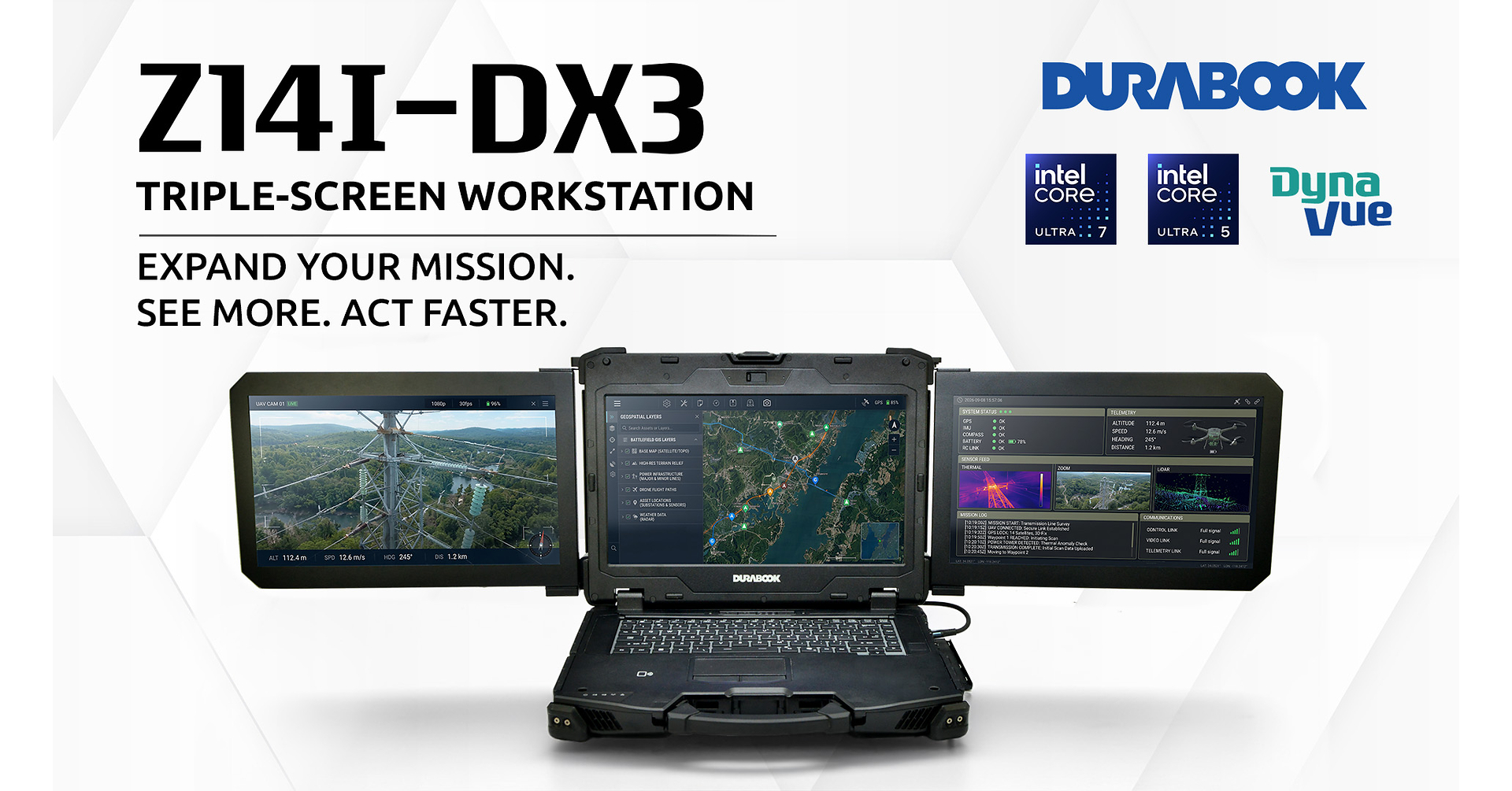
Durabook launched the Z14I-DX3, a rugged 14-inch triple-Full-HD-screen mobile workstation for edge AI applications in defense, public safety, utilities, energy and industrial field operations. Configurable with NVIDIA RTX 5000 Ada graphics delivering up to 682 TOPS, the system combines Intel Core Ultra processors, AI Boost NPU acceleration, Wi-Fi 7, optional 5G, and dual tool-less removable NVMe SSDs. The product is available immediately, although the announcement provides no pricing, sales outlook, or financial impact.
Analysis
This is not a material revenue event for INTC or NVDA, but it reinforces a useful demand signal: ruggedized edge deployments are prioritizing local inference, connectivity redundancy and legacy-interface integration over cloud-dependent workflows. NVDA benefits disproportionately where customers require real-time vision/sensor fusion, because discrete GPU attach rates rise sharply once workloads exceed an NPU’s practical throughput; however, the addressable unit volumes are niche and procurement cycles in defense, utilities and public safety are typically 6-18 months.
The more investable second-order read is on edge-AI mix. Durable field systems have high switching costs, long replacement cycles and qualification requirements, supporting professional GPU pricing and software ecosystem stickiness for NVDA. Intel’s inclusion is strategically positive for Core Ultra/NPU adoption, but it also highlights the risk that the NPU is the control-plane compute while the higher-value inference workload remains on a discrete NVIDIA accelerator; this is favorable for NVDA content per system, not necessarily for INTC margin capture.
Near term, the announcement should not alter estimates or justify a directional trade. Over 1-3 months, watch disclosures from rugged-computing peers and defense integrators for evidence that edge-AI configurations are becoming standard rather than bespoke. Over 6-18 months, a broad shift from centralized cloud analytics toward offline-capable mission systems would favor NVDA’s RTX professional stack and networking/software attach, while increasing competitive pressure on Intel to convert NPU design wins into measurable platform ASP and share gains.
Contrarian risk: claimed TOPS is a marketing metric rather than proof of deployed workload demand. If government and industrial customers standardize on lower-power integrated AI systems, or if procurement budgets prioritize drones, sensors and communications over operator workstations, discrete-GPU penetration could disappoint despite strong demonstrations. Thesis falsification for NVDA is weak professional/embedded GPU revenue or commentary on lower Ada workstation attach rates; for INTC, it is continued Client Computing Group ASP/share erosion despite rising AI-PC design-win claims.
AllMind Terminal
AI-powered research, real-time alerts, and portfolio analytics for institutional investors.
Request TrialMarket Sentiment
Overall Sentiment
moderately positive
Sentiment Score
0.42
Ticker Sentiment
Key Decisions for Investors
- No event-driven position on this launch; its low expected financial impact makes a single-product reaction in INTC or NVDA non-actionable.
- Maintain NVDA as the cleaner 6-18 month edge-AI beneficiary, but use incremental exposure only on broader enterprise/industrial GPU-data confirmation; monitor RTX professional/embedded revenue commentary and defense-system integrator orders. Reduce if workstation/professional GPU demand weakens for two consecutive reporting periods.
- Use a relative-value watch: long NVDA / short INTC only if upcoming earnings show NVDA professional or edge inference strength while Intel’s client ASP and unit share fail to improve. This isolates discrete-accelerator content gains from the broader AI-PC narrative; avoid entry without segment-level evidence.
- Track defense and industrial integrators such as LMT, NOC, RTX and GD for edge-compute, ISR, unmanned-systems and field-modernization contract awards over the next 1-3 months. Award language specifying onboard AI/video analytics would validate a broader hardware demand cycle; absent contract evidence, treat this as product marketing rather than a capex signal.
More News
- Wall Street’s Nasdaq hits all-time high as AI frenzy gathers pace
- Data-Center Bet Makes ESDS One of India’s Best New Listings
- Meta is breaking out after introducing Muse AI agent. Where the stock is going, according to the charts
- Anthropic in talks to lease 1 gigawatt from Stream Data Centers- The Information
- Meta's quick success with Muse puts consumers back in the driver's seat of the AI trade
- Alibaba says it built the ‘most powerful AI chip in China’ as the country races to catch up with the U.S.
From AllMind Research
- Anthropic IPO Preview: Valuation, Timing, and What to Watch
- Shein After the IPO: Venue, Valuation, and What Must Be Proved
- What AI Research Tools Should a Small Hedge Fund Buy First?
- AI Tools for CFA Charterholders: An Evidence Standard
- Weekly Update: Unstructured Data Search, Ask AI, and Advanced Futures Data