
Public Sector Digital Sovereignty Priorities Stall Between Assessment and Execution, Says Info-Tech Research Group
Source: PR Newswire
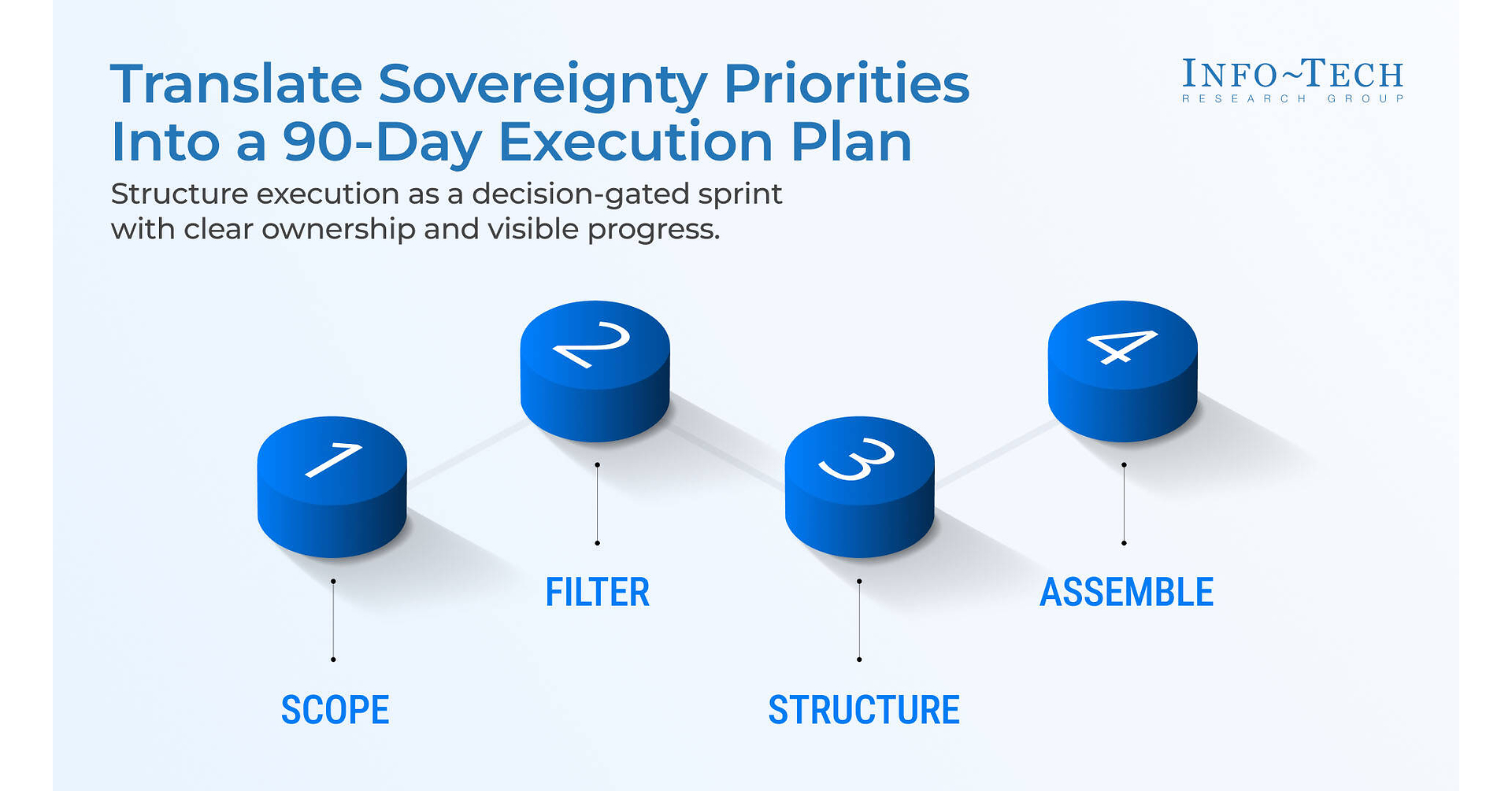
The article highlights a persistent “assessment-to-execution gap” in public-sector digital sovereignty programs, citing six obstacles that can stall operational delivery within a fiscal quarter. Info-Tech Research Group proposes a decision-gated 90-day execution sprint (4 phases) to produce 5–8 actionable recommendations with named owners, governance artifacts, and a risk register. Overall, the news is more diagnostic and process-focused than market-moving, implying limited near-term impact beyond IT/security planning priorities.
Analysis
This reads more like a procurement methodology note than a spend catalyst, so the near-term market impact is likely negligible. The only investable signal is second-order: public-sector buyers that already have sovereignty mandates may shift budget toward domestic integrators, compliance-heavy cybersecurity, and sovereign cloud architectures, while large global cloud vendors face more friction in jurisdictions where data residency and vendor concentration are politically sensitive. The economic effect is not new demand so much as budget reallocation from generic transformation projects into audit, governance, and migration work.
The key distinction is timing: 0-3 months, almost no price action unless an agency converts this into an RFP or contract award; 3-12 months, a modest tailwind for names with federal/provincial exposure and implementation services; 12-18 months, potential margin pressure for hyperscalers and multinational software vendors if sovereignty requirements harden into vendor mandates. A failed thesis would look like budget stagnation, delayed authorization, or a return to centralized cloud procurement because the operational cost of localization outweighs the political benefit. In that case, this becomes advisory noise rather than a demand signal.
Contrarian view: the market may be too eager to extrapolate 'sovereignty' into a multi-year capex cycle. Most public agencies already know their exposure; the bottleneck is execution capacity, not awareness, which means advisory firms can monetize the planning layer but hardware/software revenue may not follow unless there is visible procurement conversion. For the names provided, there is no identifiable direct earnings sensitivity here, so I would not force a trade absent contract evidence.
AllMind Terminal
AI-powered research, real-time alerts, and portfolio analytics for institutional investors.
Request TrialMarket Sentiment
Overall Sentiment
mildly negative
Sentiment Score
-0.15
Key Decisions for Investors
- No direct position in FCD.UN.TO or TCHC on this item; treat as a watchlist event only until a funded procurement cycle or contract award appears.
- If looking for a thematic basket, prefer a modest long in public-sector implementers with sovereignty/compliance exposure (e.g., ACN, BAH, LDOS) versus a short basket of hyperscaler proxies with concentrated government workloads (MSFT, AMZN) only if sovereign-cloud RFPs begin to convert.
- Use this as an alert, not a trade: monitor 1-3 month catalysts such as federal/provincial budget releases, RFPs, and contract awards; without those, expected alpha is low and theta on any options structure would likely be wasted.
- Falsifier for any bullish sovereignty thesis: no increase in public-sector procurement activity within the next quarter, or agencies re-centralizing around standard cloud frameworks despite the new planning language.
More News
- Indonesia stocks suffer biggest daily slump since 1998 as MSCI weighs downgrade
- One Singapore ship was sunk, but here's why others are still transiting the Strait of Hormuz
- Order to limit Starshield for Ukraine came from inside White House: Reuters reports
- Taiwan to curb AI chip sales to China for more U.S. alignment- Bloomberg
- BOE Chief Says Energy Shock Delays 2% Inflation Target
- The Tesla Roadster 2 Is Here—and It Flies