
Workers Choose People Over AI at Hiring's Most Critical Moments, New Staffmark Group Research Finds
Source: PR Newswire
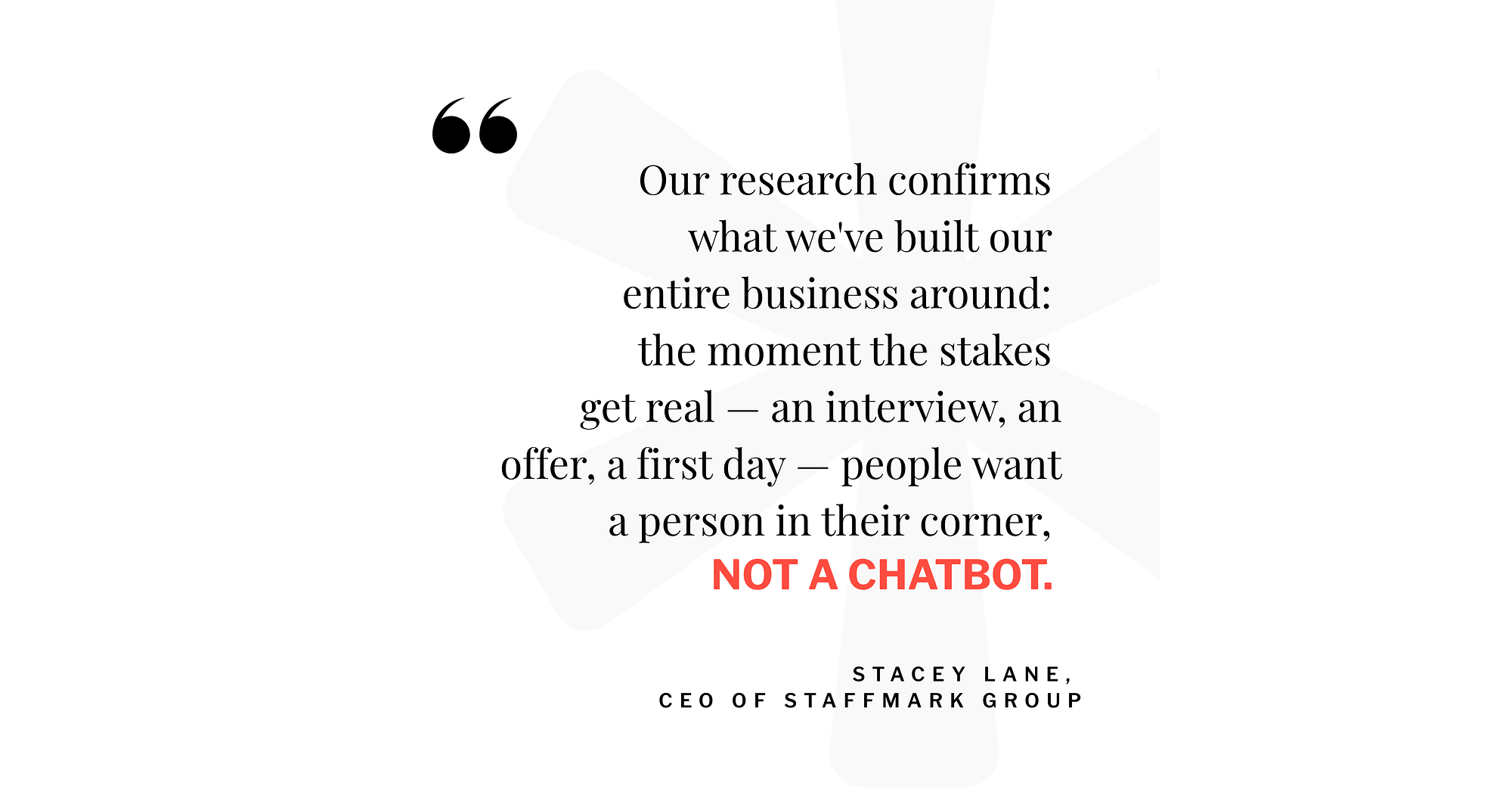
Staffmark Group’s 2026 Heart of Work Index (n=3,746 workers) scores overall preferred hiring experience at 71/100—indicating most job seekers still want human involvement despite AI-enabled processes. Human-led preference is highest post-application/pre-interview (70% human-led vs 30% tech-led), while only 18% of workers report digital-only preferences; additionally, just 29% believe AI will replace their job within a year. The survey flags a retention paradox: 85% are satisfied, but 57% expect to look for a new job within six months (rising to 69% in office/admin and 63% in transportation).
Analysis
This reads as mildly constructive for traditional staffing and recruiting intermediaries, but not as a near-term earnings catalyst. The key market mechanism is conversion: if candidates want human help at the late-stage funnel, firms with recruiter relationships, branch density, and rapid redeployment should retain pricing power versus self-serve job boards and purely automated matching tools. That supports RCRUY and U.S. staffing proxies like MAN, KELYA, RHI, and KFY more than software-first hiring platforms, because the value pool shifts toward higher-touch placement and away from low-margin lead generation.
The more important signal is turnover, not AI fear. Burnout-driven churn implies recurring requisition volume over the next 1-3 quarters, especially in office/admin and transportation where fill-speed matters and temp labor is the cheapest way to preserve service levels. If that shows up in billings, staffing stocks can re-rate on operating leverage even with flat top-line growth. The opposite risk is that employers use AI to reduce headcount instead of improve hiring conversion, which would cap volume and leave this as a sentiment-only story.
Contrarian takeaway: consensus may be overpricing a fast replacement of recruiters by software. The data actually implies AI is most useful at the top of funnel, which can lower cost per hire but also raise recruiter productivity; that is margin-accretive for incumbents, not necessarily revenue-accretive. The thesis breaks if monthly staffing demand rolls over or if management commentary in the next 1-2 quarters shows fewer open orders, weaker conversion, or slower time-to-fill despite these preferences.
AllMind Terminal
AI-powered research, real-time alerts, and portfolio analytics for institutional investors.
Request TrialMarket Sentiment
Overall Sentiment
neutral
Sentiment Score
0.05
Ticker Sentiment
Key Decisions for Investors
- RCRUY: maintain a tactical long bias into the next earnings cycle, but only on a pullback; the setup is about margin mix and retention of high-touch placements, not immediate revenue acceleration. Falsifier: no improvement in North America staffing billings or order flow over the next 1-2 quarters.
- MAN / KELYA / RHI basket: consider a relative-value long versus software-heavy hiring or job-marketplace names if labor churn data stays elevated; target 3-6 months, with upside from operating leverage if fill rates stabilize.
- Avoid shorting staffing stocks solely on the AI-replacement narrative; this survey argues for augmentation, not disintermediation. If you need a bearish hedge, express it against lower-touch recruiting platforms rather than the staffing intermediaries themselves.
- Set an alert for monthly staffing indicators and management commentary on time-to-fill and temp demand; if those metrics deteriorate despite the survey, step out quickly because the thesis is sentiment-driven rather than fundamental.
More News
- Christine Lagarde: IMFC Statement
- Palantir patient data tech rejected by many NHS trusts in England
- Why did CoreWeave stock get crushed this week? Look to this corner of the debt market for clues
- Diageo's Toxic Spill Hits Pristine River in Scottish Whisky Country
- AI stock sell-off ramps up over debt-fueled data center spending fears: ‘Full-blown crisis of confidence'
- Wall Street Anxiety Spreads as AI Rout Meets $110 Oil Shock