
Hitachi deepens commitment to U.S. manufacturing with $528 million Mississippi transformer factory
Source: PR Newswire
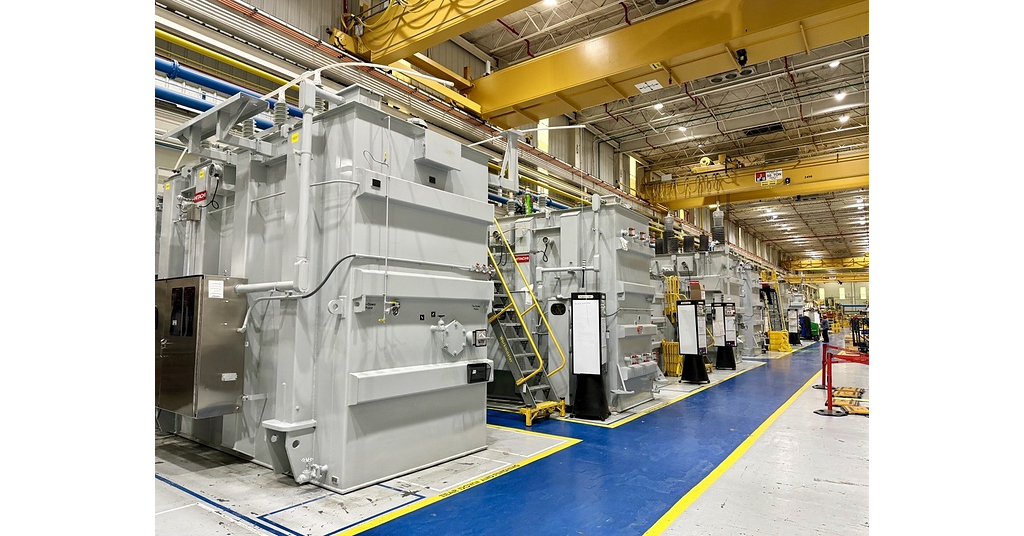
Hitachi Energy will invest $528 million in a new transformer factory in Gallman, Mississippi, its largest single U.S. investment, creating more than 700 jobs and more than doubling local transformer production capacity. The project, with construction beginning late 2026 and production scheduled for 2029, anchors roughly $1.5 billion of U.S. manufacturing expansion including projects in Virginia, Tennessee and Pennsylvania. The investments are intended to address accelerating power-grid demand from data centers, industrial electrification and advanced manufacturing while strengthening domestic transformer supply chains.
Analysis
The investable signal is less Hitachi earnings accretion than confirmation that transformer scarcity is durable enough to justify multi-year, capital-intensive localization. New capacity does not arrive until 2029, so the announcement should not materially ease current lead-time pricing; incumbent North American suppliers can preserve elevated backlog conversion and pricing through at least the next 24-30 months. ABBN is not the clean beneficiary because Hitachi Energy is separately held, but ABB's Electrification and Motion businesses benefit indirectly as grid projects move from constrained equipment procurement into broader substation, automation and power-quality spend.
The second-order constraint shifts upstream: electrical steel, copper, insulation systems, bushings and specialized transformer labor may tighten before finished-transformer availability improves. Cleveland-Cliffs (CLF), a domestic electrical-steel proxy, and copper exposure via FCX could benefit if grid capex broadens, although copper is a much less pure expression and remains China-sensitive. Eaton (ETN), Hubbell (HUBB), GE Vernova (GEV) and Quanta Services (PWR) are higher-quality listed ways to express the same utility/data-center interconnection bottleneck; PWR is especially levered to physical deployment once equipment slots are secured.
Consensus may wrongly treat announced factory capacity as near-term supply relief and rotate away from grid beneficiaries. The more relevant risk is demand timing: a data-center financing slowdown, utility rate-case resistance, or delayed interconnection approvals can defer orders well before 2029. For ABBN, require evidence that electrification orders and margin remain resilient rather than assuming a direct benefit; its valuation response should be limited absent order-book disclosures or incremental U.S. content gains.
Over 6-18 months, domestic manufacturing expansion raises the probability that utilities and hyperscalers can commit to larger projects, supporting equipment and EPC demand rather than merely redistributing market share. Falsification would be falling transformer lead times, order cancellations at ETN/GEV/HUBB, or utility capex guidance cuts in upcoming earnings cycles; a sustained decline in copper and electrical-equipment order indices would be an earlier warning.
AllMind Terminal
AI-powered research, real-time alerts, and portfolio analytics for institutional investors.
Request TrialMarket Sentiment
Overall Sentiment
moderately positive
Sentiment Score
0.68
Key Decisions for Investors
- Maintain/enter long ETN and HUBB on 3-6 month weakness rather than chasing the announcement; target a 10-15% relative upside versus industrials if bookings and price realization remain intact. Exit or reduce on two consecutive quarters of order deceleration or explicit lead-time normalization.
- Pair long PWR / short XLI over a 6-12 month horizon: PWR captures grid buildout labor and execution demand while the diversified industrial ETF has less direct pricing power. Risk is utility/hyperscaler project deferral; stop if PWR backlog growth turns negative or the spread underperforms by 10%.
- Use GEV as a watch-to-buy on any post-earnings pullback, contingent on disclosed grid-equipment backlog and service-order strength. A 2029 supply response supports its near-term scarcity value, but avoid adding if management signals material transformer delivery improvement before 2028.
- Do not initiate ABBN solely on this development. Set an alert for Electrification order growth, U.S. localization announcements, and segment-margin guidance; buy only if these establish a measurable earnings bridge, since Hitachi Energy's capacity expansion is competitive rather than directly consolidated.
- For a higher-beta materials sleeve, size CLF modestly as a 6-18 month domestic grid-buildout optionality trade, not a core transformer thesis. The trade is invalidated by weak electrical-steel shipment data, falling steel spreads, or a broader industrial recession.
More News
- Grab aims for 'next level' in financial services with purchase of buy-now pay-later platform Atome
- Saudi coalition says Houthi drone destroyed near Mecca
- Iran war increasing inflation, straining US munitions: congressional report
- Attacks on Saudi oil expose Iraqi PM’s struggle to control armed factions
- China's AI leaders keep quiet despite U.S. 'publicity' on tech risks
- Oil prices dip as U.S. inventory build offsets M.East supply jitters