
Nudge Security Unveils Adaptive Risk Management to Track How SaaS and AI Risk Changes as Usage Evolves After Approval
Source: PR Newswire
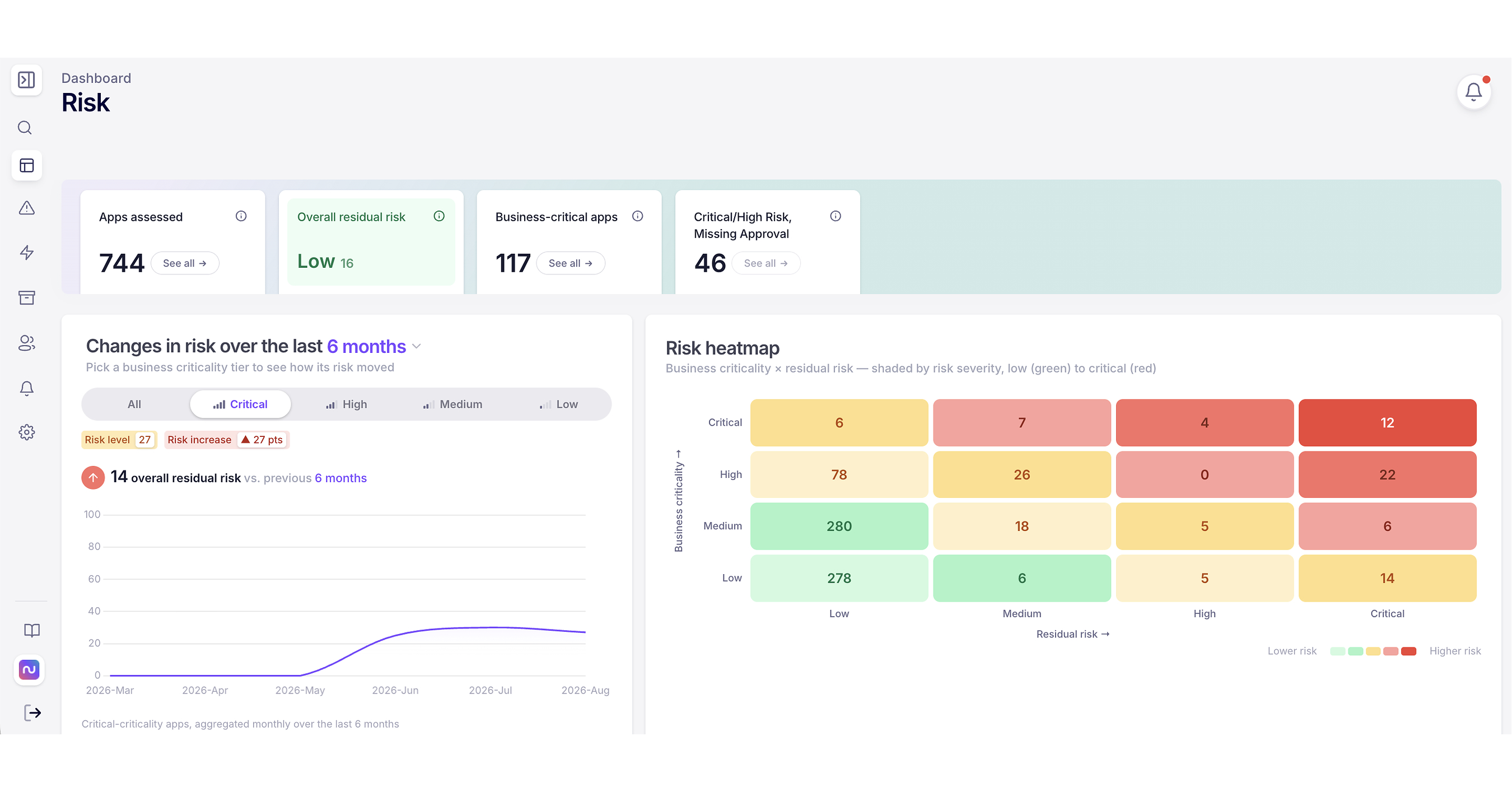
Nudge Security launched Adaptive Risk Management, a SaaS and AI governance capability that continuously recalculates application risk using more than 30 factors as usage, access and vendor security conditions change. The company says strong compensating controls such as SSO and MFA can reduce an application's residual risk by up to 60%, addressing an environment where organizations manage only 30–40% of SaaS and AI tools in use. The launch targets growing third-party exposure, which Verizon data cited by Nudge indicates rose 60% year over year to represent 48% of breaches.
Analysis
This is not a MELI fundamental catalyst: a customer reference does not establish contract size, deployment breadth, or measurable reduction in Mercado Libre's loss exposure. The relevant read-through is that AI-agent permissions and unmanaged OAuth connections are becoming a budget line adjacent to identity, SaaS posture management, and third-party risk—not a standalone security category with proven public-market revenue sensitivity yet. Near term, the announcement is immaterial for MELI and VZ; the release is principally a competitive-positioning claim from a private vendor.
Over 6-18 months, continuous access-governance demand should favor platforms already embedded in endpoint, identity, and cloud-security workflows. PANW can bundle SaaS-security controls into broader platform consolidations, while CRWD and ZS benefit where customers treat unmanaged applications as endpoint- or zero-trust-policy failures; OKTA is a more direct beneficiary if remediation translates into higher SSO/MFA adoption. The second-order risk for point SaaS-security vendors is that buyers may prefer remediation inside incumbent identity/security suites rather than add another dashboard, pressuring standalone pricing and retention.
The contrarian view is that expanding AI-tool inventories may increase discovery counts without proportionate spend: security teams can identify more exposure but still defer remediation until a high-profile incident or audit deadline. A durable spend signal would be disclosed attach-rate expansion in PANW Prisma/identity offerings, CRWD module adoption, ZS net-retention stabilization, or OKTA large-customer growth—not customer testimonials. This thesis is falsified if enterprise security budgets remain flat and platform vendors show no incremental SaaS/identity module uptake through the next two reporting cycles.
AllMind Terminal
AI-powered research, real-time alerts, and portfolio analytics for institutional investors.
Request TrialMarket Sentiment
Overall Sentiment
mildly positive
Sentiment Score
0.32
Ticker Sentiment
Key Decisions for Investors
- No directional action in MELI or VZ on this release; require evidence of a material contract, operating-cost impact, or disclosed security incident before assigning an earnings impact.
- Place PANW, CRWD, ZS, and OKTA on a 1-3 month earnings-call watchlist for quantified AI-agent, SaaS-governance, OAuth, or identity-remediation demand. Treat explicit module attach-rate acceleration as a positive catalyst rather than extrapolating from private-vendor claims.
- If the cybersecurity group sells off on macro risk while PANW reports platform-security billings resilience, consider a 6-12 month long PANW versus short HACK ETF pair; the intended payoff is platform share gain, with exit if PANW billings/guidance miss or remaining-performance-obligation growth decelerates materially.
- For OKTA, wait for confirmation that large-customer growth and dollar-based net retention have stabilized before initiating exposure. The upside is identity remediation becoming the default response to unmanaged SaaS access; the key downside is customers consolidating identity controls into Microsoft, which would invalidate the rerating case.
More News
- ‘This revolution is happening in years, not decades’: Verizon CEO Dan Schulman sees AGI within 18 months—and a century of progress in a decade
- South Korea’s exports hit record high on AI boom
- Asian stocks dip, bonds in focus after torrid September
- RAM supply set to worsen, says Micron, as CEO celebrates ‘much higher’ prices
- Tencent leases 100,000 chips from Oracle for $7 bln- FT
- Asia stocks rise on chipmaker gains, soft U.S. inflation; Nikkei outperforms