
AI Companies Brace for New Unknowns After Democrats’ Win
Source: Bloomberg
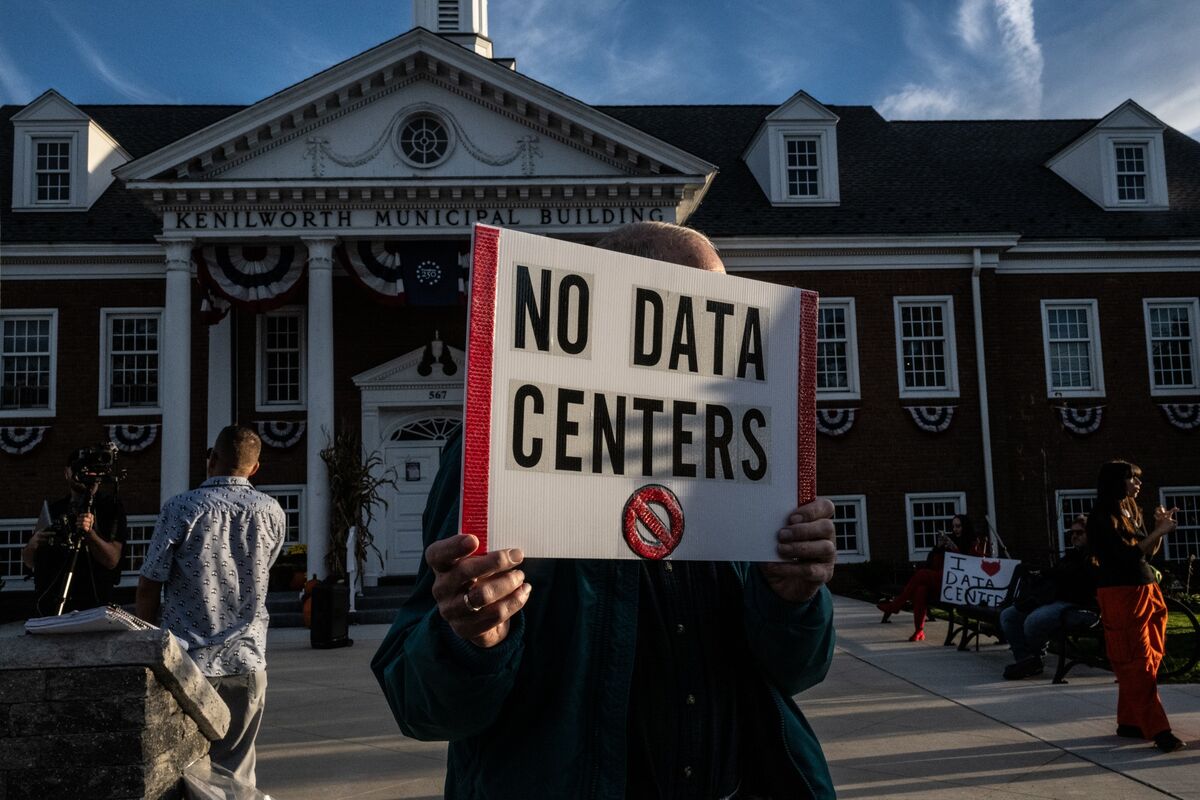
The Democrats’ midterm-election win is described as potentially adding momentum to efforts to regulate AI and restrict data centers. The article frames these developments as new challenges for AI companies but provides no specific proposals, affected companies, or financial estimates.
Analysis
Treat this as a policy-risk scenario, not yet a change in cash flows: an election result does not itself constrain permits, power access, or model deployment. The nearer-term transmission is a higher risk premium for projects whose economics depend on rapid data-center buildout, especially where local approval and grid interconnection are already gating items. If restrictions materialize, the impact is asymmetric: developers and smaller AI firms with fewer locations or less capacity to absorb compliance costs are more exposed; large cloud platforms may gain share through compliance scale, but are not insulated if power procurement or siting is constrained. Utilities and grid-equipment suppliers are not automatic winners—delayed projects can defer orders, while tighter capacity could improve pricing only where regulated returns and approvals allow it.
Over days, the headline may pressure AI-infrastructure sentiment without changing earnings. Over 1–3 months, watch proposed federal and state bills, permitting actions, and hyperscaler capex commentary; local rules could matter before broad federal legislation. Over 6–18 months, sustained limits on power and siting could shift AI workloads toward utilization improvements, existing facilities, and regions with spare capacity. The contrarian point: policy attention may increase compliance costs but also entrench incumbents by raising barriers to entry; the article provides no evidence that enforceable restrictions or project-level economics have changed. Reassess if proposals advance into binding rules or companies revise capacity plans; fade the risk premium if proposals stall and capex guidance remains intact.
AllMind Terminal
AI-powered research, real-time alerts, and portfolio analytics for institutional investors.
Request TrialMarket Sentiment
Overall Sentiment
mildly negative
Sentiment Score
-0.20
Key Decisions for Investors
- No headline-driven outright short: the article gives no bill text, jurisdiction, implementation timetable, or affected-project data. Keep AI-infrastructure exposure sized for policy volatility rather than assuming a broad earnings reset.
- For the next 1–3 months, favor a relative-risk screen: compare diversified cloud platforms with smaller AI and data-center developers, and trim the latter only where filings show concentrated exposure to delayed permits, interconnection queues, or a single region. Verify those exposures before initiating a pair.
- Track state and local permitting decisions, grid-interconnection timelines, and hyperscaler capex guidance as catalysts. A binding restriction or a project cancellation is a stronger signal than political rhetoric; stalled proposals and unchanged capacity plans would falsify the bearish near-term thesis.
- Avoid treating utilities or power-equipment suppliers as automatic hedges. Confirm backlog conversion, order cancellations, rate-case outcomes, and whether constrained power raises realized returns before adding exposure.
More News
- Magnificent 7 loses $1 trillion. The most eye-popping stats from Thursday's tech stock plunge
- Tech stocks are suffering their biggest selloff since Covid, as investors see premature end to AI datacenter boom
- Wall Street’s best post-midterm rally in 44 years lasted just one day—then $3 trillion vanished as chip stocks plunged over AI fears
- How Wall Street's postelection rally got obliterated — and what's next
- Elon Musk's Tesla and SpaceX lose over $420 billion in combined market cap after midterms
- AI stocks plunge after election, driving down US markets
From AllMind Research
- AllMind Platform Feature Updates - Fall 2026
- AI Credit Covenant Monitoring: From Clause to Review
- AI-Led Expert Interviews vs. Transcript Libraries
- Augmented Intelligence: AllMind, Elevate Human Judgement With an Accessible, Powerful, Data-Driven Financial AI Toolkit
- Choosing an AI Copilot for Equity Research