
OMNICOM MEDIA WAS AWARDED $3.3 BILLION IN NEW BILLINGS IN H1 2026, MORE THAN ANY OTHER GLOBAL MEDIA GROUP
Source: PR Newswire
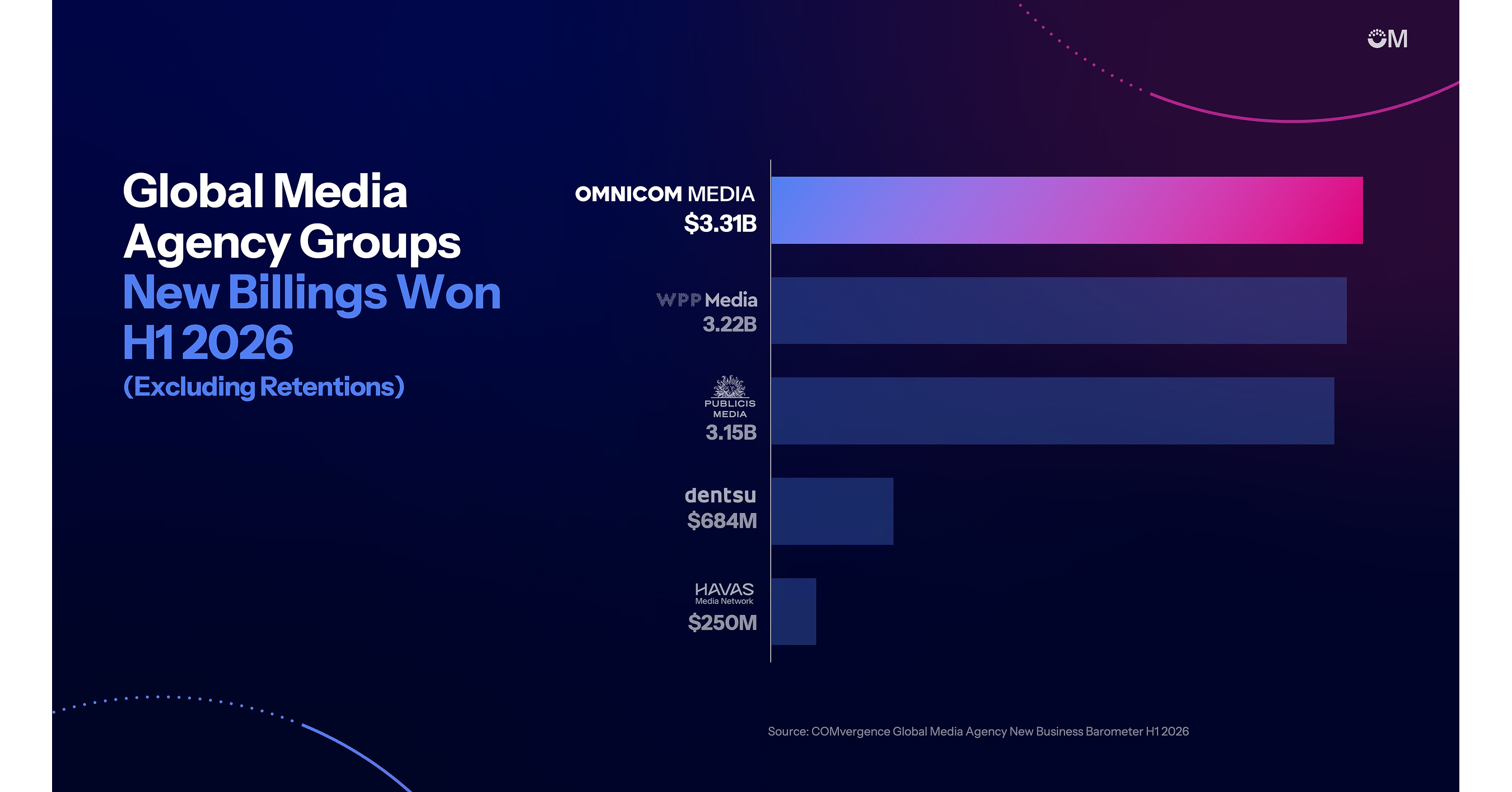
Omnicom Media secured $3.3 billion of new billings in H1 2026, the highest among global media management groups, and generated $3.15 billion in total new business after losses and retentions. PHD ranked No. 1 globally in both total and net new business, while PHD, Hearts United and Initiative held the top three positions in net new business. The results, supported by wins including Adidas, IBM, Roku and Royal Caribbean, indicate strong commercial momentum following Omnicom's acquisition of IPG and bolster its positioning around data, identity, AI and technology capabilities.
Analysis
The signal is directionally constructive for OMC, but headline billings are a poor proxy for earnings: media spend largely passes through to publishers, while the investable variables are fee yield, implementation timing, and whether wins displace lower-margin legacy accounts. The more important read-through is that scaled identity, commerce, and measurement assets may be improving OMC's pricing power and reducing client concentration risk during post-acquisition integration. Confirmation should appear in 1-3 months through organic-revenue guidance, media-margin progression, and restructuring-cost containment rather than additional award announcements.
Competitive pressure is most acute for WPP and, to a lesser degree, Publicis (PUB.PA): clients consolidating media, data, and commerce assignments increase the cost of maintaining subscale agency networks. Publicis remains the higher-quality competitor because its data assets and balance sheet give it capacity to defend accounts through pricing, so the cleaner relative hedge is OMC versus WPP rather than an outright anti-Publicis position. Publishers and platforms such as ROKU and NFLX may gain modestly if agency-led optimization redirects budgets toward measurable connected-TV inventory, but individual advertiser-account changes are immaterial to their consolidated revenue.
Consensus may over-credit the announcement as immediate revenue acceleration. Agency transitions commonly have staggered start dates, and aggressive win volume can initially dilute margins through transition staffing, rebates, and client-specific technology spending; a weak retention or margin print would negate the strategic narrative. The 6-18 month upside rests on realizing duplicated-cost savings and cross-selling data/commerce services into the combined client base, while a failure to lift fee-based revenue faster than payroll and technology costs would turn scale into a multiple-compression risk.
AllMind Terminal
AI-powered research, real-time alerts, and portfolio analytics for institutional investors.
Request TrialMarket Sentiment
Overall Sentiment
moderately positive
Sentiment Score
0.62
Ticker Sentiment
Key Decisions for Investors
- Maintain a modest long OMC only on confirmation at the next earnings release: add if organic revenue growth and operating-margin guidance are raised or maintained while integration costs decline. Treat this as a 6-12 month integration/market-share thesis, not a trade on reported billings; exit on a guidance cut or evidence of material account-transition losses.
- Consider a 3-6 month pair trade long OMC / short WPP, sized beta-neutral, if relative performance has not already repriced the gap. The thesis is share consolidation and higher fixed-cost leverage at WPP; stop out if WPP reports superior net-new-business retention or OMC's margin falls despite claimed scale benefits.
- Do not establish directional longs in ROKU or NFLX solely on this development. Set an alert for connected-TV ad-revenue acceleration and agency commentary on incremental CTV allocation; only then consider ROKU as the higher-beta expression, with platform ad-load and macro ad-spending weakness as key risks.
- Monitor OMC disclosures for net revenue from acquired accounts, fee take rate, client start dates, and retention of inherited IPG business. Absence of these metrics, or rising restructuring and technology expense without margin conversion, is a reason to reduce exposure rather than extrapolate reported billings.
More News
- Asia stocks rise tracking U.S. tech rally; Trump-Xi meeting eyed
- Paramount clears the last major hurdle to buying Warner Bros. Discovery by settling the lawsuit brought by 12 states
- Why Intel, Arm, and Other AI Chip Stocks Soared Today
- Johnson & Johnson May Offload Its Orthopedics Unit for $20 Billion -- and Investors Shouldn't Miss What That Could Signal
- President Donald Trump Just Admonished the Fed for "Doing the Wrong Thing" on Interest Rates, but Ignores the 2 Biggest Inflation Catalysts
- Market Indexes Rally as Oil Retreats and Chip Stocks Surge