
Firma Nordic wprowadza brzegową sztuczną inteligencję do urządzeń Wi-Fi zasilanych z baterii, uzyskując dwudziestokrotnie niższy pobór mocy w trybie czuwania dzięki nowej serii nRF71
Source: PR Newswire
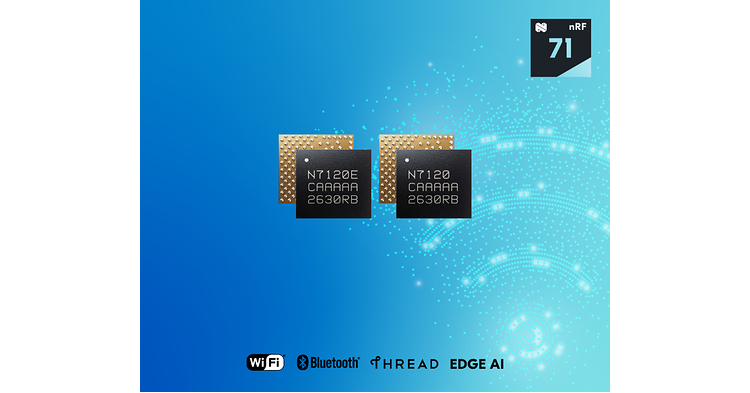
Nordic Semiconductor announced the nRF71 series, combining low-power Wi-Fi, Bluetooth LE, Thread and on-device AI; the company says standby power use is up to 20 times lower than in its current-generation nRF70 Wi-Fi products. The Axon NPU can run machine-learning models 10–17 times faster than a 256 MHz Arm Cortex-M33 CPU alone. The first chips, nRF7120 and nRF7120E, have 4 MB of nonvolatile memory and 1 MB of user-accessible RAM; the nRF7120 supports dual-band Wi-Fi 6, while the nRF7120E adds tri-band Wi-Fi 6E and an Axon NPU. Samples are available to selected customers.
Analysis
The commercial opportunity is real but further out than the announcement’s language implies. A lower standby draw does not establish multi-year battery life: Wi-Fi transmit duty cycle, cloud usage, radio coexistence, and the customer’s full-system design will determine field performance. Likewise, an NPU speed comparison against the CPU alone does not establish model accuracy, energy per inference, or usable workload size. Those are the proof points that convert the launch into design wins.
If customers can remove a separate connectivity or AI component, NOD could gain silicon content per device and make its software/tooling ecosystem harder to displace. The second-order risk runs the other way: easier battery-powered Wi-Fi may expand the market while intensifying price competition with established connectivity and MCU vendors such as Espressif, Silicon Labs, Texas Instruments, and Qualcomm. Their exposure depends on actual socket displacement, not the feature list.
Near term, selected-customer samples offer limited evidence of revenue; a headline-driven share move could outrun the information. Over 1–3 months, demonstrations and customer validation matter more than launch claims. Over 6–18 months, qualification, production availability, and repeat design wins determine whether this changes NOD’s growth or product mix. No valuation, customer commitments, or production schedule is supplied, so the announcement alone does not support a durable earnings upgrade.
AllMind Terminal
AI-powered research, real-time alerts, and portfolio analytics for institutional investors.
Request TrialMarket Sentiment
Overall Sentiment
moderately positive
Sentiment Score
0.40
Ticker Sentiment
Key Decisions for Investors
- Do not chase the launch headline. Treat NOD as a watch/conditional long: add only after evidence of named or quantified production design wins, production timing, and customer validation of whole-device power consumption.
- Track three verification items in upcoming company updates: nRF71 sample-to-production timing, design-win conversion, and whether customers can replace separate components without sacrificing battery life or connectivity performance.
- Falsify the thesis if sampling fails to progress to production over the next 6–18 months, if customer testing shows the standby advantage does not translate into materially lower system power, or if management indicates weak adoption or pricing pressure.
- For competitive monitoring, watch product announcements and customer wins from Espressif, Silicon Labs, Texas Instruments, and Qualcomm; displacement of multi-chip designs would support NOD’s opportunity, while comparable integrated alternatives would weaken differentiation.
More News
- AMD stock jumps 7% on earnings as data center revenue nearly doubles
- Marvell-Lumentum Deal Puts Optical Networking at the Center of the AI Boom
- Marvell Technology could plunge on latest multibillion-dollar acquisition
- AI Inference Startup Fal Raises Capital at $16 Billion Valuation
- AMD rides data center riches to ‘largest and most profitable’ quarter in history
- AMD’s OpenAI, Meta chip deals trigger $1 billion quarterly charge