
Swiss Refocus Army on Defense as Global Security Deteriorates
Source: Bloomberg
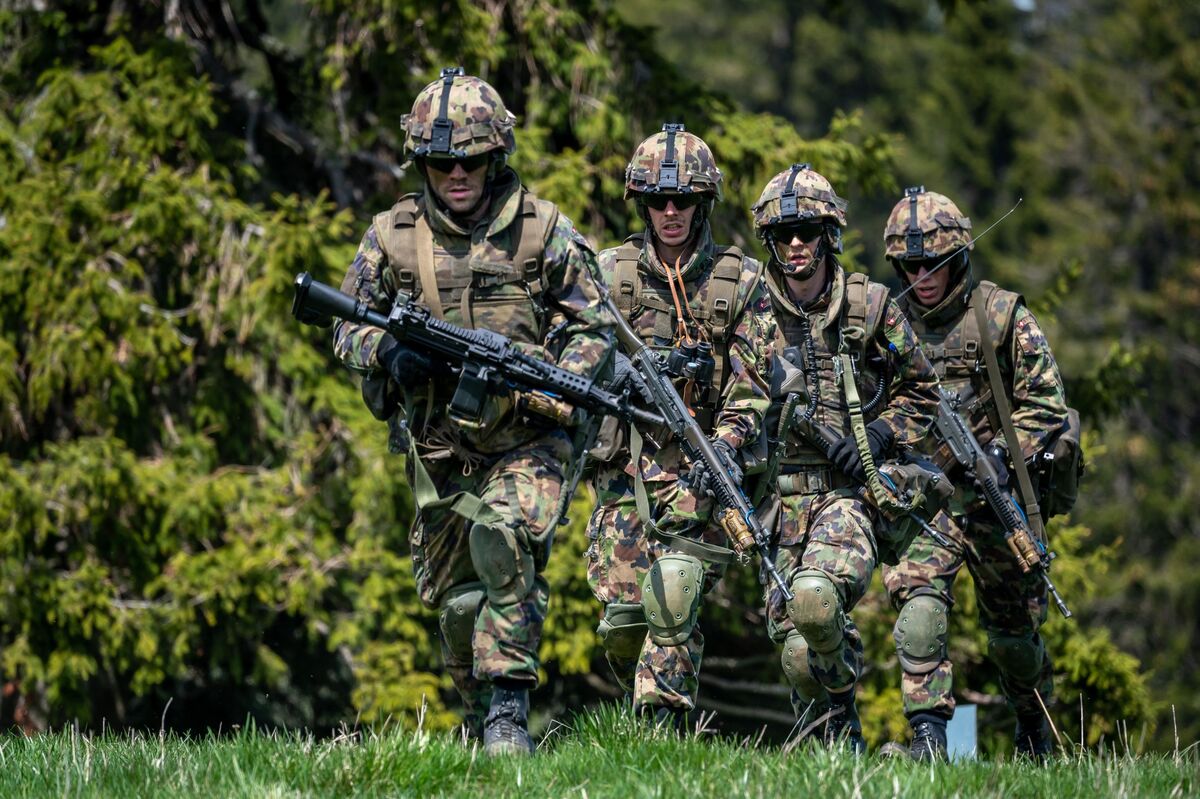
Switzerland approved a new military command structure to shift its armed forces from a training and peacekeeping orientation toward an operational force focused on domestic defense. The government is also strengthening protections against espionage and sabotage, reflecting a deterioration in the global security environment. The move is strategically significant for European defense preparedness but is unlikely to have broad immediate market impact.
Analysis
The investable implication is less a Switzerland-specific revenue event than incremental validation of Europe’s shift from expeditionary capability toward territorial defense, resilience and infrastructure protection. That mix favors short-cycle demand for air defense, sensors, secure communications, electronic warfare and cyber hardening over large naval-platform programs. Rheinmetall (RHM.DE), Hensoldt (HAG.DE), Saab (SAAB-B.ST), Thales (HO.PA) and Leonardo (LDO.IM) have greater exposure to these categories than BAE Systems (BA.L) or Airbus (AIR.PA).
Near-term market impact should be limited: without a funded procurement envelope or accelerated delivery schedule, this is not sufficient to revise earnings estimates. Over 1-3 months, the catalyst is whether Switzerland converts the organizational change into supplemental appropriations, readiness targets, ammunition inventories, air-defense orders or critical-infrastructure contracts. A broader European pattern of domestic-defense mandates also raises the probability that defense spending shifts from politically discretionary capex to recurring readiness and sustainment budgets, supporting higher medium-term valuation floors for continental defense primes.
The underappreciated offset is Swiss procurement friction. Neutrality, domestic political processes and restrictive re-export rules can favor locally controlled suppliers and limit direct revenue capture by foreign primes; this is a reason not to extrapolate a large order cycle from the announcement. The more actionable second-order beneficiary could be cybersecurity and secure-network vendors, since sabotage protection spending can be deployed faster than major weapons procurement, though contract visibility remains insufficient for a standalone cyber trade.
AllMind Terminal
AI-powered research, real-time alerts, and portfolio analytics for institutional investors.
Request TrialMarket Sentiment
Overall Sentiment
mildly negative
Sentiment Score
-0.25
Key Decisions for Investors
- No standalone Swiss-event position before a funded procurement plan; set alerts for parliamentary budget approvals, named air-defense/sensor tenders, or readiness inventory targets over the next 1-3 months.
- Use weakness to add a 6-12 month European territorial-defense basket: long RHM.DE, HAG.DE and SAAB-B.ST, sized as a basket rather than a single-name trade. The thesis is strongest if order intake and backlog conversion remain above consensus; reduce if 2026 guidance implies margins are being diluted by capacity expansion or fixed-price execution.
- Prefer HAG.DE and Thales (HO.PA) over broad defense exposure for the infrastructure-protection angle: sensors, electronic warfare, secure communications and cyber have shorter procurement cycles than armored platforms. Falsifier: no incremental European surveillance/air-defense awards by mid-2027 or evidence that civil-infrastructure spending is captured primarily by private IT vendors.
- Avoid chasing a sharp sector-wide rally on this headline. If European defense multiples expand without corresponding order-book upgrades, hedge the basket with a short position in a broad European industrial ETF such as EXH1.DE, limiting exposure to a risk-on reversal and procurement-delay risk.
More News
- Saudi Arabia intercepts missiles and drones as fighting with Houthis rages
- France’s latest debt warning describes a country where governance is breaking down — and even doing too little, too late is barely possible
- Israelis hold final rally against Netanyahu ahead of what may be the most consequential election in the country’s history
- Brookfield to open Qatar office as it expands Middle East operations
- First Russian diesel tanker heads to New York after Trump's deal with Putin to lower fuel prices
- Saudi Arabia intercepts drones and missiles as fighting with Yemen’s Houthis continues