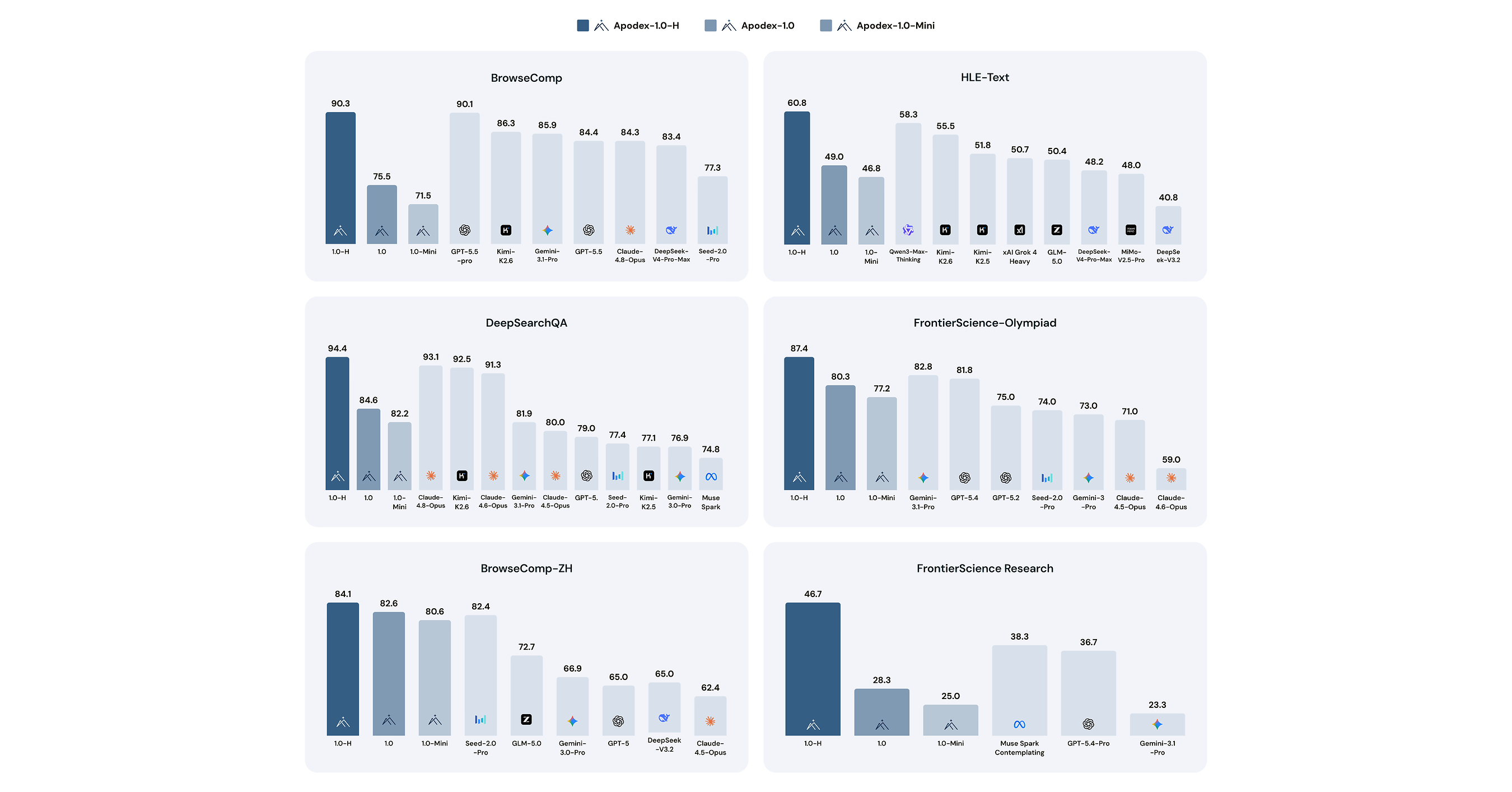
Apodex launched the Apodex Frontier Program, granting selected research institutions and deep-tech startups up to $100,000/month in compute credits plus full access to its heavy-duty AI solver (Discover Mode) and dedicated engineering support with a 3-hour SLA. The program includes access to Apodex-1.0-H, described as coordinating up to 150 sub-agents over 15,000 steps to verify evidence behind research outputs, with claims of outperformance on deep-research benchmarks. Overall, it’s a supportive capability/partnership expansion, but unlikely to move markets broadly beyond incremental AI ecosystem impact.
This is more a distribution and training-data grab than a revenue event. A free, credit-heavy research program is a customer acquisition subsidy that can seed lock-in if users build workflows around the solver, but it also signals that monetization is not yet strong enough to rely on organic pull-through. In the near term, the biggest beneficiary is Apodex’s model flywheel; the biggest risk is that benchmark superiority does not translate into durable paid usage once the free credits roll off.
For public markets, the second-order read-through is modestly positive for compute demand if these multi-agent workflows actually get adopted: heavy verification loops are exactly the kind of use case that burns inference and orchestration capacity. That favors infrastructure names with scarce high-end GPU supply and cheap power, while it pressures app-layer AI vendors whose differentiation is mostly “better answers” rather than workflow embedding. If adoption is real, the competitive pressure lands first on research tooling, not on consumer chat assistants.
Contrarian view: the market may overestimate how fast academic and deep-tech teams convert benchmark performance into budgeted spend. Those buyers are slow, grant-constrained, and reputation-sensitive; they care about reproducibility and procurement, not just leaderboard claims. The key falsifier is low conversion from credits to retained institutional accounts over the next 1-3 quarters, or evidence that usage is exploratory rather than embedded in production research workflows.
On timing, this should not move stocks today unless a public partner, cloud provider, or GPU supplier is disclosed. Over 6-18 months, the thesis only matters if Apodex can turn free usage into recurring enterprise spend and sustained compute consumption; otherwise this is mostly marketing spend with limited market spillover.
AI-powered research, real-time alerts, and portfolio analytics for institutional investors.
Request TrialOverall Sentiment
mildly positive
Sentiment Score
0.35
Ticker Sentiment
