
Huawei's NG WAN Solution Enters Large-Scale Commercial Use to Drive Carrier Growth
Source: PR Newswire
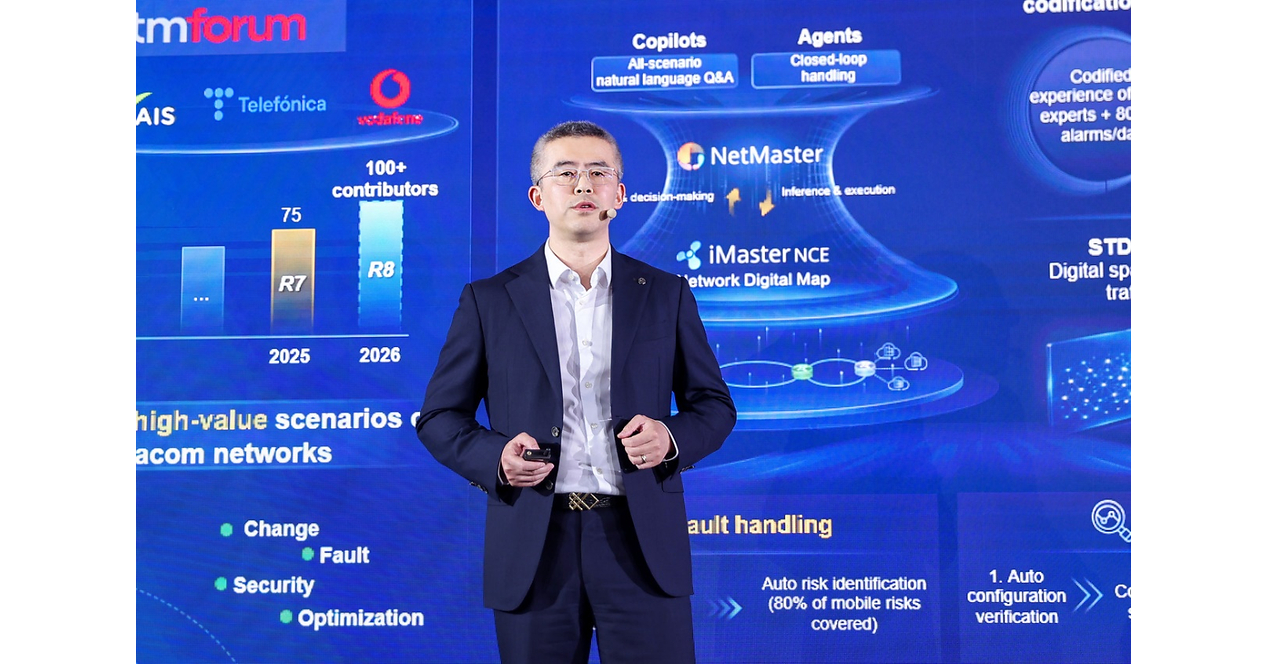
Huawei says its NG WAN solution has entered large-scale commercial use, with more than 60 carriers worldwide deploying it. Huawei cites customer results including a 50% increase in private-line revenue for a Macao carrier and a fivefold increase in private-line ARPU for a Chinese carrier’s healthcare project; the latter also cut hospital computing costs by 30%. The article is a company announcement, and the reported performance figures are Huawei’s claims.
Analysis
The investable signal is not Huawei’s performance claims but whether carriers can turn AI-network upgrades into incremental enterprise revenue rather than merely lower operating costs. If lossless transport and automation reduce the cost of serving AI workloads, carriers could capture more private-cloud, inter-data-center, and latency-sensitive traffic; conversely, better network efficiency may defer capacity spending, limiting equipment revenue. A single project’s reported ARPU uplift is not evidence of repeatable sector economics.
Near term, treat the announcement as weak evidence: deployments and outcome metrics are company-reported, with no disclosed contract values, comparable baselines, or independent validation. Over 1–3 months, look for carrier capex guidance, named commercial contracts, and evidence that AI-related private-line revenue is growing faster than legacy connectivity. Over 6–18 months, adoption outside Huawei-accessible markets is the key test. Export controls, security reviews, and multi-vendor integration could constrain Huawei’s addressable market and redirect demand toward Cisco, Juniper, Nokia, and other suppliers; this is a potential competitive tailwind, not proof of near-term orders.
Contrarian risk: automation and higher utilization can be a substitute for new hardware, so strong customer ROI need not translate into strong vendor growth. No clean directional trade from this release alone. Falsify the cautious view with repeated carrier disclosures of paid AI-network services and rising network-equipment budgets; falsify the adoption thesis with capex reductions, weak enterprise monetization, or procurement/security barriers.
AllMind Terminal
AI-powered research, real-time alerts, and portfolio analytics for institutional investors.
Request TrialMarket Sentiment
Overall Sentiment
moderately positive
Sentiment Score
0.35
Key Decisions for Investors
- No immediate position based solely on the release; avoid extrapolating the reported project-level revenue and efficiency claims to the carrier sector.
- Place Cisco, Juniper, and Nokia on a relative-beneficiary watchlist for markets where Huawei is excluded or procurement-constrained. Revisit only after order commentary or carrier capex guidance corroborates substitution.
- Monitor carrier results over the next 1–3 months for AI/private-line revenue, pricing, and capex allocation. The thesis strengthens if monetization grows without being offset by lower equipment spending.
- Require independent evidence on deployment scale, contract economics, and repeatability before treating Huawei’s security, performance, or cost-reduction claims as an investable catalyst.
More News
- Anthropic's third-quarter revenue is said to hit $16.8 billion ahead of IPO
- Why is Samsung Electronics stock plunging today?
- SK Hynix plunges 8% amid Asia tech rout as Fed rate hike fears, AI funding worries mount
- Elon Musk says Trump is 'ultimately' responsible for any curbs on Ukraine's Starshield systems
- SK Hynix seeks U.S. chip equipment exports to China tied to new factory
- Dell stock plunges 11%, leading data center sell-off on concerns about 'enterprise AI timing'