
Brookdale Reports August 2026 Occupancy
Source: PR Newswire
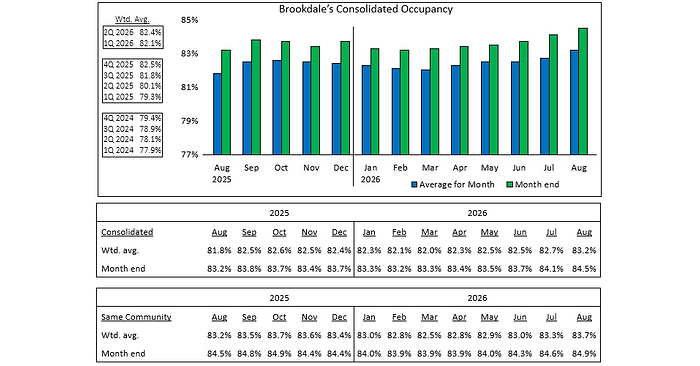
Brookdale Senior Living announced its August 2026 occupancy update, but the provided release contains no occupancy figures, month-over-month changes, or other operating metrics. The release reiterates that Brookdale operates 532 senior living communities across 41 states with capacity for approximately 45,000 residents as of August 31, 2026. Without the underlying occupancy data, the announcement provides no material basis to assess operating performance or financial implications.
Analysis
This release is not decision-useful because it omits the occupancy level, month-over-month change, year-over-year change, and same-community versus acquisition/disposition detail needed to translate census into EBITDA. For BKD, marginal occupancy can carry meaningful operating leverage once fixed community labor and facility costs are covered, but that benefit is conditional on resident-rate growth exceeding wage, agency-labor, food, insurance, and property-cost inflation. A standalone promotional release should not be treated as evidence of a changed earnings trajectory.
The more actionable read-through is to senior-housing landlords WELL and VTR, whose NOI and external-growth capacity benefit when operator occupancy and pricing support rent coverage. BKD is a higher-beta operating turnaround expression, while WELL/VTR offer cleaner exposure to senior-housing demand with less direct labor execution risk; conversely, any occupancy gain driven by discounting would be more favorable to landlords only if it ultimately supports rate increases. Over the next 1-3 months, the relevant catalyst is BKD's quarterly disclosure of RevPAR, same-community occupancy, labor costs, and adjusted EBITDA guidance; over 6-18 months, new senior-housing supply and labor availability determine whether industry occupancy tightness converts into durable margin expansion.
Contrarian risk is that investors may extrapolate census improvement without distinguishing seasonal move-ins or temporary price concessions from true pricing power. The thesis is falsified if quarterly same-community RevPAR fails to outpace operating-expense growth, adjusted EBITDA guidance is not raised, or net debt/lease-adjusted leverage does not improve despite higher occupancy. Given the absent data and low stated impact, there is no basis for a directional trade before the underlying occupancy table and earnings bridge are available.
AllMind Terminal
AI-powered research, real-time alerts, and portfolio analytics for institutional investors.
Request TrialMarket Sentiment
Overall Sentiment
neutral
Sentiment Score
0.00
Key Decisions for Investors
- No new BKD position on this release; place an alert for the underlying occupancy disclosure and the next earnings report. Require sequential occupancy improvement plus RevPAR growth above operating-expense growth before underwriting a long.
- If BKD reports both improving same-community occupancy and an EBITDA-guidance increase, consider a 1-3 month long BKD versus short WELL or VTR only if BKD's valuation discount remains materially wider than its historical range; cap risk with a stop on a guidance cut or a renewed leverage increase.
- For lower-execution-risk senior-housing exposure, monitor WELL and VTR quarterly same-store senior-housing NOI and operator rent coverage. Add only if occupancy gains are accompanied by positive pricing and stable labor-cost commentary, rather than discount-led census growth.
- Avoid using BKD options until the occupancy figures, implied volatility, and next earnings date are confirmed; the missing fundamental disclosure makes event-volatility pricing impossible to assess.
More News
- Here’s the ‘core economic flaw’ in the AI bull case as stock and bond trades unravel, according to a top economist
- How Pepsi fell behind in the cola wars—and then lost KFC
- 5 big analyst AI moves: ’Uniquely catalyst-rich’ months ahead for SpaceX
- Braskem creditors, shareholders near deal on $11bn debt restructuring
- Xencor reports phase 1 data for cancer drug XmAb819
- The experience economy keeps defying expectations. Maybe we’ve been looking at it all wrong