
TOWARD HEALTH Announces 120-Patient Study Showing Major Improvements in AHA PREVENT-Estimated Cardiovascular Risk
Source: PRWeb
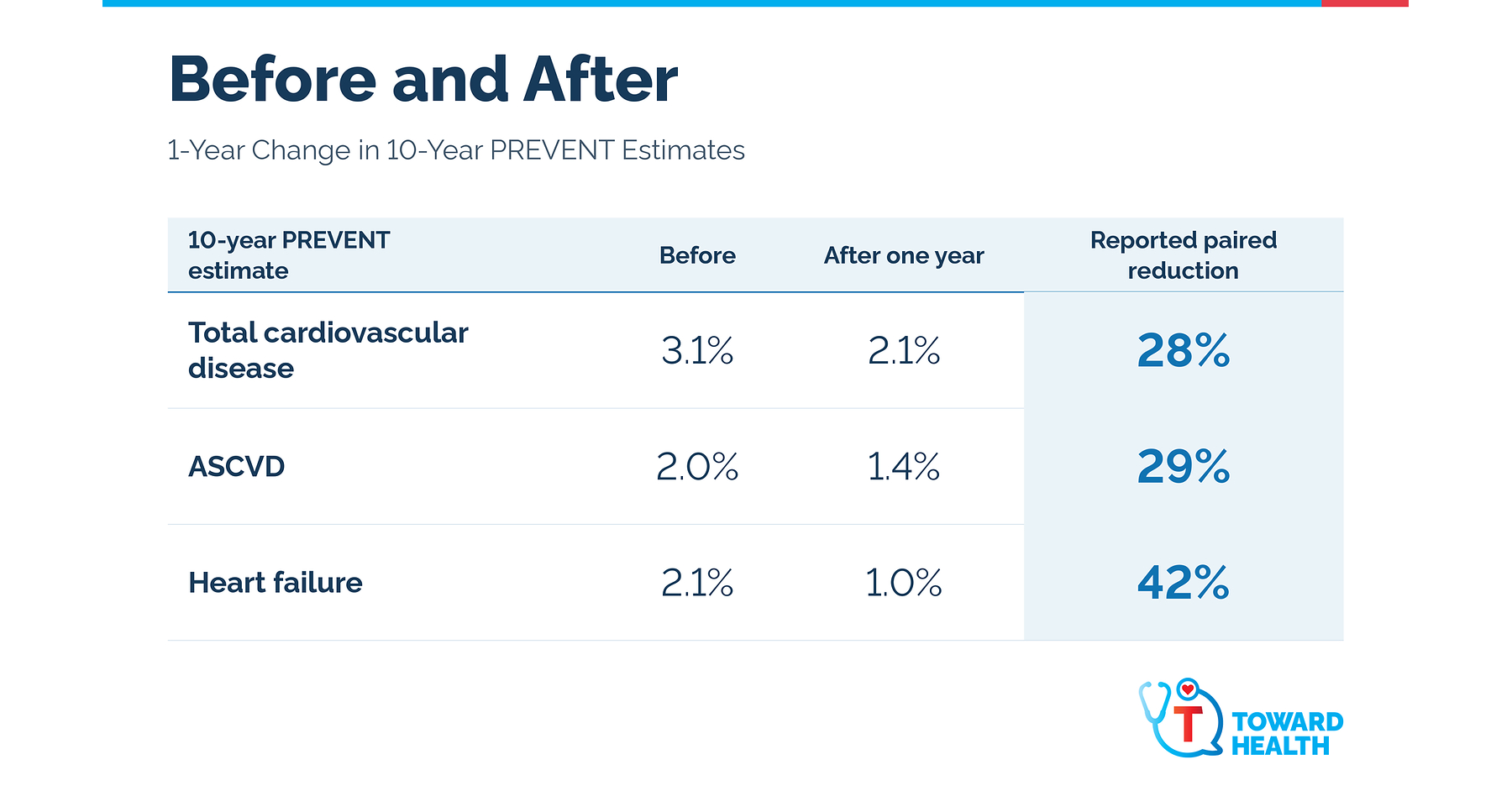
In a retrospective, uncontrolled 120-patient study, TOWARD Health reported that one year of its physician-led metabolic-care intervention was associated with a 29% reduction in estimated 10-year ASCVD risk and a 28% reduction in total cardiovascular risk; estimated heart-failure risk fell 42%. Participants had median weight loss of 12.2%, systolic blood pressure declined 10.7 mmHg, HbA1c fell 0.48 percentage points, and triglycerides dropped 34 mg/dL, while 125 medications were stopped. The study cannot establish causation or show that estimated risk changes translate into fewer cardiovascular events; TOWARD is proposing a randomized head-to-head trial of dietary approaches.
Analysis
The investable signal is a care-delivery hypothesis, not evidence that a ketogenic diet reduces cardiovascular events. If sustained coaching, monitoring and medication adjustment can produce durable weight and glycemic improvements at lower total cost, continuous-care providers could gain employer and payer contracts; the defensible asset would be retention and verified outcomes, not the app or diet label alone. TOWARD is not identified here as a publicly traded company, and this small, retrospective, uncontrolled study does not establish causal efficacy, scalability or savings.
Near term, the study is unlikely to change prescribing or payer economics: estimated risk scores are surrogate outcomes, and medication discontinuation needs validation against clinical appropriateness and subsequent control. The larger competitive read-through is modestly negative for the assumption that obesity care is exclusively a GLP-1-drug market, but it does not demonstrate substitution for GLP-1s. Over 1–3 months, the key catalyst is whether a randomized, head-to-head trial is funded and designed with independent oversight, lipid safety measures and clinical endpoints. Over 6–18 months, retention, adverse events, LDL/ApoB response, medication persistence and cost per sustained outcome determine whether the model can scale.
Contrarian point: the reported weight and metabolic changes may be commercially meaningful even if the diet-specific claim fails, because the intervention bundles frequent physician contact, coaching and monitoring. Conversely, the headline risk-score improvement could overstate durable cardiovascular benefit; any adverse atherogenic-lipid changes or regression toward the mean would weaken the case. No direct equity trade is supported without a listed exposure, trial details and independently verified economics.
AllMind Terminal
AI-powered research, real-time alerts, and portfolio analytics for institutional investors.
Request TrialMarket Sentiment
Overall Sentiment
mildly positive
Sentiment Score
0.25
Key Decisions for Investors
- No immediate trade: treat this as a low-confidence signal for care-model innovation, not a catalyst for broad healthcare or food-sector repricing.
- Put virtual metabolic-care providers and employer-focused chronic-care vendors on watch; require evidence of paid-patient growth, retention, gross-margin profile and independently measured cost savings before underwriting a long.
- For GLP-1 exposure, do not infer near-term demand displacement. Reassess only if controlled data show durable outcomes and lower cost versus medication-based care, including whether patients remain off medication without rebound.
- Monitor the proposed trial for funding, randomization, comparator, follow-up duration, LDL/ApoB and adverse-event reporting, and hard cardiovascular outcomes. A trial limited to risk-score changes would not resolve the principal investment uncertainty.
- Falsification/watch item: evidence of materially worsened LDL/ApoB, weight regain or glycemic deterioration after medication withdrawal would undermine the favorable interpretation; durable controlled outcomes and payer adoption would strengthen it.
More News
- Security researcher claims to they found KVM guest-host escape flaw
- CH Robinson to Buy RXO for $5.8B in Bet on AI Model
- Nike’s China troubles: What are the implications for other sportswear brands?
- SpaceX stock climbs to highest since June, returning Musk to trillionaire status
- Schneider Electric drops $22.6B on PTC as datacenter boom rains money on infra companies
- Wells Fargo gets a bold upgrade ahead of earnings. Why the stock can play catch-up