
LightMake Unveils L4: A Linear Motor-Powered, Independent Four-Head Desktop 3D Printer
Source: PR Newswire
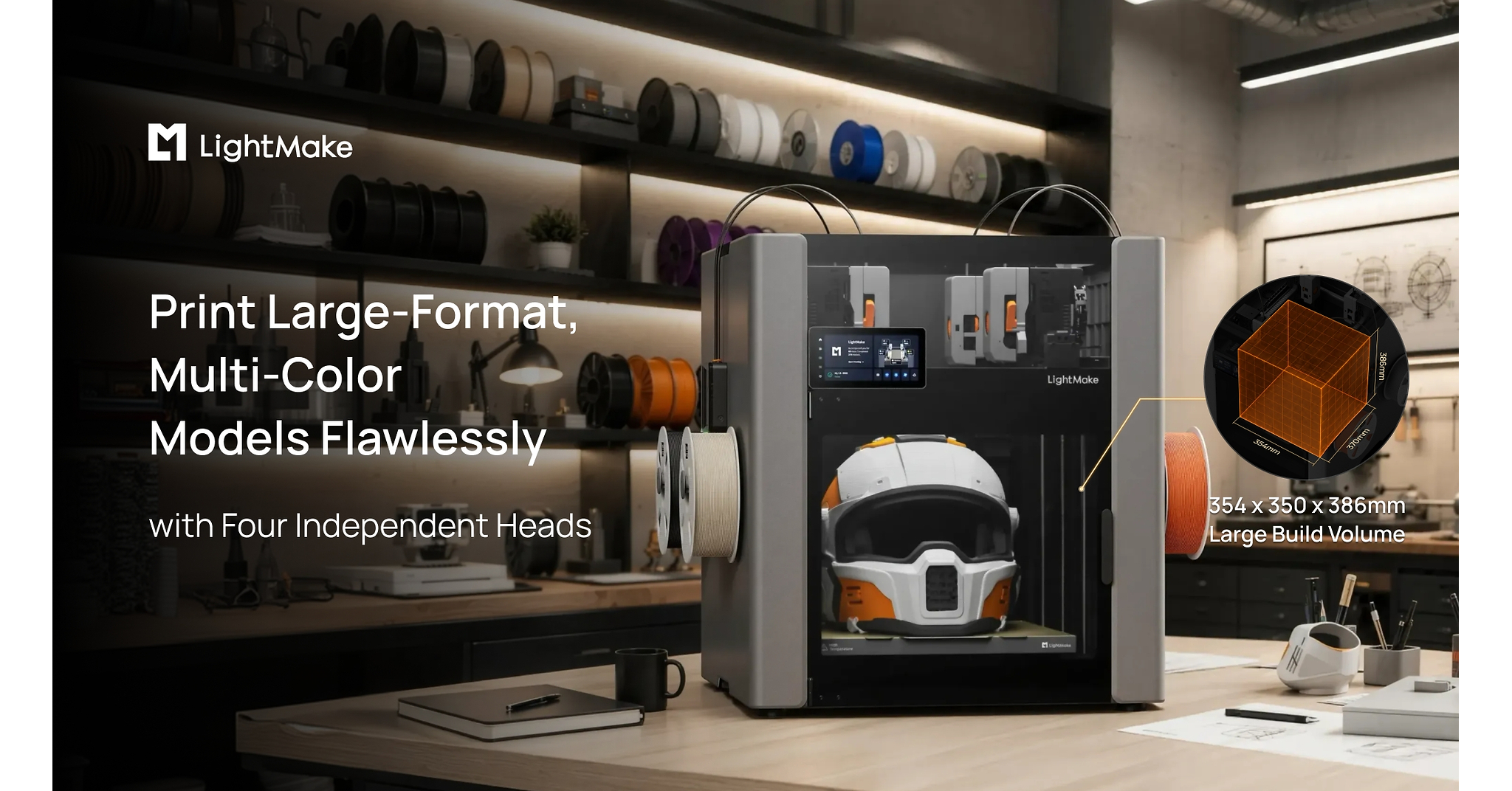
LightMake launched the L4 desktop 3D printer featuring four independent linear-motor print heads, enabling up to 4 models at once and up to 4-material blending in a single print. The company claims travel speeds up to 1,000 mm/s, ±1µm motion precision, and a >79% reduction in filament waste versus single-nozzle color changes, with toolhead changes taking ~1 second. Pre-orders are live on Kickstarter starting at $1,299 (with L1 at $1,099) and initial shipments expected in Q4 2026.
Analysis
This is more a proof-of-concept signal than a near-term industry re-rating event. In desktop 3D printing, the real moat is not raw speed claims; it is uptime, support burden, consumables economics, and whether the machine can be kept productive in the field without constant calibration. If the spec sheet is directionally true, the first-order winner is the print-farm workflow layer, not the hardware OEMs — higher throughput and lower waste matter most for users doing short-run production, education, and micro-factories, where labor is the binding constraint.
For public comps, the risk is that the market briefly extrapolates one launch into a broader demand revival for SSYS/DDD. That would likely be overdone unless order conversion shows up in channel checks or reseller inventories tighten. The more probable second-order effect is competitive pressure on mid-tier desktop printers from Bambu/Creality-style ecosystems: incumbents that rely on accessory margins and recurring filament sales could see pricing pressure if this category pushes a better value-per-part narrative.
The main catalyst path is not launch day but Q4 2026 shipment quality and early user reviews. Kickstarter pre-orders are not revenue; the falsifier is a high return rate, missed ship date, or evidence that multi-head synchronization and linear motors create service complexity that offsets the claimed productivity gain. Contrarian view: the market may be underestimating how small the addressable spend is relative to industrial AM, so even a technically interesting product may have little impact on public equities absent broader enterprise adoption.
AllMind Terminal
AI-powered research, real-time alerts, and portfolio analytics for institutional investors.
Request TrialMarket Sentiment
Overall Sentiment
mildly positive
Sentiment Score
0.25
Key Decisions for Investors
- No immediate fundamental position in SSYS or DDD; treat this as a watch item until independent shipment/review data arrives in Q4 2026. The risk/reward on a long thesis is poor without evidence of repeatable uptime and low support cost.
- If SSYS/DDD trade up 5-8% on a sympathy move in the next 1-3 weeks, consider fading the move with a short against the basket or via short-dated calls, targeting a reversion once the market refocuses on weak end-market demand and lack of public revenue impact.
- Monitor PRLB and other prototyping/manufacturing-services names for any channel evidence that faster desktop systems are displacing outsourced low-volume jobs; if adoption is real, that is a 6-18 month headwind rather than an immediate trade.
- Set a catalyst alert for Q4 2026: if shipment dates slip, early reviews flag failure rates, or actual throughput is meaningfully below claims, use that as a trigger to short the broader desktop-3D-printing sentiment basket on any speculative spike.
More News
- CoreWeave credit default swaps hit distress levels as investors sour on AI debt
- Penske Automotive agrees to be taken private by Penske, Mitsui
- Supermicro promised a new CFO in December 2024. A $2.5 billion smuggling case and a co-founder’s arrest later, it has one
- Blackstone President Jon Gray Bets Big on AI Boom
- What's behind the sell-off in AI neocloud stocks like CoreWeave and Nebius
- Giant Taiwanese chipmaker TSMC confirms it’s in talks with Elon Musk to join ‘Terafab’ complex in Texas: ‘The AI market continues to be very strong’