
El AION UT obtiene la calificación de cinco estrellas de Euro NCAP 2026
Source: PR Newswire
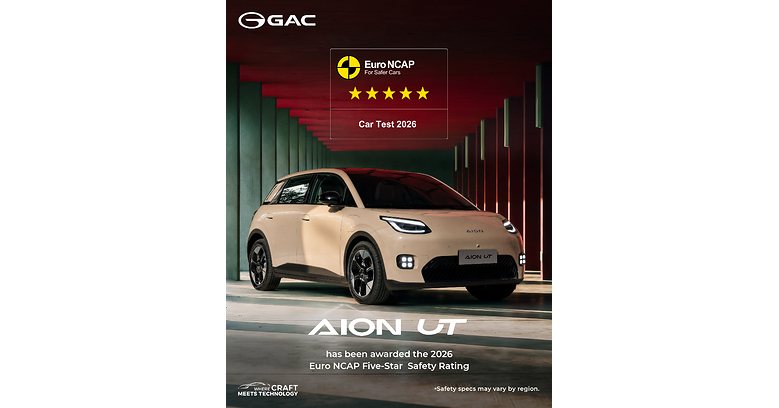
GAC's fully electric AION UT hatchback received a five-star Euro NCAP 2026 safety rating under newly tightened testing protocols, positioning it among the first mass-market Chinese-brand models to achieve the top score. The vehicle's safety design includes a body composed of 71% high-strength steel, a 180mm-wide crash box, 2.1-meter side-curtain airbags, battery-safety systems and active-driving safety technology. The certification strengthens GAC's EV safety credentials but is unlikely to have broad market impact.
Analysis
The rating is more strategically valuable as a European channel-access credential than as a near-term earnings event. For GAC (2238.HK; 601238.SS), it can reduce consumer and fleet-manager objections around Chinese-brand safety, supporting dealer recruitment and residual-value assumptions; however, it does not solve the larger EU profit equation of import duties, homologation costs, distribution investment and likely promotional pricing. The key question is whether the safety credential converts into measurable European registrations and pricing discipline within the next 1-3 months.
A broader implication is that Chinese EV makers are closing a historical differentiation gap for Renault (RNO.PA), Stellantis (STLAM.MI) and Volkswagen (VOW3.DE) in the affordable hatchback segment. Incumbents have relied on safety perception and established dealer/service networks to defend pricing; comparable third-party safety outcomes raise the probability that competition shifts decisively to financing, software and total cost of ownership, pressuring European small-EV margins over the next 6-18 months. Suppliers of ADAS sensors, airbags and high-strength steel could benefit only if the added content becomes standard across Chinese export platforms rather than remaining a flagship specification.
Contrarian view: this is a low-information PR catalyst, not evidence of demand or profitable export scale. A high safety score can raise bill-of-materials and warranty exposure, while European buyers may still discount a new badge because resale values, repair-network coverage and insurance pricing matter more than crash-test results. The thesis is falsified positively by sustained EU registration share gains without elevated incentives; it is falsified negatively if GAC needs heavy discounts, reports weak dealer uptake, or faces additional EU trade restrictions.
AllMind Terminal
AI-powered research, real-time alerts, and portfolio analytics for institutional investors.
Request TrialMarket Sentiment
Overall Sentiment
strongly positive
Sentiment Score
0.58
Key Decisions for Investors
- No immediate directional trade in GAC: wait for two monthly European registration prints and disclosed dealer-network additions. Upgrade only if unit growth is accompanied by stable realized pricing; a safety award alone is insufficient to underwrite EPS revision.
- Maintain a 6-12 month relative-risk watch: short VOW3.DE or RNO.PA versus long BYD (1211.HK) only after evidence that Chinese sub-€30k EV registrations are taking share. The intended payoff is multiple and margin divergence; stop the trade if European incentives or tariff enforcement materially restrict Chinese imports.
- For GAC (2238.HK), set an alert around management guidance or quarterly disclosures for export volume, European marketing spend and AION gross margin. Evidence of rising export mix with no margin dilution would be the actionable catalyst; incremental advertising expense or incentives would invalidate the constructive interpretation.
- Monitor European auto-insurance quotes and fleet leasing residual-value assumptions for new Chinese EV entrants over the next 3-6 months. Improving insurance/residual economics would be a more investable confirmation than safety marketing and would increase downside risk to incumbent mass-market OEM margins.
More News
- OpenAI Trims Target Value & Volvo Cars Cuts 2,500 Jobs
- The mobile ambitions of SpaceX see telecom stocks get hit again. What the latest developments mean.
- Volvo Cars shares plunge 25% amid China sales slump and fresh job cuts
- Volvo Cars to cut 2,500 jobs as third quarter swings to loss
- OpenAI nears up to $30 billion funding round at $1.25 trillion valuation led by UAE investors
- Volvo Cars posts Q3 loss of 3.7 billion crowns, to cut 2,500 jobs