
ASEAN+3: Navigating Shocks Through Stronger Foundations and Deeper Financial Integration
Source: PR Newswire
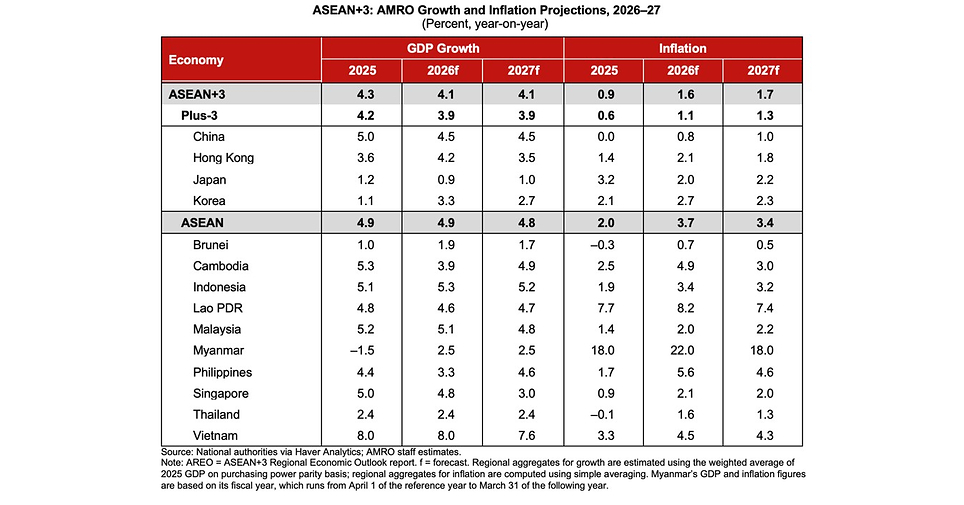
AMRO projects ASEAN+3 growth of 4.1% in both 2026 and 2027, with inflation at 1.6% and 1.7%, respectively; 2026 forecasts are unchanged from July, while both 2027 forecasts are 0.1 percentage point higher. The report describes regional financial systems as resilient, citing sound external positions and well-capitalized, liquid banks, but warns that Middle East energy disruptions, AI-asset repricing, dollar movements, leveraged nonbank institutions and digital-finance risks could amplify shocks.
Analysis
The investable signal is dispersion, not a broad ASEAN+3 growth call. AI-linked exports can support Korean and Japanese technology supply chains, but that upside is vulnerable to concentrated capex demand and a sharp valuation reset; regional aggregate forecasts do not establish durable earnings acceleration. Conversely, energy-importing manufacturers and transport businesses face margin and household-demand pressure if oil and freight costs stay elevated. Pass-through capacity and hedging differ by company, so avoid treating the region as one exposure.
Over the next 1–3 months, watch energy prices, the dollar, and AI-capex guidance: renewed dollar strength can pressure currencies, foreign funding costs, and local asset prices even where external buffers are adequate. Over 6–18 months, greater NBFI/bank interconnection and digital-finance exposures are potential volatility multipliers, not evidence of imminent systemic stress. A disorderly AI repricing could therefore spread beyond technology through deleveraging and tighter credit.
Contrarian point: resilient system-level indicators may encourage investors to underprice the tail risk from correlated exposures; equally, the cautious framing is not itself a reason to short regional assets. No broad directional trade is justified by this release alone. The key missing evidence is country/company-level earnings sensitivity, positioning, valuation, and NBFI leverage/liquidity data.
AllMind Terminal
AI-powered research, real-time alerts, and portfolio analytics for institutional investors.
Request TrialMarket Sentiment
Overall Sentiment
neutral
Sentiment Score
0.10
Key Decisions for Investors
- Keep broad ASEAN+3 exposure near benchmark rather than buying the growth forecast as a standalone catalyst; use earnings revisions and country-level valuation/flow data to determine whether the AI export theme is already priced in.
- For relative-value research, compare Korean and Japanese AI supply-chain exporters with energy-sensitive regional manufacturers and transport names. Initiate only where company disclosures confirm distinct demand and energy-cost sensitivities; avoid an unhedged regional basket.
- Treat renewed dollar strength or a sustained energy-price spike as a hedge trigger, not an automatic short: reassess Asian FX exposure and import-cost-sensitive holdings if currencies weaken alongside rising funding spreads.
- Set a downside alert for a material reversal in AI-related capex guidance or broad Asian credit/liquidity deterioration. AAXJ options could be evaluated as a regional hedge only after checking option cost, index composition, and portfolio beta; those inputs are not provided here.
- Thesis falsifiers: improving AI-related earnings revisions without valuation excess, stable energy and freight costs, and contained FX/credit spreads would weaken the case for defensive hedging; abrupt dollar appreciation, forced deleveraging, or tighter credit would strengthen it.
More News
- World Bank warns of AI concentration risks as it lifts East Asia and Pacific growth outlook to 4.5%
- Security researcher claims to they found KVM guest-host escape flaw
- CH Robinson to Buy RXO for $5.8B in Bet on AI Model
- OKX debuts a platform that turns 50 currencies into digital dollars, betting emerging market investors want stablecoins
- Nike’s China troubles: What are the implications for other sportswear brands?
- SpaceX stock climbs to highest since June, returning Musk to trillionaire status
From AllMind Research
- Anthropic IPO Preview: Valuation, Timing, and What to Watch
- Shein After the IPO: Venue, Valuation, and What Must Be Proved
- What AI Research Tools Should a Small Hedge Fund Buy First?
- Eli Lilly Q4 2025 Earnings: Revenue Surges 43% as Mounjaro and Zepbound Dominate the GLP-1 Market
- Investment Research Software Costs: A 2026 Budget Framework