
Black Book Report Warns Hospital AI Adoption Is Outpacing Cybersecurity Controls
Source: Newswire
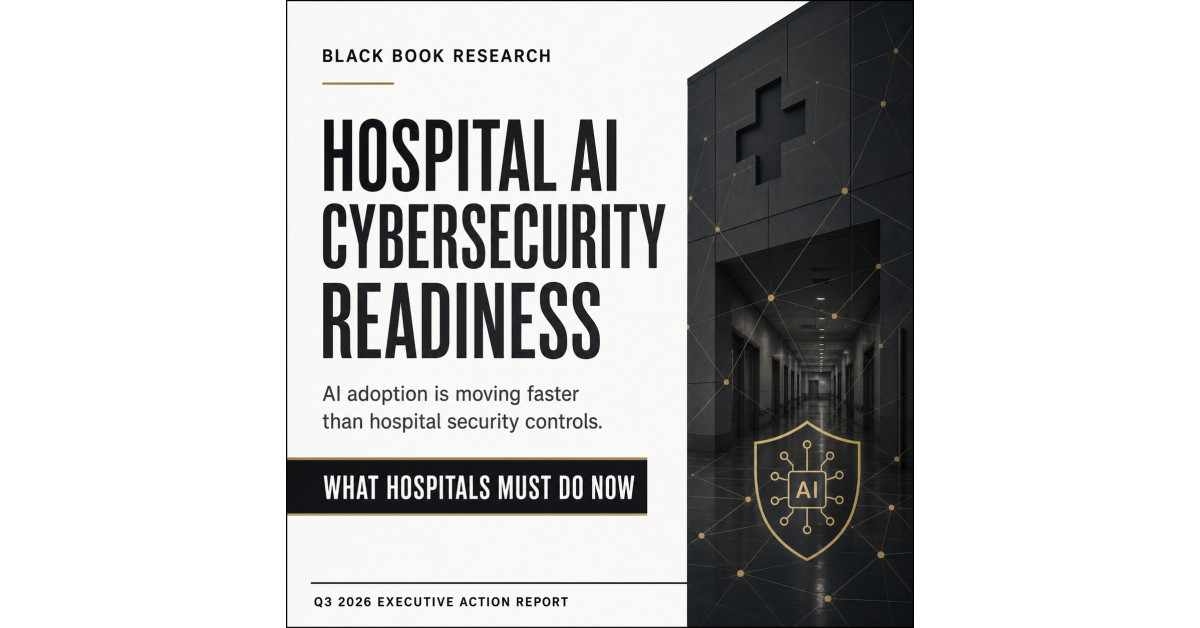
Black Book Research warns hospitals that AI adoption is outpacing cybersecurity controls, increasing the likelihood of breaches as attackers scale phishing, credential theft, and prompt-injection risks through 2027. The report urges treating each AI deployment as a new trust boundary—blocking production credentials and PHI access until an AI-specific security review and least-privilege controls are implemented. It highlights six new AI-driven breach paths (prompts/models/agents/vendors/cloud) and calls for an auditable control plane including data-loss prevention, adversarial testing, runtime monitoring, and stronger third-party oversight.
Analysis
This reads more like a procurement and budget-shift signal than a near-term earnings catalyst. The first-order winner is the identity/DLP/endpoint/incident-response stack, but the second-order effect is that hospitals will increasingly buy governance to unblock AI pilots, not to create net-new IT spend. That favors scaled security platforms with healthcare references and broad bundles (PANW, CRWD, ZS, OKTA) over niche AI-security startups, because boards will prefer one auditable control plane rather than a point solution per risk.
The likely losers are hospital AI workflow vendors and embedded clinical-assist features selling on speed and automation. Even if the breach risk never fully monetizes, longer approval cycles, tighter agent permissions, and human-in-the-loop controls will slow revenue conversion and push out implementation recognition by 1-2 quarters. For hospital operators, this is a margin headwind only in aggregate, but it can still dilute the productivity narrative that supports premium multiples on AI-enabled healthcare names.
Contrarian view: the market may overstate the immediacy of spend. Hospitals can acknowledge the risk without materially changing budgets until a real incident, regulatory mandate, or insurer requirement forces action. The more durable upside is likely in advisory, audit, and integration services, not in standalone software sell-through. Falsifier: if healthcare vertical bookings at the major cyber vendors do not improve over the next 1-2 earnings cycles, this thesis is just a narrative, not a trade.
AllMind Terminal
AI-powered research, real-time alerts, and portfolio analytics for institutional investors.
Request TrialMarket Sentiment
Overall Sentiment
mildly negative
Sentiment Score
-0.35
Key Decisions for Investors
- Buy PANW or CRWD on 3-5% weakness, 3-6 month horizon; thesis is healthcare governance converting into recurring security spend, with risk/reward skewed to upside if vertical bookings inflect.
- Pair long PANW/CRWD vs short HCA or THC only as a small tactical hedge, 1-3 month horizon; idea is that extra compliance/security overhead slows hospital AI productivity while security vendors capture the spend.
- No direct trade in HSMD/IUSDF today; keep them on watch for any evidence of hospital AI-security monetization in earnings or contract commentary before taking risk.
More News
- Indonesia stocks suffer biggest daily slump since 1998 as MSCI weighs downgrade
- Order to limit Starshield for Ukraine came from inside White House: Reuters reports
- CoreWeave credit default swaps hit distress levels as investors sour on AI debt
- Taiwan to curb AI chip sales to China for more U.S. alignment- Bloomberg
- Giant Taiwanese chipmaker TSMC confirms it’s in talks with Elon Musk to join ‘Terafab’ complex in Texas: ‘The AI market continues to be very strong’
- The Tesla Roadster 2 Is Here—and It Flies