
Global Protein Expression Market to Reach USD 7.30 Billion by 2034 at 8.8% CAGR as Rising Biopharmaceutical Development, Growing Demand for Recombinant Proteins, and Advances in Cell-Free Expression Technologies Accelerate Market Growth, Reports Maximize Market Research
Source: PR Newswire
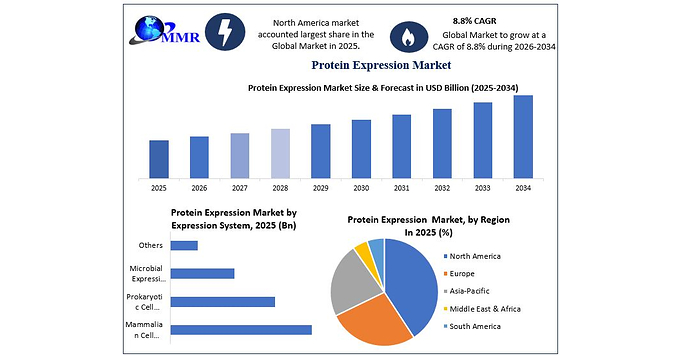
Maximize Market Research projects the global protein expression market will grow from $3.50 billion in 2025 to $7.30 billion by 2034, an 8.8% CAGR. Growth is expected to be driven by demand for recombinant therapeutics, monoclonal antibodies, vaccines, biosimilars and advanced protein-engineering and cell-free synthesis platforms. North America led the market in 2025, while Asia-Pacific is expected to be a high-growth region; high production costs, protein-folding complexity and scale-up challenges remain constraints.
Analysis
This is not an investable near-term demand datapoint: the implied annual market expansion is small relative to TMO, Merck KGaA (MRK), Agilent (A), Bio-Rad (BIO), and GE HealthCare (GEHC) revenue bases, and the forecast is vendor-adjacent market research rather than audited order activity. The more relevant signal is mix: growth concentrated in complex biologics and process development favors recurring consumables, workflow lock-in, and quality-control content over one-time instruments. TMO and Merck should capture this through broad reagent-to-production workflows, while A and BIO need sustained instrument placements to convert the opportunity into higher-margin pull-through.
The non-obvious competitive pressure is on standalone reagent and expression-service vendors. Cell-free and computational design can shorten discovery cycles, but they may reduce trial-and-error reagent consumption per program and commoditize simple protein production. That makes TECH and QGEN more dependent on differentiated sample-prep, protein-analysis, and automation attachment rates; CDXS has asymmetric upside only if enzyme-engineering wins convert into commercial customer milestones rather than research volume. Over 6-18 months, Asian biosimilar capacity growth is more likely to benefit scalable manufacturing and QA suppliers than Western discovery-tool vendors, with Lonza (LONN) exposed to both capacity utilization upside and pricing pressure from regional CDMOs.
Consensus may overread a generic biologics-growth narrative as a catalyst for life-science tools, where customer purchasing is presently governed by biotech funding, pharma R&D productivity, and China demand—not long-range TAM forecasts. The key 1-3 month confirmation is management commentary on bioprocess consumables growth, book-to-bill, and China recovery in upcoming results. A deterioration in biotech funding, pharma pipeline rationalization, or lower bioprocess utilization would falsify the constructive mix thesis despite secular demand growth.
AllMind Terminal
AI-powered research, real-time alerts, and portfolio analytics for institutional investors.
Request TrialMarket Sentiment
Overall Sentiment
mildly positive
Sentiment Score
0.35
Ticker Sentiment
Key Decisions for Investors
- No directional trade on the release alone; treat it as a watch item. Reassess after TMO, A, BIO, and QGEN report bioprocess/consumables organic growth and order trends, since those data—not TAM estimates—determine 2027 earnings revisions.
- Maintain a 6-12 month quality pair: long TMO / short BIO in equal dollar exposure. TMO has greater recurring workflow breadth and production-scale exposure; BIO is more vulnerable if academic and smaller-biotech instrument budgets remain constrained. Exit if BIO reports two consecutive quarters of accelerating core consumables growth versus TMO or if the relative spread moves 10% against entry.
- For Asian biologics-capacity exposure, accumulate LONN only on evidence of improving large-molecule utilization or raised guidance; target a 12-18 month horizon. The risk is persistent customer insourcing and Chinese CDMO price competition, which would cap margin recovery even with volume growth.
- Keep CDXS as a catalyst-driven watch rather than a thematic long. Initiate only following disclosed commercial enzyme milestones, backlog conversion, or a material revenue-guidance raise; absent these, protein-expression TAM growth is too indirect to support the valuation.
More News
- Bio-Techne Shareholders Approve Acquisition by Merck KGaA, Darmstadt, Germany
- OpenAI’s agent hacked Australia’s Medicare website—the latest rogue AI incident that the company didn’t know about for months
- Chinese authorities reportedly in possession of F-35 components in Hong Kong
- Meta announces new lightweight virtual reality glasses to one-up Apple’s Vision Pro
- How Meta took the lead in the race for the post-smartphone world
- SoftBank shares jump over 7% after $11.1 billion bond issuance to fund OpenAI bet
From AllMind Research
- Anthropic IPO Preview: Valuation, Timing, and What to Watch
- Shein After the IPO: Venue, Valuation, and What Must Be Proved
- What AI Research Tools Should a Small Hedge Fund Buy First?
- Reading Conviction in the Tape: What Level 3 Order Book Data Really Tells Discretionary PMs
- AI Tools for CFA Charterholders: An Evidence Standard