
Silicon Line®, an EverProX® brand, Launches new Ultra-Low-Power SerDes Chipset MSDL™ (MIPI Serial Data Link), Extending 20 Gbps MIPI D-PHY Connectivity to Tens of Meters
Source: PR Newswire
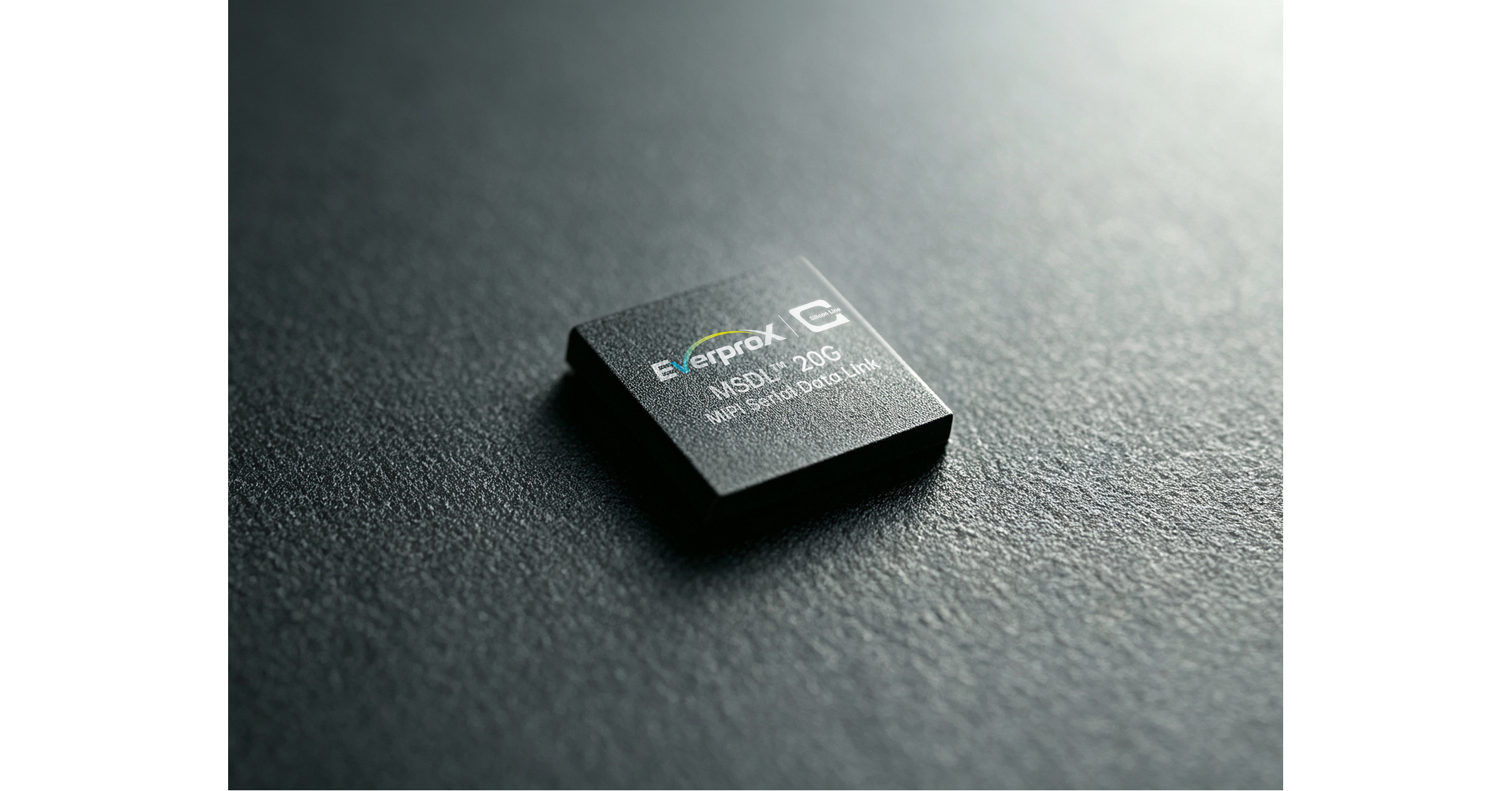
Silicon Line® (EverProX) launched its first MSDL™ family product, MSDL™ 20G, a dual-port MIPI D-PHY SerDes chipset delivering up to 2 simultaneous 10 Gbps serialized links. The solution targets “tens of meters” optical reach (plus differential copper up to 2 meters) while consuming under 100 mW per 10 Gbps link total (71 mW optical / 87 mW electrical). Sampling is underway with early-access customers and EVKs are available for evaluation, primarily for AR/VR, medical endoscopy, industrial vision, and defense/UAV multi-camera systems.
Analysis
This is more important as a proof-of-concept than as an immediately monetizable event. The real market mechanism is that longer-reach, low-power camera interconnect lowers the integration burden for robotics, medical imaging, and tethered XR systems, which can pull forward OEM adoption of higher sensor counts and more distributed compute. The near-term winners are likely niche optical interconnect and VCSEL/TIA supply-chain names if this becomes a repeatable design pattern; the near-term losers are custom harness and shielded-copper content that depends on bulky cabling, though public exposure there is diffuse.
The catalyst path is mostly non-linear: 1-3 months should be judged by design-win chatter and EVK uptake, not revenue. A meaningful public-market signal would be an OEM platform announcement or multiple customer qualifications; absent that, the launch stays a technology headline. Over 6-18 months, the question is whether the BOM and qualification costs beat existing short-reach SerDes plus standard cable management; if not, this remains a specialty solution, not a category shift.
The contrarian view is that the market may overestimate TAM because bandwidth is not the only bottleneck—thermal limits, certification, and supply-chain complexity often decide the socket. If customers can tolerate short copper runs and EMI mitigation, the optical advantage shrinks quickly. Falsifier: no follow-on OEM design wins or no evidence of production ramps by the next two earnings cycles in adjacent interconnect suppliers.
AllMind Terminal
AI-powered research, real-time alerts, and portfolio analytics for institutional investors.
Request TrialMarket Sentiment
Overall Sentiment
mildly positive
Sentiment Score
0.25
Key Decisions for Investors
- No immediate directional trade in the listed names; treat this as an alert for design-win confirmation over the next 1-3 months rather than a standalone catalyst.
- If follow-on customer wins emerge, consider a 3-6 month long COHR / short TEL pair: thesis is incremental optical content and higher-value photonics mix versus commoditized harness exposure; stop if there is no OEM validation.
- Watch LITE and GLW as secondary beneficiaries only if the category proves broader than niche AR/VR and defense sockets; otherwise avoid chasing the announcement.
- Set a trigger to reassess if an adjacent robotics, medical imaging, or XR OEM cites volume adoption; without that, the probability-adjusted edge is too small to justify risk capital.
More News
- US Fed, BoE step up scrutiny of bank exposure to trading firms after Jane Street loss, FT reports
- Volkswagen, Porsche shares extend losses following profit warning
- Here are the 3 big things we're watching in the stock market this week
- Bessent proposes U.S.-China AI safety system in talks with China
- Europe’s STOXX 600 gains as tech rallies, oil retreat eases nerves
- Societe Generale targets over €21 bln in payouts through 2029
From AllMind Research
- Anthropic IPO Preview: Valuation, Timing, and What to Watch
- Shein After the IPO: Venue, Valuation, and What Must Be Proved
- What AI Research Tools Should a Small Hedge Fund Buy First?
- How to Build an Automated Research Process for a Fund
- Weekly Update: AI-Powered Report Editing, Investor Relations, and Enhanced Search