
Amazon: The Conglomerate Of The AI Industry
Source: seekingalpha.com
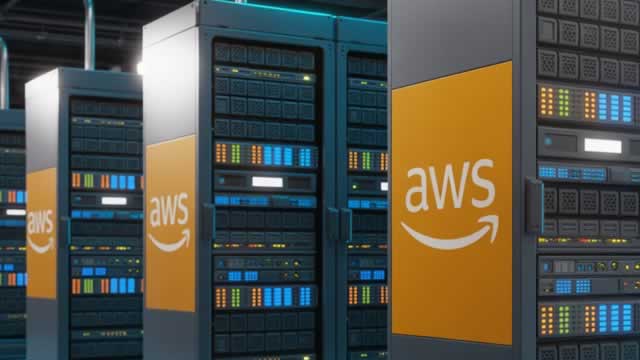
Amazon's AWS grew 36.7% year over year and accounted for 60.5% of operating income, while its backlog surged to $496B, underscoring demand for cloud and AI capacity. Growth in AWS, advertising and custom silicon is shifting the revenue mix toward higher-margin businesses. Despite negative free cash flow from a $220B capital-expenditure cycle, AMZN's 20.8x P/E and 17.27x EV/EBITDA are characterized as inexpensive relative to peers.
Analysis
The key valuation question is not the headline multiple but whether incremental AI infrastructure spending converts into durable cloud gross-profit dollars before depreciation catches up. If capacity additions are absorbed at contracted economics, AWS operating leverage can reaccelerate despite the investment cycle; if utilization lags, the depreciation burden creates a 2027-28 margin air pocket that consensus estimates may underweight. The unusually large committed-demand base reduces revenue risk, but does not eliminate execution risk around power availability, network equipment, and data-center construction schedules.
Custom silicon is strategically more consequential than near-term chip revenue: greater internal workload migration lowers Amazon's unit compute cost and weakens Nvidia's pricing umbrella at the largest hyperscalers. AVGO remains a likely second-order beneficiary from custom accelerator/networking content, while ORCL and CoreWeave face a competitive risk if Amazon can offer materially cheaper inference capacity. Conversely, a capacity-constrained AWS environment can temporarily support pricing and push enterprise workloads toward MSFT Azure and GOOGL Cloud, limiting immediate share-gain assumptions.
The near-term stock setup is favorable only if management demonstrates that capital intensity is peaking relative to revenue rather than merely rising in absolute dollars. Over the next 1-3 months, watch cloud backlog conversion, AI-related revenue disclosure, and forward CapEx commentary; over 6-18 months, the decisive variable is whether consolidated FCF inflects positively as new data centers mature. The contrarian risk is that the market is treating all AI CapEx as productive growth capital, when a lower-return compute buildout would force multiple compression even with robust top-line growth.
AllMind Terminal
AI-powered research, real-time alerts, and portfolio analytics for institutional investors.
Request TrialMarket Sentiment
Overall Sentiment
strongly positive
Sentiment Score
0.72
Ticker Sentiment
Key Decisions for Investors
- Initiate or add to AMZN on post-earnings weakness rather than chase strength; target a 6-12 month holding period contingent on evidence that AWS growth remains above 30% while consolidated operating-margin expansion offsets higher depreciation. Risk/reward is attractive only if forward CapEx-to-revenue guidance stabilizes; exit on a material AWS growth deceleration or another upward revision to multi-year infrastructure spend without a corresponding profitability bridge.
- Pair long AMZN / short ORCL over 3-6 months as a relative expression of hyperscaler scale and internally optimized compute economics. Falsify if Oracle reports sustained cloud infrastructure growth materially above expectations with improving gross margin, or if AWS capacity constraints cause recurring workload diversion rather than delayed demand.
- Maintain a watch, not a directional short, on NVDA versus AVGO: rising custom-silicon adoption is a 12-24 month margin and mix risk for merchant accelerators, but aggregate AI demand can still support Nvidia volumes. Consider long AVGO / short NVDA only after evidence of accelerated Trainium/Inferentia deployment or hyperscaler commentary showing a measurable custom-ASIC share shift.
- Set an earnings alert for AWS backlog conversion and power/capacity commentary. A slowing backlog-to-revenue conversion rate, data-center commissioning delays, or worsening FCF despite revenue acceleration would be the earliest signal to reduce AMZN exposure.
More News
- Next week brings major risks for the stock market, just as the AI trade keeps faltering
- Looters hit 3,000 French businesses. Within hours, the haul was trending on Vinted under the riot’s date
- CrowdStrike CEO's alarming prediction — plus, the sell-off spreads beyond tech
- ‘There’s nothing temporary about a temporary store’: How Spirit Halloween’s CEO took it from 130 stores to 1,550—and swallowed your mall’s Hot Topic
- What we want to see when this data center stock reports earnings next week
- Instacart explores potential sale, holds talks with Uber and DoorDash: report
From AllMind Research
- Anthropic IPO Preview: Valuation, Timing, and What to Watch
- Shein After the IPO: Venue, Valuation, and What Must Be Proved
- What AI Research Tools Should a Small Hedge Fund Buy First?
- Research Workflows, Report Format Selection, and Interactive Synthesis
- Can ChatGPT Analyze a 10-K? A Verification Workflow