
Trillion-Dollar Dislocation Hides in Calm Credit Markets
Source: Bloomberg
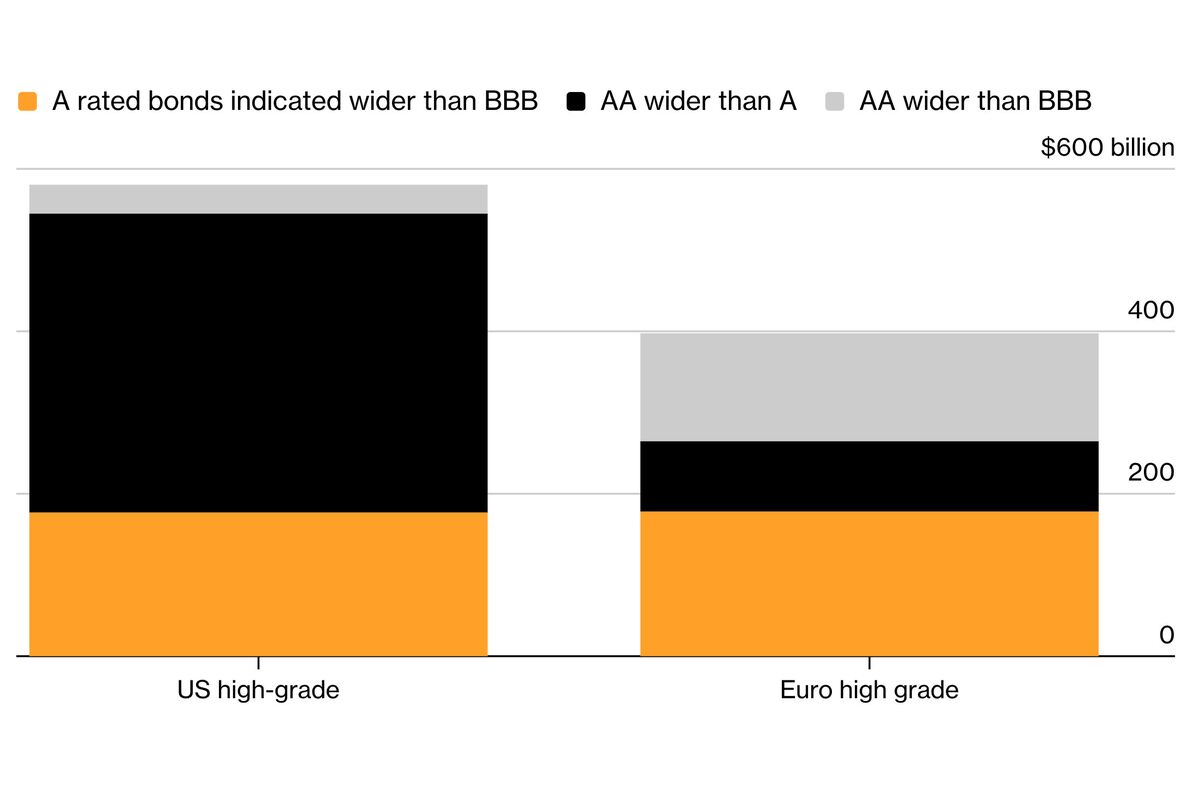
Credit markets look calm, but warning signals are building: about $1 trillion of non-financial high-grade bonds are trading with unusually wide spreads, up more than 2x since the start of the year. This includes roughly $580B of US bonds and nearly $400B in Europe, suggesting latent stress outside the most visible parts of credit. The divergence between “calm” headline conditions and widening spreads raises near-term risk for credit performance.
Analysis
The market is signaling a widening bifurcation between headline stability and underlying balance-sheet stress. When spread dispersion rises faster than index-level credit volatility, it usually means the weakest BBBs are absorbing most of the pain first — a setup that can take 1-3 quarters to show up in earnings as higher refinancing costs, lower buybacks, and capex deferrals.
The second-order effect is less about default risk today and more about funding friction. A wider bid/ask for lower-rated IG typically forces new-issue concessions higher, which can shut windows for marginal borrowers and pressure sectors with heavy maturities, pension drag, or acquisition-led leverage. That tends to spill into equity multiples before it shows up in defaults, especially for industrials, telecom, utilities, and other long-duration cash-flow names.
The contrarian risk is that this is partly a technical dislocation rather than a clean fundamental warning: ETF flows, dealer balance-sheet constraints, and a crowded issuance calendar can create temporary spread widening without a true deterioration in credit quality. If CDX IG stays contained and downgrade activity does not inflect over the next earnings cycle, this move can mean-revert quickly. The key falsifier is a retracement in the widest-spread buckets and no rise in interest expense or guidance pressure by the next reporting season.
AllMind Terminal
AI-powered research, real-time alerts, and portfolio analytics for institutional investors.
Request TrialMarket Sentiment
Overall Sentiment
mildly negative
Sentiment Score
-0.25
Key Decisions for Investors
- Buy a relative-value hedge: short LQD vs long IEF for 1-3 months. Risk/reward is attractive if spread dispersion keeps widening; look for 2-4% relative downside in LQD versus modest Treasury upside if risk appetite rolls over. Stop if LQD spreads retrace most of the recent widening.
- Add small convex protection via CDX IG / iTraxx Main if available. This is a cleaner expression than outright equity shorts because the dislocation is in credit microstructure first; best used as a portfolio hedge into earnings and heavy new-issue windows.
- Underweight BBB-heavy cyclical equities by shorting XLI against long XLP for 1-3 months. If funding costs bleed into guidance, industrial margins and buyback capacity should compress before defensives re-rate.
- Watch the next wave of new issuance and downgrade counts as a trigger rather than forcing a larger short now. If concessions keep rising and downgrade momentum accelerates, increase credit hedges; if spreads tighten back and issuance clears smoothly, fade the trade.
More News
- Indonesia stocks suffer biggest daily slump since 1998 as MSCI weighs downgrade
- UK's Healey Plans to Raise Bank Taxes
- CoreWeave credit default swaps hit distress levels as investors sour on AI debt
- The IPO drought is driving private equity-owned companies to the debt market to pay investors
- Treasuries Soar as Tech Slump Threatens Growth
- Suddenly, Wall Street is worried that the U.S. economy is more ‘vulnerable’ than it looks