
Inaugural AI Music Awards Coming to Los Angeles This November as SIQA Launches Verified Registry for AI Music Provenance
Source: PR Newswire
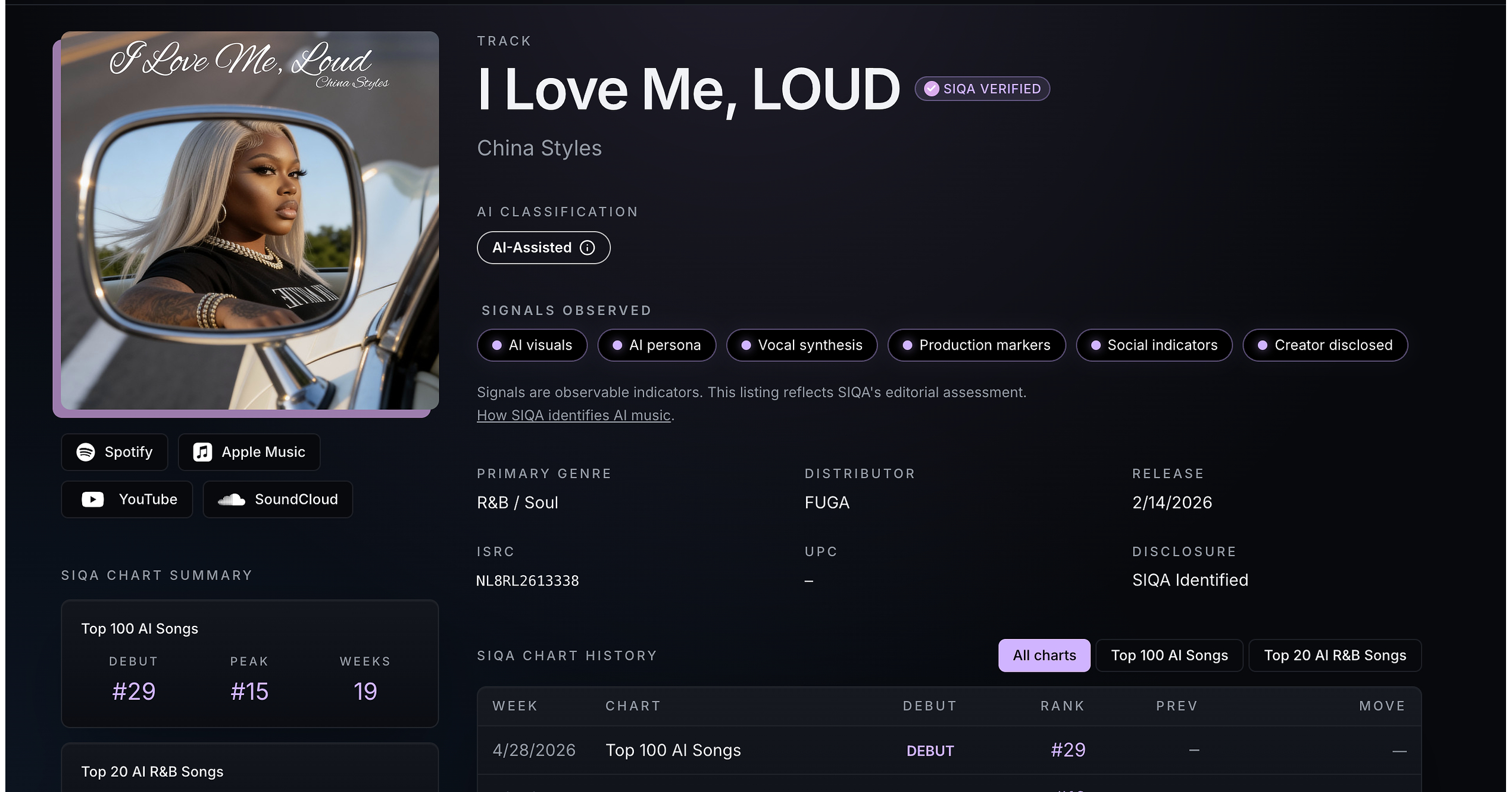
SIQA launched its Verified Registry and iOS app to establish and display AI-music provenance through audio fingerprinting, classifying tracks as Fully AI-Generated, AI-Assisted, or Human + AI Hybrid. The company aims to shift the industry response from post-release flagging of suspected AI tracks to source-level verification as AI-generated content expands across streaming platforms. SIQA will host its inaugural AI Music Awards in Los Angeles on November 13, 2026, preceded by an industry summit on November 12; the initiative is backed by 1517 Fund and sponsored by music and technology companies including Deepgram.
Analysis
The economic relevance for SPOT and DEEZR begins only if provenance metadata becomes embedded in distributor ingestion, royalty allocation, recommendation systems, or licensing workflows. A standalone consumer-facing registry has little direct effect on streaming revenue; however, credible verification standards could raise the cost of uploading synthetic catalog at scale and reduce low-quality content dilution. That would be modestly supportive of engagement and royalty-pool integrity, but could also constrain a low-cost source of catalog supply and create compliance friction for independent artists.
Near term, this is not a trading catalyst for SPOT, DEEZR, or TWLO. The key 1-3 month watch item is whether a major DSP, distributor (e.g., Believe, Warner Music), or rights-management platform adopts the registry or a comparable machine-readable classification standard; without integration, registry participation is primarily marketing. Over 6-18 months, a fragmented set of competing provenance schemes is more likely than a single winner, limiting monetization and making any valuation impact to streamers immaterial.
The contrarian read is that transparent AI labeling may expand, rather than suppress, AI-music supply by making synthetic and hybrid works commercially acceptable to platforms, advertisers, and listeners. That could worsen royalty-pool dilution for human creators and heighten eventual regulatory or contractual pressure on DSP gross margins. SIQA's claims are not independently sufficient to establish adoption, accuracy rates, rights-chain validation, or revenue contribution; those are the variables that matter.
AllMind Terminal
AI-powered research, real-time alerts, and portfolio analytics for institutional investors.
Request TrialMarket Sentiment
Overall Sentiment
mildly positive
Sentiment Score
0.35
Ticker Sentiment
Key Decisions for Investors
- No directional position in SPOT, DEEZR, or TWLO on this announcement; the reported impact is too indirect and no disclosed commercial integration, pricing model, or adoption metric supports an earnings estimate.
- Set an event-driven alert on SPOT and DEEZR for formal provenance-labeling requirements or distributor partnerships. Reassess only if implementation includes catalog-scale ingestion and disclosed effects on content-removal costs, royalty fraud, or recommendation inventory within the next 1-3 quarters.
- For SPOT holders, monitor gross-margin guidance and premium churn rather than AI-content headlines. A material rise in content-moderation expense or rights-holder concessions would be the falsification trigger for the view that AI provenance is economically negligible.
- Treat TWLO as unrelated absent evidence that Deepgram sponsorship converts into a contracted voice-verification or communications workload. Any trade would require disclosed customer usage, pricing, or revenue linkage rather than ecosystem association.
More News
- Spotify Earnings: A Miss, But Long-Term Potential Remains
- The AI graveyard: a running list of projects and startups that didn’t make it
- Here’s the ‘core economic flaw’ in the AI bull case as stock and bond trades unravel, according to a top economist
- Biotech stocks are surging. How investors can play the new drug innovation boom
- AI funding fears rattle Wall Street. Here's how we're adjusting our portfolio
- Nvidia's role as AI financier faces first big test as neoclouds take market hit
From AllMind Research
- Anthropic IPO Preview: Valuation, Timing, and What to Watch
- Shein After the IPO: Venue, Valuation, and What Must Be Proved
- What AI Research Tools Should a Small Hedge Fund Buy First?
- Bitcoin's 52% Crash Proves It's a Tech Stock: Here's What That Means for Portfolio Construction
- What Is an AI Investment Research Platform?