
Intento Publishes The State of Translation Automation 2026, an Interactive Benchmark of 229 AI Translation Solutions in 100 Languages
Source: PR Newswire
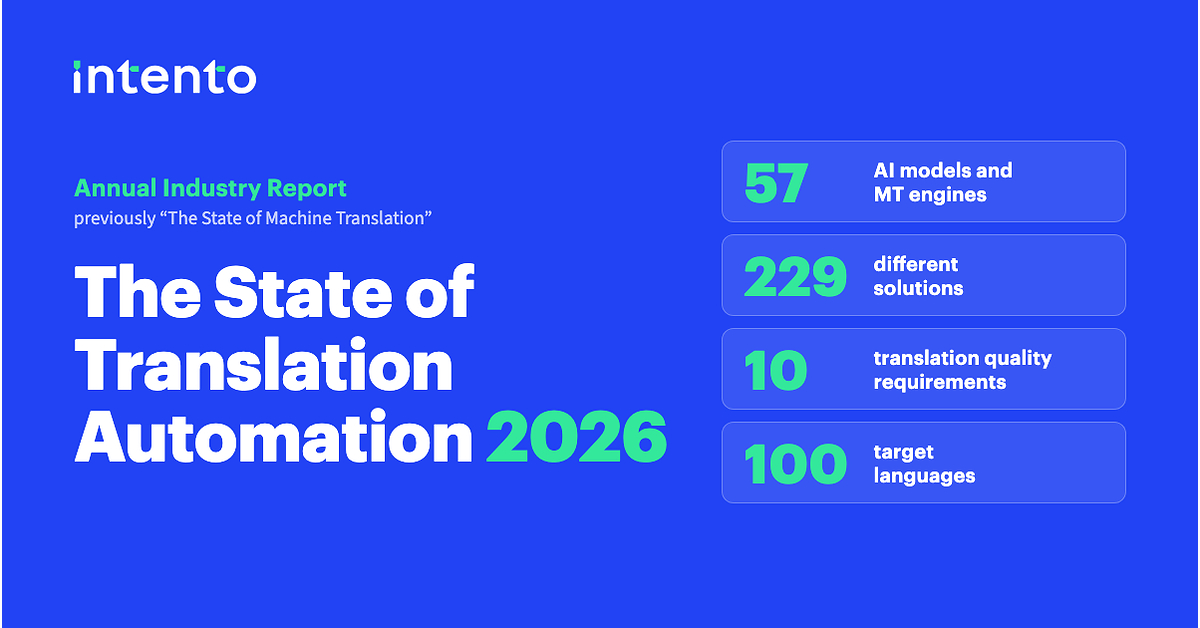
Intento published an interactive 2026 report comparing 229 translation solutions built from 57 AI models and machine-translation engines across 100 languages. The evaluation found that the number of languages with a qualifying one-step solution and backup drops from 54 for Basic quality to 38 for Standard and 12 for Advanced; none of the real-time one-step solutions assessed in 84 languages met every Standard requirement. The report also found that post-editing and quality assessment with repair helped some initially underperforming LLM solutions meet general quality requirements.
Analysis
The economic value in enterprise translation is shifting from owning a “best” model to reliably meeting language-, formatting- and compliance-specific requirements. That favors workflow orchestration, evaluation and integration over undifferentiated model access; it may also raise switching costs once terminology and validation rules are embedded. But this report is evidence of a technical capability gap, not evidence of customer adoption, pricing power or material revenue for any public vendor.
For AMZN, GOOG and MSFT, translation is one possible source of model and cloud workloads, but any incremental usage is likely too diffuse to infer from this release. More capable open-weight and competing models can also intensify price competition, limiting the benefit of higher workloads. The potential loser is simple per-word translation: providers unable to bundle quality assurance and workflow integration may face price pressure. Intento’s reported customer base is not enough to establish market share or displacement of incumbents.
Near term, expect little fundamental repricing. Over 1–3 months, the useful catalyst is not another benchmark but evidence of production deployment, paid workflow expansion, or enterprise procurement moving from pilots to scaled programs. Over 6–18 months, automated quality control could lower the labor component of localization while increasing demand for human review in languages where checks remain unreliable; net savings depend on error costs and integration burden.
Contrarian point: the breadth of the benchmark can overstate production readiness. Four English source texts and model-judge agreement do not establish performance across domains, language pairs, or live content. The latency-quality trade-off also constrains real-time use. No listed-company trade is justified from this announcement alone.
AllMind Terminal
AI-powered research, real-time alerts, and portfolio analytics for institutional investors.
Request TrialMarket Sentiment
Overall Sentiment
neutral
Sentiment Score
0.10
Key Decisions for Investors
- No immediate position in AMZN, GOOG or MSFT: the release does not establish a material revenue or margin change for any mapped public company.
- Treat enterprise translation automation as a watch item. Reassess if named cloud or software vendors disclose scaled deployments, paid usage growth, or measurable localization-cost savings.
- For any future vendor-specific thesis, verify production volumes, customer retention, per-workflow inference cost, human-review rates and error-related liabilities; benchmark performance alone is insufficient.
- Falsify the adoption thesis if pilots fail to convert, real-world review costs erase automation savings, or quality failures force customers back to human-led workflows.
More News
- All the news about the iPhone Duo
- Semiconductors are out, software is in. Why that’s not about to change anytime soon
- After years of U.S. export bans, China plans its own: 40 AI, chip and solar technologies could be restricted
- Alphabet stock analysis: stalled near 200-day average ahead of Q3 earnings
- Open-weight models win hearts, minds, and wallets
- CoreWeave investor explains how the loss-making AI ‘neocloud’ provider plans to claw its way out of debt
From AllMind Research
- Anthropic IPO Preview: Valuation, Timing, and What to Watch
- Shein After the IPO: Venue, Valuation, and What Must Be Proved
- What AI Research Tools Should a Small Hedge Fund Buy First?
- Research Workflows, Report Format Selection, and Interactive Synthesis
- Can ChatGPT Analyze a 10-K? A Verification Workflow