
IEEE Study Presents New Approach to Control Dewetting of Thin Films
Source: PR Newswire
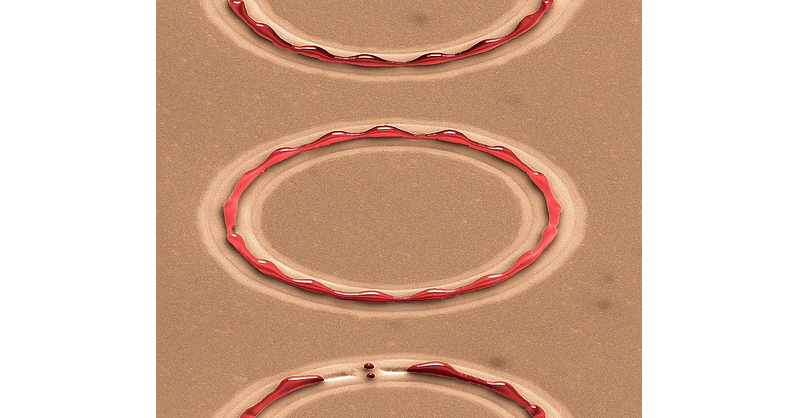
Researchers report that engineering the optical cavity beneath a 10 nm gold film can influence laser-induced dewetting and the resulting particle morphologies. Tests of four substrates found broad particle-size distributions and complex spatial patterns in two samples; the authors say the approach may improve control of nanostructure fabrication or help reduce dewetting-related damage, but no commercial or market impact is reported.
Analysis
This is a process-control proof of concept, not yet a commercial inflection. The investable question is whether cavity-engineered substrates can deliver repeatable particle size and placement at production throughput—and whether that control is worth the added stack complexity versus established patterning methods. Near term, the paper is unlikely to move earnings for broad semiconductor, laser, or materials suppliers; the research predates this release, further limiting catalyst value. Over 1–3 months, watch for independent replication or demonstrations on additional metals, substrate geometries, and larger areas. Over 6–18 months, successful scale-up could expand options for plasmonic devices and patterned coatings, while potentially improving durability where dewetting is a failure mode. The countervailing effect is that cavity layers add process steps and may narrow compatibility, making the technique uneconomic for high-volume coatings. The result is confined to a specific thin-film experiment; it does not establish manufacturing yield, cost, device performance, or commercial adoption. No direct public-equity beneficiary is identifiable from the supplied information, so this is a diligence signal rather than a directional sector call.
AllMind Terminal
AI-powered research, real-time alerts, and portfolio analytics for institutional investors.
Request TrialMarket Sentiment
Overall Sentiment
mildly positive
Sentiment Score
0.20
Key Decisions for Investors
- No immediate trade: the study provides no evidence of revenue impact, production readiness, or a near-term listed-company catalyst.
- Put nanophotonics and laser-processing suppliers on a watchlist, but require a named commercial partner or customer qualification before assigning meaningful exposure.
- Track replication, area-scale uniformity, throughput, and performance across metals and substrates. Failure to reproduce the morphology control beyond the demonstrated samples would weaken the commercialization thesis.
- For low-emissivity and other thin-film coating applications, treat reduced dewetting as a potential lifetime benefit—not a forecast—until accelerated-aging data show improved durability without unacceptable added cost or process complexity.
More News
- Marvell to buy Lumentum in $115 billion deal in AI data-center bet
- Marvell, Lumentum tout historic $115B deal to create ‘category leader' in AI connectivity
- The AI boom is facing another supply crunch. This time it’s the amount of capital available to feed Silicon Valley’s endless need for cash
- Oil Prices Retreat, Apple Results on Deck
- New Apple CEO John Ternus chalks up some early wins, but the honeymoon is over
- In one of the largest deals in tech history, Marvell buys Lumentum for $115B